Best time to visit Glacier National Park
Re-score for me — drag the dial — every chart on the page recolours live for your heat limit 27°C
Default 27 °C is the upper edge of the Holiday Climate Index "ideal comfort" band (Scott, Rutty, Amelung & Tang, 2016). Above this, most warm-tourism travellers report measurable discomfort.
Greyed factors are scored normally — extreme cold overrides them, so a clear sky or low rain can't lift the period.
Greyed factors are scored normally — extreme cold overrides them, so a clear sky or low rain can't lift the period.
Greyed factors are scored normally — extreme cold overrides them, so a clear sky or low rain can't lift the period.
Greyed factors are scored normally — extreme cold overrides them, so a clear sky or low rain can't lift the period.
Greyed factors are scored normally — extreme cold overrides them, so a clear sky or low rain can't lift the period.
Greyed factors are scored normally — extreme cold overrides them, so a clear sky or low rain can't lift the period.
Greyed factors are scored normally — extreme cold overrides them, so a clear sky or low rain can't lift the period.
Greyed factors are scored normally — extreme cold overrides them, so a clear sky or low rain can't lift the period.
Greyed factors are scored normally — extreme cold overrides them, so a clear sky or low rain can't lift the period.
Greyed factors are scored normally — extreme cold overrides them, so a clear sky or low rain can't lift the period.
Greyed factors are scored normally — extreme cold overrides them, so a clear sky or low rain can't lift the period.
Greyed factors are scored normally — extreme cold overrides them, so a clear sky or low rain can't lift the period.
Greyed factors are scored normally — extreme cold overrides them, so a clear sky or low rain can't lift the period.
Greyed factors are scored normally — extreme cold overrides them, so a clear sky or low rain can't lift the period.
Greyed factors are scored normally — extreme cold overrides them, so a clear sky or low rain can't lift the period.
Greyed factors are scored normally — extreme cold overrides them, so a clear sky or low rain can't lift the period.
Greyed factors are scored normally — extreme cold overrides them, so a clear sky or low rain can't lift the period.
Greyed factors are scored normally — extreme cold overrides them, so a clear sky or low rain can't lift the period.
Greyed factors are scored normally — extreme cold overrides them, so a clear sky or low rain can't lift the period.
Greyed factors are scored normally — extreme cold overrides them, so a clear sky or low rain can't lift the period.
Greyed factors are scored normally — extreme cold overrides them, so a clear sky or low rain can't lift the period.
Greyed factors are scored normally — extreme cold overrides them, so a clear sky or low rain can't lift the period.
Greyed factors are scored normally — extreme cold overrides them, so a clear sky or low rain can't lift the period.
Greyed factors are scored normally — extreme cold overrides them, so a clear sky or low rain can't lift the period.
Greyed factors are scored normally — extreme cold overrides them, so a clear sky or low rain can't lift the period.
Greyed factors are scored normally — extreme cold overrides them, so a clear sky or low rain can't lift the period.
Greyed factors are scored normally — extreme cold overrides them, so a clear sky or low rain can't lift the period.
Greyed factors are scored normally — extreme cold overrides them, so a clear sky or low rain can't lift the period.
Greyed factors are scored normally — extreme cold overrides them, so a clear sky or low rain can't lift the period.
Greyed factors are scored normally — extreme cold overrides them, so a clear sky or low rain can't lift the period.
Greyed factors are scored normally — extreme cold overrides them, so a clear sky or low rain can't lift the period.
Greyed factors are scored normally — extreme cold overrides them, so a clear sky or low rain can't lift the period.
Greyed factors are scored normally — extreme cold overrides them, so a clear sky or low rain can't lift the period.
Greyed factors are scored normally — extreme cold overrides them, so a clear sky or low rain can't lift the period.
Greyed factors are scored normally — extreme cold overrides them, so a clear sky or low rain can't lift the period.
Greyed factors are scored normally — extreme cold overrides them, so a clear sky or low rain can't lift the period.
Greyed factors are scored normally — extreme cold overrides them, so a clear sky or low rain can't lift the period.
Greyed factors are scored normally — extreme cold overrides them, so a clear sky or low rain can't lift the period.
Greyed factors are scored normally — extreme cold overrides them, so a clear sky or low rain can't lift the period.
Greyed factors are scored normally — extreme cold overrides them, so a clear sky or low rain can't lift the period.
How is this scored? HCI / Steadman / CCI gate — full methodology and citations below.
Compare with another destination
Add as many as you like — stacked below the main strips above. Each row is just the recent-window score strip and (for beach destinations) sea-temperature strip.
Tours in Glacier National Park
17 top-rated tours via Viator. Booking links earn this site a commission at no cost to you. Map locations are approximate (centred on Glacier National Park).
- 1
 Full Day Glacier National Park Whitewater Rafting Adventure - With Lunch!
 - 2
 Banff, Moraine Lake, Lake Louise & Columbia 4-Day Tour
 - 3
 Glacier National Park – Winter Driving Tour (5-6 hours)
 - 4
 Clear Kayak Rentals for Glacier Park
 - 5
 Self-Guided Audio Driving Tour in Glacier National Park
 - 6
 Sunset LED Clear Kayak Rentals for Glacier Park
 - 7
 Glacier National Park Self-Guided Driving Audio Tour
 - 8
 Ultimate Audio Tours: Yellowstone, Glacier, Grand Teton & Banff
 - 9
 Glacier National Park Going-to-the-Sun Road Self-Guided Tour
 - 10
 Clear Kayak Rentals for Flathead Lake
 - 11
 Smartphone Audio Driving Tour between Kamloops & Revelstoke
 - 12
 Glacier National Park Self-Guided Audio Tour Bundle
 - 13
 Sunset LED Clear Paddleboard Rentals for Glacier Park
 - 14
 Going to The Sun Road E Bike Tour
 - 15
 Glacier National Park – Snowshoe Tour (5-6 hours)
 - 16
 Clear Paddleboard Rentals for Glacier Park
 - 17Self Guided Driving Audio Tour of Northern Parks Bundle
Last refreshed 2026-08-13.
Similar climatesAthabasca Glacier85% · Lake Louise83% · Olympic National Park82%
Other destinations with the most-alike year-round climate to Glacier National Park (apparent temperature, rain hours, sunshine — matched within the same trip-profile). The ±N chip compares each match's typical score for the current month against Glacier National Park's. Based on the 2020-2024 climatology, not this year's actual weather.
Month-by-month
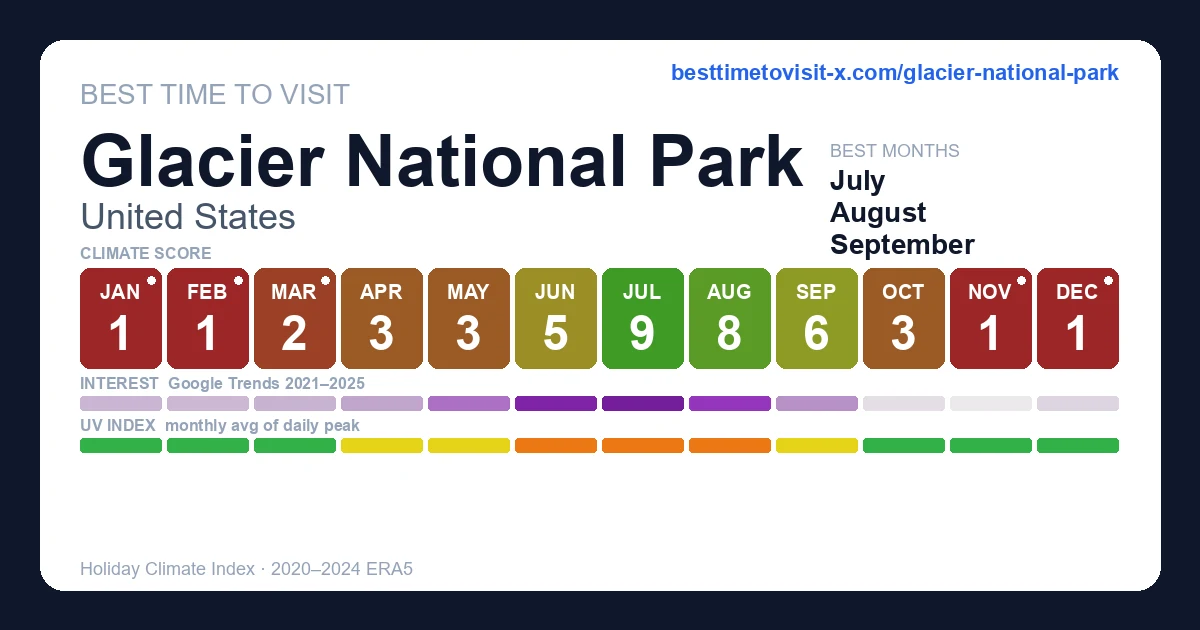
| Month | Temp °C | Feels °C | Rain days | Rain h | Rain h/day | Humidity | Wind km/h | Sun h | UV | Interest | Score |
|---|---|---|---|---|---|---|---|---|---|---|---|
| Jan | -12–-7 | -11 | 18 | 319 | 17.7 | 84% | 15 | 89 | 1 | Quiet | 1 |
| Feb | -14–-8 | -12 | 16 | 309 | 19.3 | 78% | 16 | 103 | 2 | Quiet | 1 |
| Mar | -10–-3 | -7 | 16 | 249 | 15.6 | 67% | 15 | 188 | 3 | Quiet | 2 |
| Apr | -7–1 | -3 | 15 | 212 | 14.1 | 61% | 15 | 226 | 5 | Quiet | 3 |
| May | -1–7 | 4 | 17 | 232 | 13.6 | 62% | 14 | 256 | 6 | Moderate | 3 |
| Jun | 3–13 | 10 | 16 | 193 | 12.1 | 60% | 14 | 273 | 6 | Peak | 5 |
| Jul | 9–20 | 17 | 7 | 76 | 10.9 | 43% | 15 | 335 | 7 | Peak | 9 |
| Aug | 8–18 | 16 | 8 | 98 | 12.3 | 48% | 15 | 284 | 6 | Busy | 8 |
| Sep | 4–13 | 11 | 10 | 124 | 12.4 | 57% | 15 | 240 | 4 | Moderate | 6 |
| Oct | -3–5 | 1 | 12 | 199 | 16.6 | 69% | 15 | 175 | 3 | Quiet | 3 |
| Nov | -9–-4 | -9 | 19 | 327 | 17.2 | 85% | 16 | 89 | 1 | Quiet | 1 |
| Dec | -11–-6 | -11 | 20 | 360 | 18.0 | 86% | 15 | 65 | 1 | Quiet | 1 |
UV Index in Glacier National Park by Month
UV index in Glacier National Park peaks at 7 (high) in July, dropping to 1 (low) in December. June, July, August have high UV — SPF 30+ and sunglasses recommended.
Best months in detail
July
9/109–20°C (feels 17°C) · 7 rain days (76h) · 335 sun hours · 43% humidity · Peak crowd · UV 7 (high) · sunniest 1 in 10 days reach 9 (very high)
August
8/108–18°C (feels 16°C) · 8 rain days (98h) · 284 sun hours · 48% humidity · Busy crowd · UV 6 (high) · sunniest 1 in 10 days reach 8 (high)
September
6/104–13°C (feels 11°C) · 10 rain days (124h) · 240 sun hours · 57% humidity · Moderate crowd · UV 4 (moderate) · sunniest 1 in 10 days reach 6 (high)
Every month
Show the other 9 months in detail
January
1/10-12–-7°C (feels -11°C) · 18 rain days (319h) · 89 sun hours · 84% humidity · Quiet crowd · UV 1 (low)
February
1/10-14–-8°C (feels -12°C) · 16 rain days (309h) · 103 sun hours · 78% humidity · Quiet crowd · UV 2 (low)
March
2/10-10–-3°C (feels -7°C) · 16 rain days (249h) · 188 sun hours · 67% humidity · Quiet crowd · UV 3 (low) · sunniest 1 in 10 days reach 4 (moderate)
April
3/10-7–1°C (feels -3°C) · 15 rain days (212h) · 226 sun hours · 61% humidity · Quiet crowd · UV 5 (moderate) · sunniest 1 in 10 days reach 6 (high)
May
3/10-1–7°C (feels 4°C) · 17 rain days (232h) · 256 sun hours · 62% humidity · Moderate crowd · UV 6 (moderate) · sunniest 1 in 10 days reach 8 (very high)
June
5/103–13°C (feels 10°C) · 16 rain days (193h) · 273 sun hours · 60% humidity · Peak crowd · UV 6 (high) · sunniest 1 in 10 days reach 8 (very high)
October
3/10-3–5°C (feels 1°C) · 12 rain days (199h) · 175 sun hours · 69% humidity · Quiet crowd · UV 3 (low) · sunniest 1 in 10 days reach 4 (moderate)
November
1/10-9–-4°C (feels -9°C) · 19 rain days (327h) · 89 sun hours · 85% humidity · Quiet crowd · UV 1 (low)
December
1/10-11–-6°C (feels -11°C) · 20 rain days (360h) · 65 sun hours · 86% humidity · Quiet crowd · UV 1 (low)
The road across the park can open in mid-May or mid-July
Going-to-the-Sun Road is the reason most people come to Glacier, and its opening date swings by almost two months. The National Park Service keeps the record back to 1933: the earliest full opening was 16 May 1987, the latest 13 July, reached twice — in 2011 after an exceptional snowpack and continued winter weather through June, and in 2020 because of the pandemic.
Recent years sit in the usual late-spring band: the road opened on 16 June for the 2025 season and 22 June for 2026. Crews plough the alpine section by hand-guided equipment through drifts many metres deep, so the timing follows the snowpack, not the calendar.
One thing has changed in the visitor's favour: vehicle reservations are not required in 2026, after several seasons in which they were — so a great deal of published advice on booking entry slots no longer applies.
Sources: NPS — Logan Pass opening and closing dates , NPS — Going-to-the-Sun Road general information
What is the best month to visit Glacier National Park?
Late July through early September. That is the only period when the full Going-to-the-Sun Road, the high trails and the boat services are all reliably running. June can be beautiful at lower elevations but the alpine section is often still closed. The road's full opening has ranged from 16 May to 13 July across the record, so late June plans carry real risk.
Is 2 days enough in Glacier National Park?
It covers the essentials — a drive of Going-to-the-Sun Road with stops, and one hike from Logan Pass such as Hidden Lake. But the park is split between a west and east side separated by a long drive, so three or four days lets you add Many Glacier, which many visitors rate the finest part.
How crowded is Glacier in September?
Noticeably quieter than July and August, particularly after the first week when American schools return. The trade-off is that services begin closing for the season and early snow can shut the alpine section of Going-to-the-Sun Road at short notice.
Do you need a vehicle reservation for Glacier National Park?
Not in 2026 — the park has stated vehicle reservations are not required this year. That reverses several previous seasons, so much of the advice still circulating about booking entry slots is out of date. A standard park entrance pass is still needed.
Is Going-to-the-Sun Road closed in 2026?
No — the full length opened on 22 June for the 2026 season, and vehicle reservations are not required this year. That reverses several previous seasons, so a lot of circulating advice about booking entry slots is out of date. The road closes again for winter in autumn, so check the park's status page for the current date.
What is the best time of year to go to Glacier National Park?
Late July to early September. That is the only stretch when the full Going-to-the-Sun Road, the high trails and the boat services are all reliably running. July is warmest at about 18C by day — this is a cool, high park, and snow lingers at Logan Pass well into summer.
What month does it start snowing in Glacier National Park?
September at elevation, and it can snow at Logan Pass in any month. December lows average around −13C. The snowpack is precisely why the road's opening date swings by nearly two months, from 16 May in 1987 to 13 July in heavy years — crews clear drifts many metres deep by hand-guided equipment.
Do I need bear spray in Glacier National Park?
Yes. This is genuine grizzly country and the park recommends carrying bear spray and knowing how to use it. Make noise on blind corners, hike in groups where you can, and store food properly. Bear spray cannot be carried on aircraft, so buy or hire it locally rather than packing it.
What is the rainiest month in Glacier National Park?
June, at around 115 mm, with July the driest at about 43 mm. June rain often falls as snow at Logan Pass, which is part of why the alpine section opens so late. The practical implication is that late June trips can still meet closed road sections and wet trails at elevation.
What not to miss in Glacier National Park?
Driving the full Going-to-the-Sun Road, which is the park in one 50-mile stretch; the Hidden Lake Overlook trail from Logan Pass; and Many Glacier on the eastern side, which many visitors rate the finest part and most day-trippers never reach. Check the road status first — its full opening has ranged from 16 May to 13 July.
What to do in Glacier besides hiking?
The Going-to-the-Sun Road itself is the main event and needs no walking. Red Bus tours run in restored 1930s coaches with the roof rolled back, boat cruises operate on Lake McDonald, Two Medicine and the Many Glacier lakes, and the historic lodges are worth visiting in their own right. Wildlife watching from pull-outs is productive at dawn.
What is the most beautiful place in Glacier National Park?
Most visitors name either Logan Pass on the Going-to-the-Sun Road or the Many Glacier valley, where Swiftcurrent Lake sits beneath a wall of peaks. Beauty rankings are personal, but Many Glacier is the one that regularly surprises people, because it requires a deliberate detour and so is far quieter than the road corridor.
Frequently asked questions about visiting Glacier National Park
When is the best time to visit Glacier National Park?
July is the highest-scoring month (9/10 on the Holiday Climate Index). Typical conditions: 9–20°C (7 rainy days). The top three months by score are July, August, September.
What is the worst time to visit Glacier National Park?
December is the lowest-scoring month (1/10, capped by extreme cold). Typical conditions: -11–-6°C (20 rainy days).
Is Glacier National Park too cold in winter?
5 months (January, February, March, November, December) cross our cold deal-breaker (apparent temperature below the cap). Doable with the right gear, but expect the climate score to be held down by the gate.
When are crowds lowest in Glacier National Park?
Search-interest seasonality (Google Trends 2021-2025) is lowest in November and peaks in July. Interest tracks both in-trip visitors and lead-time planners, so treat it as a "destination is on people's minds" signal rather than literal arrivals.
What is the UV index in Glacier National Park by month?
UV peaks at 7 (high) in July and is lowest in December at 1 (low). Monthly peak values: Jan 1, Feb 2, Mar 3, Apr 5, May 6, Jun 6, Jul 7, Aug 6, Sep 4, Oct 3, Nov 1, Dec 1.
What is the UV index in Glacier National Park in July?
July is the peak UV month in Glacier National Park, with a daily-peak UV index of 7 (high). Apply SPF 30+, wear sunglasses, and seek shade during midday hours.
How high can UV get in Glacier National Park on the sunniest days?
Most days look like the monthly average, but on the sunniest ~1 in 10 days UV climbs higher than the mean suggests. July is the worst case: typical days average UV 7 (high), but the top 10% of days reach UV 9 (very high) — and even higher. Months where the sunniest days routinely exceed the typical reading: March, April, May, June, July, August, September, October. Plan sun protection for the worst case, not the average.
Is air quality in Glacier National Park bad for travelers?
PM2.5 (fine-particle pollution) exceeds the WHO sensitive-group guideline (15 µg/m³) in 1 month: September. The worst month is May with a typical-day mean of 9 µg/m³ (fair); on the worst 10% of days PM2.5 reaches 13 µg/m³ (moderate) and higher. People with asthma, heart conditions, or sensitive children may want to avoid these months or limit outdoor activity. Source: CAMS via Open-Meteo.