Best time to visit Olympic National Park
Re-score for me — drag the dial — every chart on the page recolours live for your heat limit 27°C
Default 27 °C is the upper edge of the Holiday Climate Index "ideal comfort" band (Scott, Rutty, Amelung & Tang, 2016). Above this, most warm-tourism travellers report measurable discomfort.
How is this scored? HCI / Steadman / CCI gate — full methodology and citations below.
Compare with another destination
Add as many as you like — stacked below the main strips above. Each row is just the recent-window score strip and (for beach destinations) sea-temperature strip.
Tours in Olympic National Park
6 top-rated tours via Viator. Booking links earn this site a commission at no cost to you. Map locations are approximate (centred on Olympic National Park).
- 1
 Olympic Full Day Private Tour & Hike
 - 2
 Olympic Full Day Small Group Tour & Hike
 - 3
 Olympic Two Day Private Tour and Hike
 - 4
 5-Day Olympic Backpacking - Hoh Rainforest and the Blue Glacier
 - 5
 4-Day Olympic Backpacking - Sol Duc and the Seven Lakes Basin
 - 6
 Self Guided Audio Tour Bundle US Pacific Coastline
Last refreshed 2026-08-13.
Similar climatesWhistler88% · Glacier National Park82% · Vancouver81%
Other destinations with the most-alike year-round climate to Olympic National Park (apparent temperature, rain hours, sunshine — matched within the same trip-profile). The ±N chip compares each match's typical score for the current month against Olympic National Park's. Based on the 2020-2024 climatology, not this year's actual weather.
Month-by-month
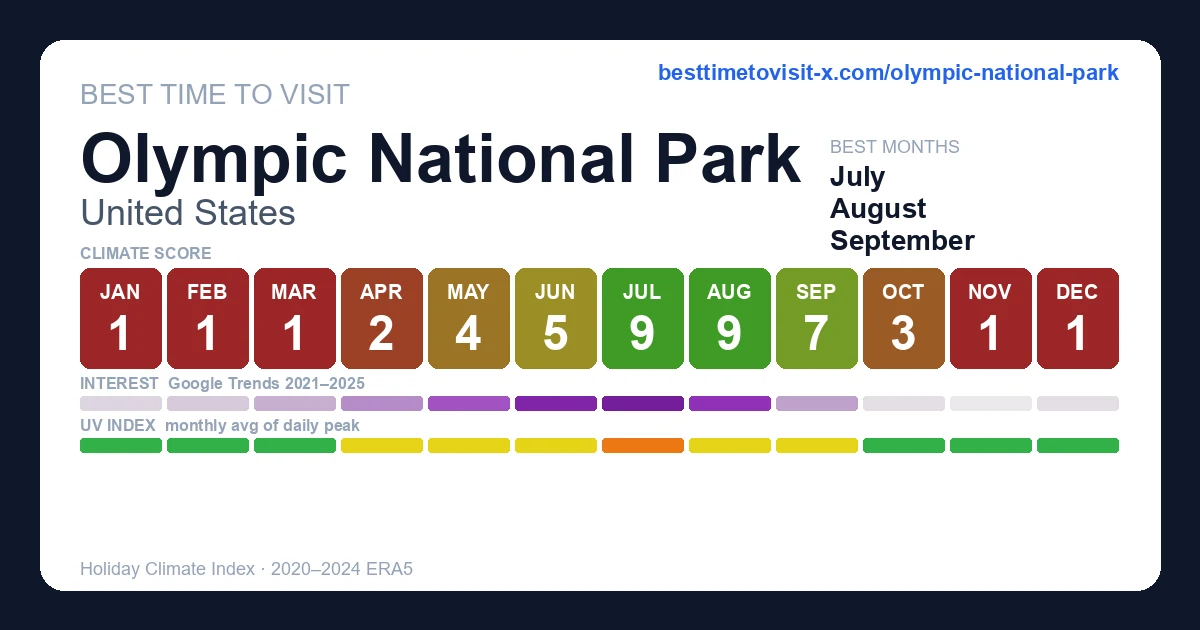
| Month | Temp °C | Feels °C | Rain days | Rain h | Rain h/day | Humidity | Wind km/h | Sun h | UV | Interest | Score |
|---|---|---|---|---|---|---|---|---|---|---|---|
| Jan | -5–1 | -3 | 24 | 424 | 17.7 | 85% | 10 | 67 | 1 | Quiet | 1 |
| Feb | -6–0 | -4 | 19 | 310 | 16.3 | 79% | 9 | 96 | 1 | Quiet | 1 |
| Mar | -6–1 | -2 | 18 | 312 | 17.3 | 72% | 9 | 148 | 2 | Quiet | 1 |
| Apr | -5–4 | 0 | 17 | 262 | 15.4 | 68% | 9 | 180 | 4 | Moderate | 2 |
| May | -1–9 | 6 | 15 | 226 | 15.1 | 68% | 9 | 220 | 5 | Busy | 4 |
| Jun | 3–14 | 12 | 13 | 197 | 15.2 | 63% | 10 | 243 | 6 | Peak | 5 |
| Jul | 7–19 | 18 | 5 | 64 | 12.8 | 52% | 10 | 312 | 7 | Peak | 9 |
| Aug | 7–20 | 18 | 7 | 98 | 14.0 | 52% | 10 | 279 | 6 | Busy | 9 |
| Sep | 5–16 | 15 | 11 | 153 | 13.9 | 58% | 10 | 211 | 4 | Quiet | 7 |
| Oct | 0–9 | 7 | 16 | 252 | 15.8 | 72% | 10 | 148 | 2 | Quiet | 3 |
| Nov | -5–2 | -1 | 20 | 342 | 17.1 | 83% | 10 | 78 | 1 | Quiet | 1 |
| Dec | -6–0 | -3 | 22 | 381 | 17.3 | 85% | 10 | 64 | 1 | Quiet | 1 |
UV Index in Olympic National Park by Month
UV index in Olympic National Park peaks at 7 (high) in July, dropping to 1 (low) in December. July have high UV — SPF 30+ and sunglasses recommended.
Best months in detail
July
9/107–19°C (feels 18°C) · 5 rain days (64h) · 312 sun hours · 52% humidity · Peak crowd · UV 7 (high) · sunniest 1 in 10 days reach 9 (very high)
August
9/107–20°C (feels 18°C) · 7 rain days (98h) · 279 sun hours · 52% humidity · Busy crowd · UV 6 (moderate) · sunniest 1 in 10 days reach 8 (very high)
September
7/105–16°C (feels 15°C) · 11 rain days (153h) · 211 sun hours · 58% humidity · Quiet crowd · UV 4 (moderate) · sunniest 1 in 10 days reach 6 (moderate)
Every month
Show the other 9 months in detail
January
1/10-5–1°C (feels -3°C) · 24 rain days (424h) · 67 sun hours · 85% humidity · Quiet crowd · UV 1 (low)
February
1/10-6–0°C (feels -4°C) · 19 rain days (310h) · 96 sun hours · 79% humidity · Quiet crowd · UV 1 (low)
March
1/10-6–1°C (feels -2°C) · 18 rain days (312h) · 148 sun hours · 72% humidity · Quiet crowd · UV 2 (low) · sunniest 1 in 10 days reach 4 (moderate)
April
2/10-5–4°C (feels 0°C) · 17 rain days (262h) · 180 sun hours · 68% humidity · Moderate crowd · UV 4 (moderate) · sunniest 1 in 10 days reach 6 (moderate)
May
4/10-1–9°C (feels 6°C) · 15 rain days (226h) · 220 sun hours · 68% humidity · Busy crowd · UV 5 (moderate) · sunniest 1 in 10 days reach 8 (high)
June
5/103–14°C (feels 12°C) · 13 rain days (197h) · 243 sun hours · 63% humidity · Peak crowd · UV 6 (moderate) · sunniest 1 in 10 days reach 8 (very high)
October
3/100–9°C (feels 7°C) · 16 rain days (252h) · 148 sun hours · 72% humidity · Quiet crowd · UV 2 (low) · sunniest 1 in 10 days reach 4 (moderate)
November
1/10-5–2°C (feels -1°C) · 20 rain days (342h) · 78 sun hours · 83% humidity · Quiet crowd · UV 1 (low)
December
1/10-6–0°C (feels -3°C) · 22 rain days (381h) · 64 sun hours · 85% humidity · Quiet crowd · UV 1 (low)
In winter the mountain road opens only Friday to Sunday
Olympic is really three parks — coast, rainforest and alpine — and the alpine one runs to a timetable. Hurricane Ridge, the park's accessible high country, is reached by a single road, and in winter that road is open Friday through Sunday and on holiday Mondays, weather and road conditions permitting, and closed on all other days. All vehicles must carry tyre chains during the winter months.
Through summer the road opens daily. It can still close at any time for weather, and the park asks visitors to check conditions before setting out.
Services at the top are also reduced: a fire destroyed the Hurricane Ridge Day Lodge, so the shelter and facilities visitors remember from earlier trips are no longer there. The coast and the Hoh Rainforest remain open year-round, which is what makes a winter trip worthwhile.
Sources: NPS — Visiting Hurricane Ridge , NPS — Hurricane Ridge in winter
What is the best month to visit Olympic National Park?
July through September, the region's dry window, when Hurricane Ridge is open daily and the high-country trails are clear. September is the pick for thinner crowds. Outside that, expect substantial rain — this is one of the wettest places in the contiguous United States.
How much time do you need to spend in Olympic National Park?
Four days. The park's three environments are separated by long drives around the peninsula: allow a day for Hurricane Ridge, a day for the Hoh Rainforest, a day for the coast at Rialto or Ruby Beach, and a day for Lake Crescent and Sol Duc. Two days forces you to pick one or two.
Should I visit Mount Rainier or Olympic National Park?
Rainier is focused on one enormous volcano with alpine meadows, and is easier to see in a short visit. Olympic is three distinct environments — rainforest, wild coast and mountains — spread around a large peninsula, so it rewards more time. If you have two days, choose Rainier; four or more, Olympic.
What airport do you fly into for Olympic National Park?
Seattle-Tacoma International is the practical choice, then a hire car around or across Puget Sound; allow three to four hours to Port Angeles. Some visitors use the Kingston or Bainbridge Island ferries to shorten the drive. A car is essential once you arrive.
What is the monthly weather like in Olympic National Park?
Wet, and dramatically so outside summer. November averages around 385 mm of rain — among the highest figures anywhere in the contiguous United States — while July drops to about 47 mm. Temperatures are mild rather than extreme, peaking near 19C in August, so the deciding variable is rainfall, not heat.
What is the most beautiful part of the Olympic National Park?
It depends which of the three parks you mean. The Hoh Rainforest is the most distinctive — moss-hung and green year-round. Hurricane Ridge gives the alpine panorama, though its road runs Friday to Sunday only in winter. Rialto and Ruby Beach give the wild Pacific coastline with sea stacks, and stay open all year.
What town should I stay in when visiting Olympic National Park?
Port Angeles is the practical base — closest to Hurricane Ridge and Lake Crescent, with the most lodging. Forks is better positioned for the Hoh Rainforest and the coast. Because the park wraps around a large peninsula with no road through the middle, many visitors split their stay between the two rather than driving back and forth.
Are ticks a problem in Olympic National Park?
Present but not a major concern relative to other parts of the United States, and Lyme disease is far less common in western Washington than in the northeast. Standard precautions are enough: stay on trails, check yourself after walking through brush. Wet weather and hypothermia are the more realistic risks here.
How many days is ideal for Olympic National Park?
Four. The park's three environments are separated by long drives around the peninsula — allow a day each for Hurricane Ridge, the Hoh Rainforest and the coast, plus one for Lake Crescent and Sol Duc. Two days forces you to pick one or two, and the drives are longer than the map suggests.
What not to miss in Olympic National Park?
The Hoh Rainforest's Hall of Mosses, Rialto Beach or Ruby Beach for sea stacks and driftwood, and Hurricane Ridge for the alpine panorama — remembering its road runs Friday to Sunday plus holiday Mondays in winter. Lake Crescent's water clarity and the Sol Duc valley round out the three environments without adding much driving.
Which park is better, Olympic or Mount Rainier?
Rainier is one enormous volcano with alpine meadows beneath it, and is far easier to see well in a short visit. Olympic is three separate environments — rainforest, wild coast and mountains — spread around a large peninsula with no road through the middle, so it needs more time. Two days favours Rainier; four or more favours Olympic.
What are things to do in Olympic National Park without hiking?
Drive to Hurricane Ridge for the view from the car park, walk the short flat loops in the Hoh Rainforest, beachcomb at Ruby Beach, soak at Sol Duc Hot Springs, and drive the shore of Lake Crescent. The park's three environments are all accessible from the road, which is unusual for a wilderness park of this size.
Frequently asked questions about visiting Olympic National Park
When is the best time to visit Olympic National Park?
July is the highest-scoring month (9/10 on the Holiday Climate Index). Typical conditions: 7–19°C (5 rainy days). The top three months by score are July, August, September.
What is the worst time to visit Olympic National Park?
January is the lowest-scoring month (1/10). Typical conditions: -5–1°C (24 rainy days).
When are crowds lowest in Olympic National Park?
Search-interest seasonality (Google Trends 2021-2025) is lowest in November and peaks in July. Interest tracks both in-trip visitors and lead-time planners, so treat it as a "destination is on people's minds" signal rather than literal arrivals.
Which months in Olympic National Park have good weather but fewer tourists?
September (climate 7/10, crowd index 36) — shoulder months with above-average climate and below-median search-interest. Often the best value-for-weather trade.
What is the UV index in Olympic National Park by month?
UV peaks at 7 (high) in July and is lowest in December at 1 (low). Monthly peak values: Jan 1, Feb 1, Mar 2, Apr 4, May 5, Jun 6, Jul 7, Aug 6, Sep 4, Oct 2, Nov 1, Dec 1.
What is the UV index in Olympic National Park in July?
July is the peak UV month in Olympic National Park, with a daily-peak UV index of 7 (high). Apply SPF 30+, wear sunglasses, and seek shade during midday hours.
How high can UV get in Olympic National Park on the sunniest days?
Most days look like the monthly average, but on the sunniest ~1 in 10 days UV climbs higher than the mean suggests. July is the worst case: typical days average UV 7 (high), but the top 10% of days reach UV 9 (very high) — and even higher. Months where the sunniest days routinely exceed the typical reading: March, April, May, June, July, August, September, October. Plan sun protection for the worst case, not the average.