Best time to visit Whistler
Re-score for me — drag the dial — every chart on the page recolours live for your heat limit 27°C
Default 27 °C is the upper edge of the Holiday Climate Index "ideal comfort" band (Scott, Rutty, Amelung & Tang, 2016). Above this, most warm-tourism travellers report measurable discomfort.
How is this scored? HCI / Steadman / CCI gate — full methodology and citations below.
Compare with another destination
Add as many as you like — stacked below the main strips above. Each row is just the recent-window score strip and (for beach destinations) sea-temperature strip.
Tours in Whistler
30 top-rated tours via Viator. Booking links earn this site a commission at no cost to you. Map locations are approximate (centred on Whistler).
- 1
 Private Whistler Sightseeing Tour: Discover all of Whistler in Comfort!
 - 2
 Whistler Bear Tour
 - 3
 Guided Fishing Adventure in Whistler
 - 4
 Whistler Glacier Spectacular: Scenic Seaplane Sightseeing Tour
 - 5
 Whistler Distillery Tour & Tasting Experience
 - 6
 Private Whistler Tour: Discover the best of Whistler!
 - 7
 Private Whistler Helicopter Tour + Mountain Landing
 - 8
 Whistler Tour with Shannon Falls and Sea to Sky Gondola
 - 9
 Scenic Valley Ride - E Bike Tour - Whistler Marmot Activity
 - 10
 Whistler Train Wreck, Suspension Bridge & Hidden Waterfall Adventure
 - 11
 Whistler Helicopter Tour + Mountain Landing
 - 12
 The Great Whistler Walking Tour: Discover Whistler's Sights, History & Culture!
 - 13
 Zipline Adventure in Whistler
 - 14
 Whistler Sightseeing Tour: Discover all of Whistler Year-Round!
 - 15
 Whistler's Hidden Gems Tasting Tour - 4 Restaurants 1 Fun Evening
 - 16
 Superfly Ziplines on Cougar Mountain - Includes 4 Ziplines!
 - 17
 Whistler Sasquatch® Zipline
 - 18
 Whistler's Guided Axe Throwing Experience
 - 19
 Whistler Sightseeing Tour from Vancouver: See Horseshoe Bay and Shannon Falls
 - 20
 Side-by-Side Off-Roading Adventures on Cougar Mountain
 - 21
 eBike Adventure in Whistler
 - 22
 Whistler Via Ferrata Tour
 - 23
 Whistler Morning With The Bears Land Rover Scenic Tour
 - 24
 Whistler's Finer Things: 4-Course Dinner & Champagne Sabering
 - 25
 Vancouver City Centre to-or-from Whistler or Squamish (One-way)
 - 26
 Vancouver Airport to-or-from Whistler or Squamish by Bus (Single trip)
 - 27
 Summer Bobsleigh
 - 28
 Passenger Bobsleigh in Whistler
 - 29
 Whistler to Vancouver Scenic Seaplane Transfer: One Way
 - 30
 Private Whistler Helicopter Tour: Glaciers and Black Tusk
Last refreshed 2026-08-13.
Similar climatesVancouver88% · Olympic National Park88% · Portland82%
Other destinations with the most-alike year-round climate to Whistler (apparent temperature, rain hours, sunshine — matched within the same trip-profile). The ±N chip compares each match's typical score for the current month against Whistler's. Based on the 2020-2024 climatology, not this year's actual weather.
Month-by-month
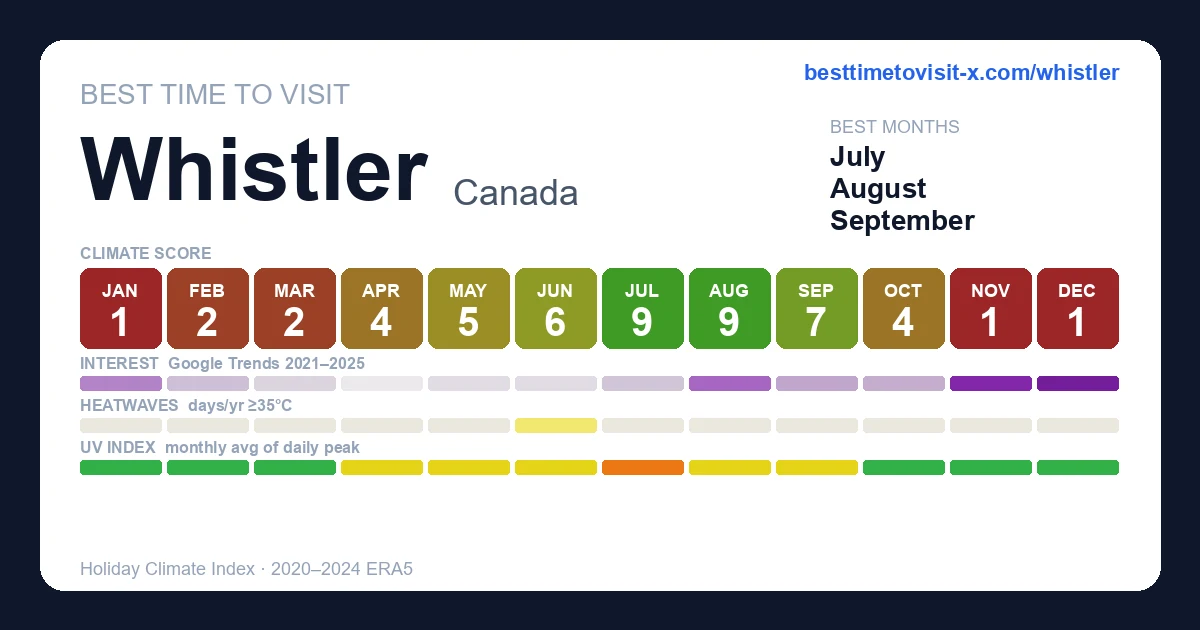
| Month | Temp °C | Feels °C | Rain days | Rain h | Rain h/day | Humidity | Wind km/h | Sun h | UV | Interest | Score |
|---|---|---|---|---|---|---|---|---|---|---|---|
| Jan | -3–2 | -1 | 22 | 378 | 17.2 | 80% | 7 | 66 | 1 | Moderate | 1 |
| Feb | -5–2 | -1 | 17 | 280 | 16.5 | 72% | 8 | 107 | 1 | Moderate | 2 |
| Mar | -3–5 | 2 | 17 | 280 | 16.5 | 65% | 8 | 166 | 2 | Quiet | 2 |
| Apr | -1–8 | 6 | 14 | 229 | 16.4 | 61% | 9 | 202 | 4 | Quiet | 4 |
| May | 4–15 | 13 | 13 | 210 | 16.2 | 61% | 9 | 248 | 5 | Quiet | 5 |
| Jun | 8–19 | 18 | 17 | 232 | 13.6 | 61% | 10 | 265 | 5 | Quiet | 6 |
| Jul | 12–24 | 24 | 7 | 91 | 13.0 | 52% | 10 | 317 | 6 | Moderate | 9 |
| Aug | 12–24 | 24 | 8 | 115 | 14.4 | 52% | 10 | 275 | 5 | Moderate | 9 |
| Sep | 9–19 | 19 | 11 | 168 | 15.3 | 61% | 9 | 209 | 4 | Quiet | 7 |
| Oct | 4–12 | 10 | 16 | 270 | 16.9 | 71% | 8 | 134 | 2 | Quiet | 4 |
| Nov | -2–4 | 2 | 19 | 310 | 16.3 | 77% | 8 | 82 | 1 | Moderate | 1 |
| Dec | -4–2 | -1 | 21 | 333 | 15.9 | 78% | 7 | 69 | — | Peak | 1 |
UV Index in Whistler by Month
UV index in Whistler peaks at 6 (high) in July, dropping to 0 (low) in December. July have high UV — SPF 30+ and sunglasses recommended.
Best months in detail
July
9/1012–24°C · 7 rain days (91h) · 317 sun hours · 52% humidity · Moderate crowd · UV 6 (high) · sunniest 1 in 10 days reach 8 (very high)
August
9/1012–24°C · 8 rain days (115h) · 275 sun hours · 52% humidity · Moderate crowd · UV 5 (moderate) · sunniest 1 in 10 days reach 7 (high)
September
7/109–19°C · 11 rain days (168h) · 209 sun hours · 61% humidity · Quiet crowd · UV 4 (moderate) · sunniest 1 in 10 days reach 6 (moderate)
Every month
Show the other 9 months in detail
January
1/10-3–2°C (feels -1°C) · 22 rain days (378h) · 66 sun hours · 80% humidity · Moderate crowd · UV 1 (low)
February
2/10-5–2°C (feels -1°C) · 17 rain days (280h) · 107 sun hours · 72% humidity · Moderate crowd · UV 1 (low)
March
2/10-3–5°C (feels 2°C) · 17 rain days (280h) · 166 sun hours · 65% humidity · Quiet crowd · UV 2 (low) · sunniest 1 in 10 days reach 4 (moderate)
April
4/10-1–8°C (feels 6°C) · 14 rain days (229h) · 202 sun hours · 61% humidity · Quiet crowd · UV 4 (moderate) · sunniest 1 in 10 days reach 6 (high)
May
5/104–15°C (feels 13°C) · 13 rain days (210h) · 248 sun hours · 61% humidity · Quiet crowd · UV 5 (moderate) · sunniest 1 in 10 days reach 8 (very high)
June
6/108–19°C · 17 rain days (232h) · 265 sun hours · 61% humidity · Quiet crowd · UV 5 (moderate) · sunniest 1 in 10 days reach 8 (very high)
October
4/104–12°C (feels 10°C) · 16 rain days (270h) · 134 sun hours · 71% humidity · Quiet crowd · UV 2 (low) · sunniest 1 in 10 days reach 3 (moderate)
November
1/10-2–4°C (feels 2°C) · 19 rain days (310h) · 82 sun hours · 77% humidity · Moderate crowd · UV 1 (low)
December
1/10-4–2°C (feels -1°C) · 21 rain days (333h) · 69 sun hours · 78% humidity · Peak crowd
Summer skiing ended as Horstman Glacier lost 75% of its area
The glacier that carried Whistler's summer ski camps is nearly gone, and there is now a peer-reviewed measurement of it. Work published in Annals of Glaciology in May 2026 by researchers at Simon Fraser University and Natural Resources Canada finds that Horstman Glacier lost nearly 75 percent of its area between 1973 and 2024, shrinking from 0.467 to 0.121 square kilometres. Neighbouring Whistler Glacier lost 95 percent over the same period and Blackcomb Glacier 60 percent.
The retreat closed the activity in stages rather than at once. Summer camps began on Horstman in 1988. The Horstman T-Bar was removed permanently in 2020, once the changing shape of the ice made the lift unworkable. In 2024 the glacier did not open at all for lack of snow — the first summer since 1996 with no glacier skiing on either mountain — and in March 2025 the camps were cancelled indefinitely. Whistler Blackcomb's published 2026 summer programme is hiking, sightseeing and the bike park, with no skiing in it.
The winter end of the calendar is untouched and still unusually long: recent seasons have opened on Blackcomb in the third week of November, and spring skiing on Blackcomb has run into mid-May.
Sources: Monty et al. (2026), Annals of Glaciology — On the demise of Whistler, Horstman and Blackcomb Glaciers , Whistler Blackcomb — Summer in the Alpine returns (2026 summer operations)
Can you ski at Whistler in summer?
No. Summer camps on the Horstman Glacier were cancelled indefinitely in March 2025, after the glacier failed to open at all in summer 2024 for lack of snow — the first summer since 1996 with no glacier skiing at Whistler. Research in Annals of Glaciology puts the glacier's area loss at nearly 75 percent since 1973. Summer at Whistler is now biking, hiking and the lakes.
What is the best time to visit Whistler?
January to March for the most reliable snow, late March and April for spring skiing with longer daylight, and July to September for hiking, biking and the lakes — July is the driest month at about 82 mm. May is a crossover month, with spring skiing on Blackcomb overlapping the bike park opening. October is the quiet shoulder, and November is wettest at around 374 mm.
What is the rainiest month in Whistler?
November, at around 374 mm — by far the wettest figure among these destinations, and at the village elevation much of it falls as rain rather than snow. July is driest at about 82 mm. November is the awkward gap month: too wet to hike, not yet reliably open to ski.
When does the ski season run in Whistler?
Recent seasons have opened on Blackcomb in the third week of November and closed on Whistler Mountain in mid-to-late April, with Blackcomb carrying spring skiing into mid-May. That is a long season by North American standards, but it no longer runs into summer: glacier skiing on Horstman ended in 2025. Peak conditions and peak prices fall between late December and February.
Is Whistler worth visiting in summer?
Very much so. Summer brings mountain biking on one of the world's best-known bike parks, hiking on the alpine trails, and the Peak 2 Peak gondola without winter queues. July is the driest month at about 82 mm, and lodging is far cheaper than in ski season.
How many days do you need in Whistler?
Three or more for skiing, given two large mountains and the likelihood of at least one poor-weather day. Two is enough in summer for the bike park or a couple of alpine hikes plus the gondola. The drive from Vancouver takes around two hours on the Sea to Sky Highway.
How cold does Whistler get?
December lows average around −4C in the village, which is mild for a major ski resort — this is a coastal range, so it is wetter and warmer than the Rockies. That means heavy, dense snowfall and occasional rain at village level, with far better conditions higher up the mountain.
What is Whistler best known for?
Being one of the largest ski resorts in North America, across two linked mountains, and a co-host venue of the 2010 Winter Olympics. In summer it is equally known for the Whistler Mountain Bike Park, among the most developed lift-served bike parks anywhere. The Peak 2 Peak gondola between the two mountains runs year-round.
What not to miss in Whistler?
The Peak 2 Peak gondola, which spans between Whistler and Blackcomb with the longest unsupported span of any lift in the world. Beyond that: the alpine trails from the top in summer, the Audain Art Museum for Northwest Coast art, and the drive itself — the Sea to Sky Highway from Vancouver is a large part of the trip.
How far is Whistler from Vancouver?
About 120 km, or roughly two hours by road on the Sea to Sky Highway, which is a substantial part of the appeal — it runs along Howe Sound past Shannon Falls and Squamish. Shuttle buses run frequently from Vancouver airport and downtown, so a car is not necessary if you are staying in the village.
Frequently asked questions about visiting Whistler
When is the best time to visit Whistler?
July is the highest-scoring month (9/10 on the Holiday Climate Index). Typical conditions: 12–24°C (7 rainy days). The top three months by score are July, August, September.
What is the worst time to visit Whistler?
December is the lowest-scoring month (1/10). Typical conditions: -4–2°C (21 rainy days).
When are crowds lowest in Whistler?
Search-interest seasonality (Google Trends 2021-2025) is lowest in May and peaks in December. Interest tracks both in-trip visitors and lead-time planners, so treat it as a "destination is on people's minds" signal rather than literal arrivals.
Which months in Whistler have good weather but fewer tourists?
September (climate 7/10, crowd index 30) — shoulder months with above-average climate and below-median search-interest. Often the best value-for-weather trade.
What is the UV index in Whistler by month?
UV peaks at 6 (high) in July and is lowest in December at 0 (low). Monthly peak values: Jan 1, Feb 1, Mar 2, Apr 4, May 5, Jun 5, Jul 6, Aug 5, Sep 4, Oct 2, Nov 1, Dec —.
What is the UV index in Whistler in July?
July is the peak UV month in Whistler, with a daily-peak UV index of 6 (high). Apply SPF 30+, wear sunglasses, and seek shade during midday hours.
How high can UV get in Whistler on the sunniest days?
Most days look like the monthly average, but on the sunniest ~1 in 10 days UV climbs higher than the mean suggests. June is the worst case: typical days average UV 5 (moderate), but the top 10% of days reach UV 8 (very high) — and even higher. Months where the sunniest days routinely exceed the typical reading: March, April, May, June, July, August, September, October. Plan sun protection for the worst case, not the average.
Is air quality in Whistler bad for travelers?
PM2.5 (fine-particle pollution) exceeds the WHO sensitive-group guideline (15 µg/m³) in 1 month: August. The worst month is August with a typical-day mean of 8 µg/m³ (fair); on the worst 10% of days PM2.5 reaches 16 µg/m³ (unhealthy for sensitive) and higher. People with asthma, heart conditions, or sensitive children may want to avoid these months or limit outdoor activity. Source: CAMS via Open-Meteo.