Best time to visit Yellowstone
Re-score for me — drag the dial — every chart on the page recolours live for your heat limit 27°C
Default 27 °C is the upper edge of the Holiday Climate Index "ideal comfort" band (Scott, Rutty, Amelung & Tang, 2016). Above this, most warm-tourism travellers report measurable discomfort.
Greyed factors are scored normally — extreme cold overrides them, so a clear sky or low rain can't lift the period.
Greyed factors are scored normally — extreme cold overrides them, so a clear sky or low rain can't lift the period.
Greyed factors are scored normally — extreme cold overrides them, so a clear sky or low rain can't lift the period.
Greyed factors are scored normally — extreme cold overrides them, so a clear sky or low rain can't lift the period.
Greyed factors are scored normally — extreme cold overrides them, so a clear sky or low rain can't lift the period.
Greyed factors are scored normally — extreme cold overrides them, so a clear sky or low rain can't lift the period.
Greyed factors are scored normally — extreme cold overrides them, so a clear sky or low rain can't lift the period.
Greyed factors are scored normally — extreme cold overrides them, so a clear sky or low rain can't lift the period.
Greyed factors are scored normally — extreme cold overrides them, so a clear sky or low rain can't lift the period.
Greyed factors are scored normally — extreme cold overrides them, so a clear sky or low rain can't lift the period.
Greyed factors are scored normally — extreme cold overrides them, so a clear sky or low rain can't lift the period.
Greyed factors are scored normally — extreme cold overrides them, so a clear sky or low rain can't lift the period.
Greyed factors are scored normally — extreme cold overrides them, so a clear sky or low rain can't lift the period.
Greyed factors are scored normally — extreme cold overrides them, so a clear sky or low rain can't lift the period.
Greyed factors are scored normally — extreme cold overrides them, so a clear sky or low rain can't lift the period.
Greyed factors are scored normally — extreme cold overrides them, so a clear sky or low rain can't lift the period.
Greyed factors are scored normally — extreme cold overrides them, so a clear sky or low rain can't lift the period.
Greyed factors are scored normally — extreme cold overrides them, so a clear sky or low rain can't lift the period.
Greyed factors are scored normally — extreme cold overrides them, so a clear sky or low rain can't lift the period.
Greyed factors are scored normally — extreme cold overrides them, so a clear sky or low rain can't lift the period.
Greyed factors are scored normally — extreme cold overrides them, so a clear sky or low rain can't lift the period.
Greyed factors are scored normally — extreme cold overrides them, so a clear sky or low rain can't lift the period.
Greyed factors are scored normally — extreme cold overrides them, so a clear sky or low rain can't lift the period.
Greyed factors are scored normally — extreme cold overrides them, so a clear sky or low rain can't lift the period.
Greyed factors are scored normally — extreme cold overrides them, so a clear sky or low rain can't lift the period.
Greyed factors are scored normally — extreme cold overrides them, so a clear sky or low rain can't lift the period.
Greyed factors are scored normally — extreme cold overrides them, so a clear sky or low rain can't lift the period.
Greyed factors are scored normally — extreme cold overrides them, so a clear sky or low rain can't lift the period.
Greyed factors are scored normally — extreme cold overrides them, so a clear sky or low rain can't lift the period.
Greyed factors are scored normally — extreme cold overrides them, so a clear sky or low rain can't lift the period.
Greyed factors are scored normally — extreme cold overrides them, so a clear sky or low rain can't lift the period.
Greyed factors are scored normally — extreme cold overrides them, so a clear sky or low rain can't lift the period.
Greyed factors are scored normally — extreme cold overrides them, so a clear sky or low rain can't lift the period.
Greyed factors are scored normally — extreme cold overrides them, so a clear sky or low rain can't lift the period.
Greyed factors are scored normally — extreme cold overrides them, so a clear sky or low rain can't lift the period.
Greyed factors are scored normally — extreme cold overrides them, so a clear sky or low rain can't lift the period.
Greyed factors are scored normally — extreme cold overrides them, so a clear sky or low rain can't lift the period.
How is this scored? HCI / Steadman / CCI gate — full methodology and citations below.
Compare with another destination
Add as many as you like — stacked below the main strips above. Each row is just the recent-window score strip and (for beach destinations) sea-temperature strip.
Tours in Yellowstone
29 top-rated tours via Viator. Booking links earn this site a commission at no cost to you. Map locations are approximate (centred on Yellowstone).
- 1
 Private Yellowstone Wildlife Sightseeing Tour
 - 2
 Private Yellowstone Wolf Watching & Wildlife Safari + lunch
 - 3
 Yellowstone National Park Private Wildlife Tour
 - 4
 Lower Loop Van Tour from West Yellowstone: Grand Prismatic and Old Faithful
 - 5
 Grand Canyon of the Yellowstone Rim and Loop Hike with Lunch
 - 6
 4-Hour Kayak on Yellowstone Lake with Lunch
 - 7
 Upper Loop Tour and Lamar Valley from West Yellowstone with Lunch
 - 8
 Lamar Valley Safari Hiking Tour with Lunch
 - 9
 6-Mile Geyser Hiking Tour in Yellowstone with Lunch
 - 10
 Half Day Yellowstone “Hot Spots” Deals From West Yellowstone
 - 11
 250th Anniversary Yellowstone 55+ Adults Only Deals,gifts & lunch
 - 12
 Guided Yellowstone Tour from Big Sky and West Yellowstone
 - 13
 250th Celebration Yellowstone Open Air tour W/lunch and Souvenir
 - 14
 Private Yellowstone Tour: ICONIC Sites, Wildlife, Family Friendly Hikes + lunch
 - 15
 Yellowstone National Park Self-Guided Driving Audio Tour
 - 16
 Private Yellowstone Wildlife and Photo from West Yellowstone
 - 17
 Full-Day Guided Yellowstone Day Tour
 - 18
 Self-Guided Audio Driving Tour in Yellowstone National Park
 - 19
 Grand Teton and Yellowstone Self-Guided Driving Tours Bundle
 - 20
 Lake Yellowstone Half Day Kayak Tours Past Geothermal Features
 - 21
 Kayak Day Paddle on Yellowstone Lake
 - 22
 Private Hidden Gems of Yellowstone! Lunch w/ family friendly hikes included!
 - 23
 Yellowstone Lake & Hot Springs / 3 Hour Morning or Twilight Tour
 - 24
 Yellowstone National Park Self-Guided Audio Tour
 - 25
 Small-Group Sunset Kayaking Tour on Lake Yellowstone
 - 26
 Private Yellowstone Wildlife Tour in the American Serengeti
 - 27
 Private Yellowstone Summer Wildlife Photo Safaris - Half Day
 - 28
 Yellowstone PRIVATE Winter SAFARI and Wolf Watching
 - 29
 Yellowstone's Grand Prismatic Self-Guided Walking Tour
Last refreshed 2026-08-13.
Similar climatesMoraine Lake90% · Lake Louise89% · Lake Minnewanka88%
Other destinations with the most-alike year-round climate to Yellowstone (apparent temperature, rain hours, sunshine — matched within the same trip-profile). The ±N chip compares each match's typical score for the current month against Yellowstone's. Based on the 2020-2024 climatology, not this year's actual weather.
Month-by-month
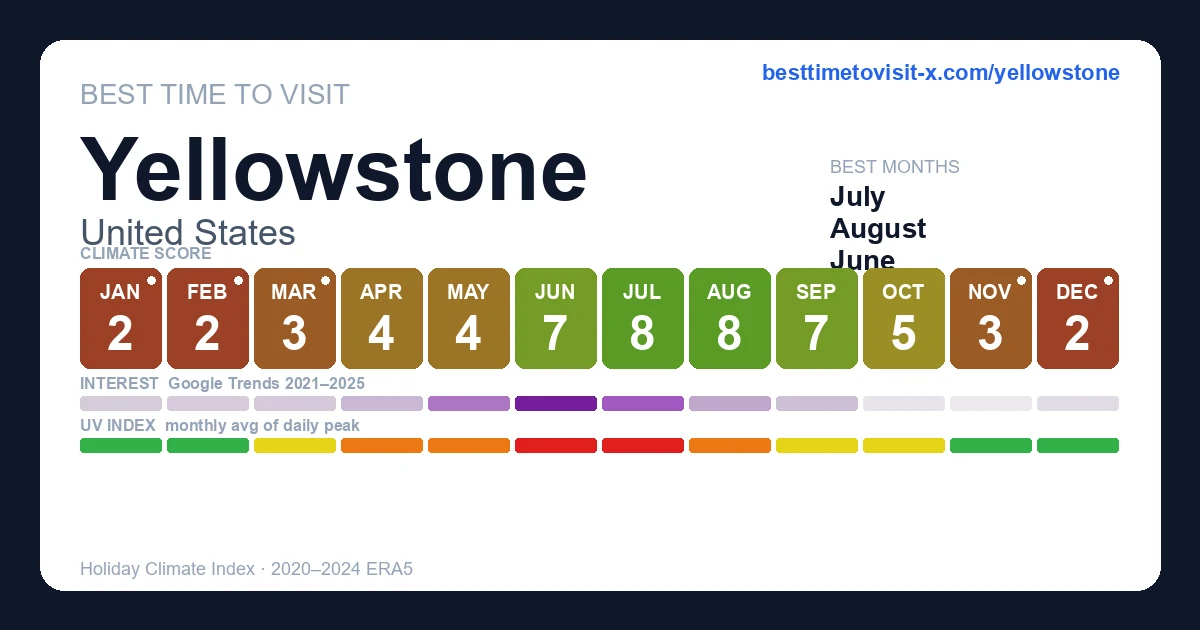
| Month | Temp °C | Feels °C | Rain days | Rain h | Rain h/day | Humidity | Wind km/h | Sun h | UV | Interest | Score |
|---|---|---|---|---|---|---|---|---|---|---|---|
| Jan | -12–-7 | -12 | 12 | 185 | 15.4 | 74% | 18 | 130 | 1 | Quiet | 2 |
| Feb | -13–-6 | -12 | 12 | 206 | 17.2 | 69% | 20 | 140 | 2 | Quiet | 2 |
| Mar | -9–-2 | -7 | 13 | 199 | 15.3 | 61% | 19 | 198 | 4 | Quiet | 3 |
| Apr | -7–2 | -3 | 12 | 158 | 13.2 | 54% | 19 | 233 | 6 | Quiet | 4 |
| May | -2–7 | 3 | 14 | 159 | 11.4 | 55% | 17 | 275 | 8 | Moderate | 4 |
| Jun | 3–15 | 11 | 10 | 103 | 10.3 | 46% | 19 | 291 | 8 | Peak | 7 |
| Jul | 8–22 | 18 | 9 | 67 | 7.4 | 32% | 19 | 331 | 9 | Busy | 8 |
| Aug | 9–21 | 17 | 9 | 94 | 10.4 | 39% | 19 | 280 | 8 | Quiet | 8 |
| Sep | 5–16 | 13 | 7 | 84 | 12.0 | 41% | 19 | 249 | 6 | Quiet | 7 |
| Oct | 0–8 | 4 | 10 | 138 | 13.8 | 56% | 19 | 199 | 4 | Quiet | 5 |
| Nov | -7–-1 | -6 | 12 | 156 | 13.0 | 71% | 20 | 141 | 2 | Quiet | 3 |
| Dec | -11–-5 | -10 | 14 | 218 | 15.6 | 75% | 20 | 105 | 1 | Quiet | 2 |
UV Index in Yellowstone by Month
UV index in Yellowstone peaks at 9 (very high) in July, dropping to 1 (low) in December. June, July reach very high or extreme levels — apply SPF 50+, wear a hat and protective clothing, and limit direct sun between 11:00 and 17:00.
Best months in detail
July
8/108–22°C (feels 18°C) · 9 rain days (67h) · 331 sun hours · 32% humidity · Busy crowd · UV 9 (very high)
August
8/109–21°C (feels 17°C) · 9 rain days (94h) · 280 sun hours · 39% humidity · Quiet crowd · UV 8 (high) · sunniest 1 in 10 days reach 9 (very high)
September
7/105–16°C (feels 13°C) · 7 rain days (84h) · 249 sun hours · 41% humidity · Quiet crowd · UV 6 (moderate) · sunniest 1 in 10 days reach 7 (high)
Every month
Show the other 9 months in detail
January
2/10-12–-7°C (feels -12°C) · 12 rain days (185h) · 130 sun hours · 74% humidity · Quiet crowd · UV 1 (low)
February
2/10-13–-6°C (feels -12°C) · 12 rain days (206h) · 140 sun hours · 69% humidity · Quiet crowd · UV 2 (low) · sunniest 1 in 10 days reach 3 (moderate)
March
3/10-9–-2°C (feels -7°C) · 13 rain days (199h) · 198 sun hours · 61% humidity · Quiet crowd · UV 4 (moderate) · sunniest 1 in 10 days reach 6 (high)
April
4/10-7–2°C (feels -3°C) · 12 rain days (158h) · 233 sun hours · 54% humidity · Quiet crowd · UV 6 (high) · sunniest 1 in 10 days reach 8 (very high)
May
4/10-2–7°C (feels 3°C) · 14 rain days (159h) · 275 sun hours · 55% humidity · Moderate crowd · UV 8 (high) · sunniest 1 in 10 days reach 10 (very high)
June
7/103–15°C (feels 11°C) · 10 rain days (103h) · 291 sun hours · 46% humidity · Peak crowd · UV 8 (very high) · sunniest 1 in 10 days reach 11 (very high)
October
5/100–8°C (feels 4°C) · 10 rain days (138h) · 199 sun hours · 56% humidity · Quiet crowd · UV 4 (moderate) · sunniest 1 in 10 days reach 5 (moderate)
November
3/10-7–-1°C (feels -6°C) · 12 rain days (156h) · 141 sun hours · 71% humidity · Quiet crowd · UV 2 (low)
December
2/10-11–-5°C (feels -10°C) · 14 rain days (218h) · 105 sun hours · 75% humidity · Quiet crowd · UV 1 (low)
One road stays open to cars all winter. The rest close on 1 November
Yellowstone's season is set by a published date, not by conditions. The last day to drive most of the park's roads is 31 October; on 1 November the West, South and East entrances and nearly all roads close to regular vehicle traffic while the park is prepared for the winter season.
One route is the exception. The road from the North Entrance at Gardiner, Montana, through Mammoth Hot Springs and Tower Junction to the Northeast Entrance at Cooke City stays open to wheeled vehicles all year, weather permitting. That corridor takes in the Lamar Valley, which is why winter wildlife watching concentrates there.
Motorised access to the interior returns on 15 December, but by snowmobile and snowcoach — not in your own car.
Sources: NPS — Yellowstone park roads , NPS — Yellowstone operating dates
How many days are ideal for Yellowstone?
Four to five days. The park is far larger than most visitors expect and the figure-of-eight Grand Loop is around 230 km, so driving eats the day. Three days covers the geyser basins and the Grand Canyon of the Yellowstone; five lets you add the Lamar Valley for wildlife at dawn without a punishing schedule.
What is the cheapest month to go to Yellowstone?
April and early May, or November, when gateway-town lodging in Gardiner and West Yellowstone drops sharply. The catch is direct and severe: on 1 November nearly all roads close to regular vehicles, and in April many are still being cleared, so the saving comes with substantially reduced access. Only the northern road stays open to cars all winter.
How far in advance should I plan a Yellowstone trip?
For summer, six to twelve months for in-park lodging, which books out early. Campgrounds and gateway hotels in Gardiner and West Yellowstone can be found later. For winter, book snowcoach or snowmobile transport well ahead — capacity is limited and the season only runs from 15 December.
Is it better to stay inside or outside Yellowstone?
Inside saves substantial driving and puts you at the geyser basins for sunrise, but rooms are basic, expensive and booked far ahead. Staying outside in West Yellowstone or Gardiner costs less and offers more choice, at the price of an hour or more each way through the entrance queue.
What are the best months to visit Yellowstone National Park?
June to September, when all roads are open to cars. July is warmest at around 21C by day, but it is also the busiest. Early June and September are the sweet spots — fewer people, active wildlife, and the roads still open. Note the park sits high, so nights are cold in every month of the year.
What months to avoid Yellowstone National Park?
November and early December, and again in April. These are the shoulder gaps when most roads are closed to cars but the winter snowcoach season has not started — it begins 15 December. You get the disadvantages of winter access without the compensating snowcoach and snowmobile experience.
What month does it start snowing in Yellowstone?
September, and it can snow in any month at this elevation. The park closes most roads to regular vehicles on 1 November precisely because winter arrives early and hard, with December lows around −12C. Visitors booking a late-September trip should carry proper cold-weather clothing and expect the possibility of snow on the passes.
Is Yellowstone too cold in September?
No — September is one of the best months to visit. Days are cool but comfortable, the crowds have thinned after the American school holidays, elk are in rut and wildlife is highly active. Nights drop below freezing and early snow is possible, so bring layers, but road access is still full until 31 October.
What is the top predator in Yellowstone?
The grizzly bear, alongside grey wolves, which were reintroduced in 1995 and are now most reliably seen in the Lamar Valley. That valley sits on the one road corridor open to cars all winter, from the North Entrance to the Northeast Entrance, which is why winter wolf-watching trips concentrate there.
When is the best time to see wildlife in Yellowstone?
Dawn and dusk, in late spring or autumn. May and June bring newborn bison and elk calves; September brings the elk rut. Winter concentrates wildlife at lower elevations along the Lamar Valley, and the northern road stays open to cars, making it the most reliable season for wolves despite the cold.
What not to miss in Yellowstone?
Grand Prismatic Spring from the Fairy Falls overlook rather than only the boardwalk, which is where the colour actually reads; the Grand Canyon of the Yellowstone at Artist Point; and the Lamar Valley at dawn for wolves and bison. Old Faithful is worth one eruption but is the most crowded spot in the park — the surrounding geyser basin repays more time.
Which is better, Yellowstone or Glacier?
Yellowstone for geothermal features and wildlife — geysers, hot springs, wolves and bison across a vast plateau. Glacier for alpine scenery and one of the great mountain drives. Yellowstone needs four to five days and stays partly open in winter; Glacier is effectively a July-to-September destination, since its road can open as late as mid-July.
Is Yellowstone worth visiting?
It is the most geothermally active place on earth that you can drive through, with roughly half the world's geysers, alongside wolves and free-roaming bison. The honest caveat is scale and traffic: the Grand Loop is around 230 km, distances eat the day, and summer queues are real. Give it four days or you will spend the trip driving.
Frequently asked questions about visiting Yellowstone
When is the best time to visit Yellowstone?
July is the highest-scoring month (8/10 on the Holiday Climate Index). Typical conditions: 8–22°C (9 rainy days). The top three months by score are July, August, September.
What is the worst time to visit Yellowstone?
December is the lowest-scoring month (2/10, capped by extreme cold). Typical conditions: -11–-5°C (14 rainy days).
Is Yellowstone too cold in winter?
5 months (January, February, March, November, December) cross our cold deal-breaker (apparent temperature below the cap). Doable with the right gear, but expect the climate score to be held down by the gate.
When are crowds lowest in Yellowstone?
Search-interest seasonality (Google Trends 2021-2025) is lowest in November and peaks in June. Interest tracks both in-trip visitors and lead-time planners, so treat it as a "destination is on people's minds" signal rather than literal arrivals.
Which months in Yellowstone have good weather but fewer tourists?
August (climate 8/10, crowd index 34) and September (climate 7/10, crowd index 23) — shoulder months with above-average climate and below-median search-interest. Often the best value-for-weather trade.
What is the UV index in Yellowstone by month?
UV peaks at 9 (very high) in July and is lowest in December at 1 (low). Monthly peak values: Jan 1, Feb 2, Mar 4, Apr 6, May 8, Jun 8, Jul 9, Aug 8, Sep 6, Oct 4, Nov 2, Dec 1. June, July reach very high or extreme levels — apply SPF 50+, wear a hat and protective clothing, and limit direct sun between 11:00 and 17:00.
What is the UV index in Yellowstone in July?
July is the peak UV month in Yellowstone, with a daily-peak UV index of 9 (very high). At this level, sunburn can occur in under 20 minutes on unprotected fair skin. Apply SPF 50+, wear protective clothing and a hat, and avoid direct midday sun (11:00–17:00).
How high can UV get in Yellowstone on the sunniest days?
Most days look like the monthly average, but on the sunniest ~1 in 10 days UV climbs higher than the mean suggests. June is the worst case: typical days average UV 8 (very high), but the top 10% of days reach UV 11 (very high) — and even higher. Months where the sunniest days routinely exceed the typical reading: February, March, April, May, June, August, September, October. Plan sun protection for the worst case, not the average.