Best time to visit Sequoia National Park
Re-score for me — drag the dial — every chart on the page recolours live for your heat limit 27°C
Default 27 °C is the upper edge of the Holiday Climate Index "ideal comfort" band (Scott, Rutty, Amelung & Tang, 2016). Above this, most warm-tourism travellers report measurable discomfort.
Greyed factors are scored normally — extreme cold overrides them, so a clear sky or low rain can't lift the period.
Greyed factors are scored normally — extreme cold overrides them, so a clear sky or low rain can't lift the period.
Greyed factors are scored normally — extreme cold overrides them, so a clear sky or low rain can't lift the period.
Greyed factors are scored normally — extreme cold overrides them, so a clear sky or low rain can't lift the period.
Greyed factors are scored normally — extreme cold overrides them, so a clear sky or low rain can't lift the period.
Greyed factors are scored normally — extreme cold overrides them, so a clear sky or low rain can't lift the period.
Greyed factors are scored normally — extreme cold overrides them, so a clear sky or low rain can't lift the period.
Greyed factors are scored normally — extreme cold overrides them, so a clear sky or low rain can't lift the period.
Greyed factors are scored normally — extreme cold overrides them, so a clear sky or low rain can't lift the period.
Greyed factors are scored normally — extreme cold overrides them, so a clear sky or low rain can't lift the period.
Greyed factors are scored normally — extreme cold overrides them, so a clear sky or low rain can't lift the period.
Greyed factors are scored normally — extreme cold overrides them, so a clear sky or low rain can't lift the period.
Greyed factors are scored normally — extreme cold overrides them, so a clear sky or low rain can't lift the period.
How is this scored? HCI / Steadman / CCI gate — full methodology and citations below.
Compare with another destination
Add as many as you like — stacked below the main strips above. Each row is just the recent-window score strip and (for beach destinations) sea-temperature strip.
Tours in Sequoia National Park
14 top-rated tours via Viator. Booking links earn this site a commission at no cost to you. Map locations are approximate (centred on Sequoia National Park).
- 1
 Giant Sequoia Private Tour
 - 2
 Sequoia National Park Small-Group Tour from Three Rivers
 - 3
 Private Guided Hiking Tour - Sequoia National Park
 - 4
 5-Star Rated Sequoia Winter Tour
 - 5
 Sequoia National Park Tour from Wuksachi Lodge
 - 6
 Sequoia & Kings Canyon NP Self-Guided Driving Audio Tour
 - 7
 Private Stargazing - Sequoia National Park
 - 8
 Sequoia National Park Adventure from Tulare
 - 9
 Self-Guided Audio Driving Tour in Death Valley National Park
 - 10
 Sequoia Full Day Private Tour & Hike
 - 11
 Sequoia National Park Self-Guided Audio Tour
 - 12
 Private Snowshoe Adventure - Sequoia National Park
 - 13
 Sequoia and Kings Canyon Audio Tour Self Guide National Park Tour
 - 14
 Heart of the Giant Forest Hike
Last refreshed 2026-08-13.
Similar climatesBryce Canyon86% · Lake Tahoe84% · Lake Minnewanka80%
Other destinations with the most-alike year-round climate to Sequoia National Park (apparent temperature, rain hours, sunshine — matched within the same trip-profile). The ±N chip compares each match's typical score for the current month against Sequoia National Park's. Based on the 2020-2024 climatology, not this year's actual weather.
Month-by-month
| Month | Temp °C | Feels °C | Rain days | Rain h | Rain h/day | Humidity | Wind km/h | Sun h | UV | Interest | Score |
|---|---|---|---|---|---|---|---|---|---|---|---|
| Jan | -11–-2 | -6 | 8 | 112 | 14.0 | 50% | 11 | 192 | 3 | Quiet | 4 |
| Feb | -12–-2 | -6 | 7 | 116 | 16.6 | 53% | 10 | 194 | 5 | Quiet | 4 |
| Mar | -12–-3 | -7 | 14 | 189 | 13.5 | 60% | 10 | 227 | 7 | Quiet | 3 |
| Apr | -7–2 | -2 | 6 | 77 | 12.8 | 59% | 9 | 268 | 9 | Moderate | 5 |
| May | -4–7 | 4 | 7 | 74 | 10.6 | 54% | 10 | 313 | 9 | Busy | 6 |
| Jun | 3–14 | 11 | 8 | 64 | 8.0 | 39% | 11 | 306 | 10 | Peak | 7 |
| Jul | 7–19 | 16 | 7 | 57 | 8.1 | 30% | 10 | 321 | 11 | Peak | 8 |
| Aug | 6–17 | 14 | 6 | 52 | 8.7 | 32% | 10 | 301 | 10 | Busy | 8 |
| Sep | 3–15 | 12 | 5 | 51 | 10.2 | 33% | 10 | 266 | 8 | Moderate | 7 |
| Oct | -1–10 | 7 | 3 | 28 | 9.3 | 33% | 9 | 246 | 6 | Quiet | 7 |
| Nov | -8–2 | -2 | 5 | 62 | 12.4 | 43% | 9 | 204 | 4 | Quiet | 6 |
| Dec | -11–-1 | -5 | 9 | 129 | 14.3 | 50% | 10 | 174 | 3 | Quiet | 4 |
UV Index in Sequoia National Park by Month
UV index in Sequoia National Park peaks at 11 (extreme) in July, dropping to 3 (low) in December. April, May, June, July, August reach very high or extreme levels — apply SPF 50+, wear a hat and protective clothing, and limit direct sun between 11:00 and 17:00.
Best months in detail
July
8/107–19°C (feels 16°C) · 7 rain days (57h) · 321 sun hours · 30% humidity · Peak crowd · UV 11 (extreme) · sunniest 1 in 10 days reach 13 (extreme)
August
8/106–17°C (feels 14°C) · 6 rain days (52h) · 301 sun hours · 32% humidity · Busy crowd · UV 10 (very high) · sunniest 1 in 10 days reach 12 (extreme)
September
7/103–15°C (feels 12°C) · 5 rain days (51h) · 266 sun hours · 33% humidity · Moderate crowd · UV 8 (high) · sunniest 1 in 10 days reach 9 (very high)
Every month
Show the other 9 months in detail
January
4/10-11–-2°C (feels -6°C) · 8 rain days (112h) · 192 sun hours · 50% humidity · Quiet crowd · UV 3 (moderate)
February
4/10-12–-2°C (feels -6°C) · 7 rain days (116h) · 194 sun hours · 53% humidity · Quiet crowd · UV 5 (moderate) · sunniest 1 in 10 days reach 6 (high)
March
3/10-12–-3°C (feels -7°C) · 14 rain days (189h) · 227 sun hours · 60% humidity · Quiet crowd · UV 7 (high) · sunniest 1 in 10 days reach 9 (very high)
April
5/10-7–2°C (feels -2°C) · 6 rain days (77h) · 268 sun hours · 59% humidity · Moderate crowd · UV 9 (very high) · sunniest 1 in 10 days reach 11 (very high)
May
6/10-4–7°C (feels 4°C) · 7 rain days (74h) · 313 sun hours · 54% humidity · Busy crowd · UV 9 (very high) · sunniest 1 in 10 days reach 11 (very high)
June
7/103–14°C (feels 11°C) · 8 rain days (64h) · 306 sun hours · 39% humidity · Peak crowd · UV 10 (very high) · sunniest 1 in 10 days reach 13 (extreme)
October
7/10-1–10°C (feels 7°C) · 3 rain days (28h) · 246 sun hours · 33% humidity · Quiet crowd · UV 6 (moderate) · sunniest 1 in 10 days reach 7 (high)
November
6/10-8–2°C (feels -2°C) · 5 rain days (62h) · 204 sun hours · 43% humidity · Quiet crowd · UV 4 (moderate)
December
4/10-11–-1°C (feels -5°C) · 9 rain days (129h) · 174 sun hours · 50% humidity · Quiet crowd · UV 3 (low) · sunniest 1 in 10 days reach 3 (moderate)
California law makes you carry chains even in a four-wheel drive
Sequoia's access problem is the road, not the trees. The parks sit on a steep western slope of the Sierra Nevada, and from autumn through spring the National Park Service operates chain controls at three levels. Under R-1 chains are required unless you have two snow-tread tyres on the drive wheels; under R-2 unless you have all-wheel or four-wheel drive with snow tyres on all four; and under R-3 chains or traction devices must be fitted to every vehicle, no exceptions.
The part visitors miss is the carrying rule. State law requires all vehicles — including four-wheel and all-wheel drive — to carry tyre chains or cables when entering a chain-control zone. Having the right car does not exempt you from having the chains in it.
Controls are most common from November through March, but can be imposed any time snow falls.
Sources: NPS — Winter driving and tire chains, Sequoia & Kings Canyon , NPS — Sequoia & Kings Canyon road conditions
How many days do we need at Sequoia National Park?
Two days. One for the Giant Forest, General Sherman, Moro Rock and Crescent Meadow; a second for Kings Canyon and Grant Grove, which is a long but genuinely scenic drive. One day is possible if you stay only in the Giant Forest area. Between November and March, allow extra time — chain controls slow the Generals Highway considerably.
Which is better to see, redwoods or sequoias?
Giant sequoias are the more massive tree by volume and grow only on this Sierra Nevada slope, so Sequoia National Park is the place to see them. Coast redwoods are taller and slimmer, and grow along the northern California coast. Sequoias impress by bulk, redwoods by height.
Is Sequoia as busy as Yosemite?
No. Sequoia and Kings Canyon receive a fraction of Yosemite's visitors, and the crowding concentrates around the General Sherman Tree and the Giant Forest shuttle. Away from those, trails are noticeably quieter than Yosemite Valley in the same week.
What are the best months to visit Sequoia National Park?
June to September, when the Generals Highway is clear of chain controls and the high country is open. July is warmest at around 20C by day — cool for California, because the Giant Forest sits above 2,000 m. September is the pick for thinner crowds with the roads still reliably open.
Is it always cold in Sequoia park?
Cooler than visitors expect, because the sequoia groves sit above 2,000 m. Summer days reach only about 20C in the Giant Forest and February lows average around −8C. Meanwhile the park's foothills entrance near Three Rivers can be baking on the same afternoon — the elevation range within the park is enormous.
What's better, Sequoia or Kings Canyon?
They are administered together and most visitors do both. Sequoia holds the headline trees — General Sherman, the Giant Forest, Moro Rock — and takes the bulk of the traffic. Kings Canyon offers a dramatic glacial canyon drive and noticeably quieter trails. If you have one day, choose Sequoia; two days lets you do both properly.
What is the best town to stay in when visiting Sequoia National Park?
Three Rivers, just outside the southern entrance, is the usual base — closest to the Giant Forest and well supplied with lodging. Visalia is larger with more choice and better value, at the cost of an hour's drive each way on a winding mountain road that is slow going in the dark.
Do you need chains for Sequoia National Park?
Between roughly November and March, yes — and you must carry them even in a four-wheel drive. California law requires all vehicles, including 4WD and AWD, to carry chains or cables when entering a chain-control zone, and under an R-3 restriction chains must be fitted to every vehicle without exception. Hire cars do not include them.
What not to miss in Sequoia National Park?
General Sherman, the largest tree on earth by volume, and the Congress Trail loop beyond it, which gets you away from the crowd within minutes. Moro Rock's stairway climbs to a granite dome with a view across the Great Western Divide. Crescent Meadow at dusk is the best chance of seeing bears feeding at a safe distance.
Is Sequoia National Park worth visiting?
Yes, and it is the only place to see giant sequoias at this scale — they grow naturally on this western Sierra slope and nowhere else. It is also markedly quieter than Yosemite, its better-known neighbour. The main practical demand is the road: chain controls apply from roughly November to March, and California law requires even a 4WD to carry chains.
What are some things to do in Sequoia besides hiking?
Drive the Generals Highway for the groves and viewpoints, tour Crystal Cave in summer with a booked ticket, and stop at the Giant Forest Museum for the context that makes the trees legible. Wildlife watching in Crescent Meadow at dawn or dusk needs no walking to speak of, and the winter park offers snowshoeing on ranger-led outings.
Frequently asked questions about visiting Sequoia National Park
When is the best time to visit Sequoia National Park?
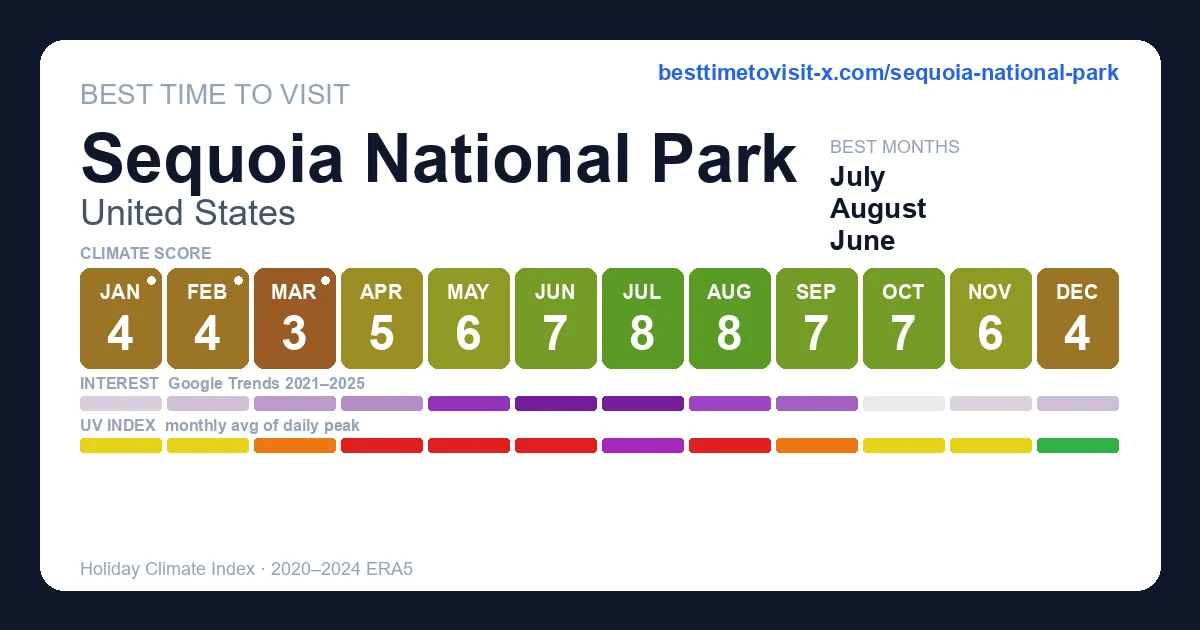
July is the highest-scoring month (8/10 on the Holiday Climate Index). Typical conditions: 7–19°C (7 rainy days). The top three months by score are July, August, September.
What is the worst time to visit Sequoia National Park?
March is the lowest-scoring month (3/10, capped by extreme cold). Typical conditions: -12–-3°C (14 rainy days).
Is Sequoia National Park too cold in winter?
3 months (January, February, March) cross our cold deal-breaker (apparent temperature below the cap). Doable with the right gear, but expect the climate score to be held down by the gate.
When are crowds lowest in Sequoia National Park?
Search-interest seasonality (Google Trends 2021-2025) is lowest in October and peaks in June. Interest tracks both in-trip visitors and lead-time planners, so treat it as a "destination is on people's minds" signal rather than literal arrivals.
Which months in Sequoia National Park have good weather but fewer tourists?
October (climate 7/10, crowd index 0) and November (climate 6/10, crowd index 13) — shoulder months with above-average climate and below-median search-interest. Often the best value-for-weather trade.
What is the UV index in Sequoia National Park by month?
UV peaks at 11 (extreme) in July and is lowest in December at 3 (low). Monthly peak values: Jan 3, Feb 5, Mar 7, Apr 9, May 9, Jun 10, Jul 11, Aug 10, Sep 8, Oct 6, Nov 4, Dec 3. April, May, June, July, August reach very high or extreme levels — apply SPF 50+, wear a hat and protective clothing, and limit direct sun between 11:00 and 17:00.
What is the UV index in Sequoia National Park in July?
July is the peak UV month in Sequoia National Park, with a daily-peak UV index of 11 (extreme). At this level, sunburn can occur in under 20 minutes on unprotected fair skin. Apply SPF 50+, wear protective clothing and a hat, and avoid direct midday sun (11:00–17:00).
How high can UV get in Sequoia National Park on the sunniest days?
Most days look like the monthly average, but on the sunniest ~1 in 10 days UV climbs higher than the mean suggests. July is the worst case: typical days average UV 11 (extreme), but the top 10% of days reach UV 13 (extreme) — and even higher. Months where the sunniest days routinely exceed the typical reading: February, March, April, May, June, July, August, September, October, December. Plan sun protection for the worst case, not the average.
Is air quality in Sequoia National Park bad for travelers?
PM2.5 (fine-particle pollution) exceeds the WHO sensitive-group guideline (15 µg/m³) in 1 month: August. The worst month is August with a typical-day mean of 9 µg/m³ (fair); on the worst 10% of days PM2.5 reaches 21 µg/m³ (unhealthy for sensitive) and higher. People with asthma, heart conditions, or sensitive children may want to avoid these months or limit outdoor activity. Source: CAMS via Open-Meteo.