Best time to visit Bryce Canyon
Re-score for me — drag the dial — every chart on the page recolours live for your heat limit 27°C
Default 27 °C is the upper edge of the Holiday Climate Index "ideal comfort" band (Scott, Rutty, Amelung & Tang, 2016). Above this, most warm-tourism travellers report measurable discomfort.
Greyed factors are scored normally — extreme cold overrides them, so a clear sky or low rain can't lift the period.
Greyed factors are scored normally — extreme cold overrides them, so a clear sky or low rain can't lift the period.
Greyed factors are scored normally — extreme cold overrides them, so a clear sky or low rain can't lift the period.
Greyed factors are scored normally — extreme cold overrides them, so a clear sky or low rain can't lift the period.
Greyed factors are scored normally — extreme cold overrides them, so a clear sky or low rain can't lift the period.
Greyed factors are scored normally — extreme cold overrides them, so a clear sky or low rain can't lift the period.
Greyed factors are scored normally — extreme cold overrides them, so a clear sky or low rain can't lift the period.
Greyed factors are scored normally — extreme cold overrides them, so a clear sky or low rain can't lift the period.
Greyed factors are scored normally — extreme cold overrides them, so a clear sky or low rain can't lift the period.
Greyed factors are scored normally — extreme cold overrides them, so a clear sky or low rain can't lift the period.
How is this scored? HCI / Steadman / CCI gate — full methodology and citations below.
Compare with another destination
Add as many as you like — stacked below the main strips above. Each row is just the recent-window score strip and (for beach destinations) sea-temperature strip.
Tours in Bryce Canyon
23 top-rated tours via Viator. Booking links earn this site a commission at no cost to you. Map locations are approximate (centred on Bryce Canyon).
- 1
 Scenic Tour of Bryce Canyon
 - 2
 Bryce Canyon National Park Self-Guided Driving Audio Tour
 - 3
 Bryce Canyon E-bike Tour
 - 4
 Bryce Canyon Private Tour
 - 5
 Bryce Canyon National Park: Private Guided Hike & Picnic
 - 6
 Peekaboo, Spooky and Dry Fork Slot Canyon Tour
 - 7
 Zion and Bryce Canyon National Parks Self-Driving Bundle Tour
 - 8
 Bryce Canyon Hiking Challenge
 - 9
 One Hour Guided ATV Ride in Utah
 - 10
 Ruby's Horseback Adventures Utah 1.5 Hour Ride
 - 11
 Utah Mighty 5 National Parks Self-Guided Driving Audio Tours
 - 12
 Ruby's Horseback Adventures Utah Half Day Ride
 - 13
 Bryce Canyon Full Day Private Tour & Hike
 - 14
 Bryce Canyon Stargazing Adventure
 - 15
 Ruby's Horseback Adventures Utah Thunder Mt. 4 Hour Ride
 - 16
 Zebra Slot Canyon Hiking Tour in Escalante
 - 17
 Shuttle between Las Vegas, Bryce Canyon, Zion National Park and St George
 - 18
 Late Night Stargazing
 - 19
 2-Hour, 4-seat ATV Rental next to Bryce National Park
 - 20
 Self Guided Audio Tour Bundle for Utah's Mighty Five
 - 21
 4-Hour, 5-seat ATV Rental next to Bryce National Park
 - 22
 Bryce Canyon Full Day Small Group Tour & Hike
 - 23
 Private Bryce Canyon and Slot Canyon Full Day Hike
Last refreshed 2026-08-13.
Similar climatesGrand Canyon90% · Zion88% · Lake Tahoe87%
Other destinations with the most-alike year-round climate to Bryce Canyon (apparent temperature, rain hours, sunshine — matched within the same trip-profile). The ±N chip compares each match's typical score for the current month against Bryce Canyon's. Based on the 2020-2024 climatology, not this year's actual weather.
Month-by-month
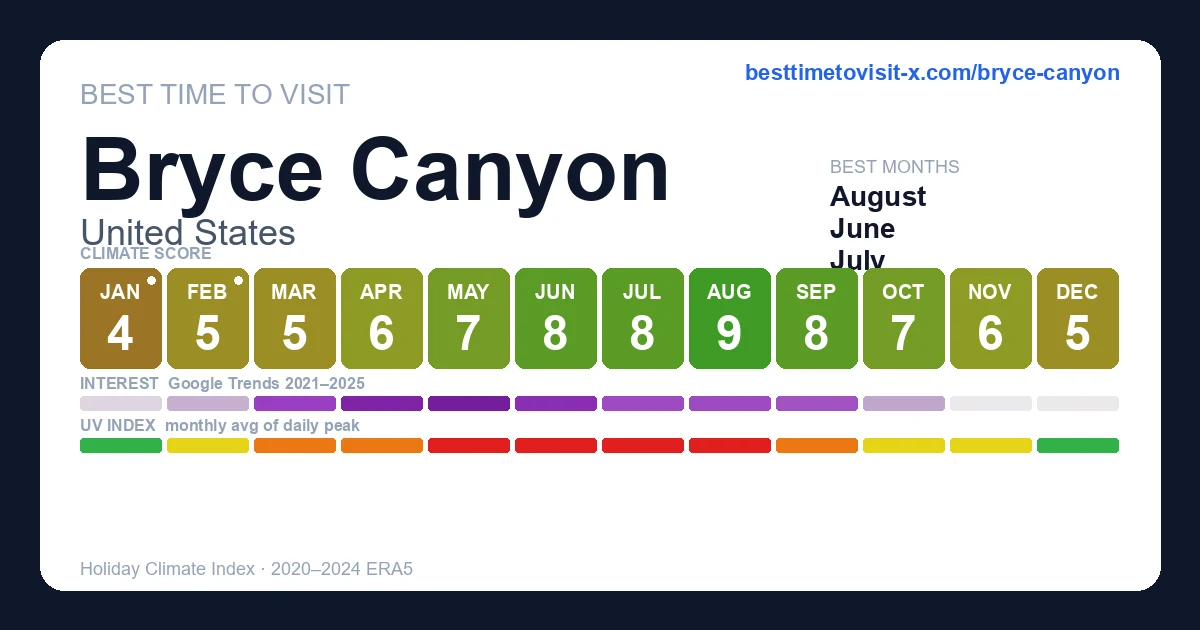
| Month | Temp °C | Feels °C | Rain days | Rain h | Rain h/day | Humidity | Wind km/h | Sun h | UV | Interest | Score |
|---|---|---|---|---|---|---|---|---|---|---|---|
| Jan | -9–-2 | -7 | 6 | 77 | 12.8 | 66% | 21 | 191 | 3 | Quiet | 4 |
| Feb | -9–-1 | -7 | 5 | 67 | 13.4 | 62% | 23 | 201 | 5 | Quiet | 5 |
| Mar | -6–2 | -3 | 9 | 106 | 11.8 | 59% | 22 | 235 | 6 | Busy | 5 |
| Apr | -1–10 | 5 | 4 | 42 | 10.5 | 36% | 24 | 279 | 8 | Peak | 6 |
| May | 5–17 | 12 | 5 | 36 | 7.2 | 23% | 25 | 308 | 9 | Peak | 7 |
| Jun | 11–23 | 19 | 6 | 39 | 6.5 | 20% | 23 | 316 | 10 | Peak | 8 |
| Jul | 15–27 | 23 | 10 | 57 | 5.7 | 25% | 19 | 313 | 11 | Busy | 8 |
| Aug | 13–24 | 21 | 10 | 76 | 7.6 | 32% | 19 | 291 | 10 | Busy | 9 |
| Sep | 10–21 | 17 | 5 | 44 | 8.8 | 27% | 19 | 264 | 8 | Busy | 8 |
| Oct | 4–14 | 9 | 3 | 41 | 13.7 | 34% | 20 | 243 | 6 | Quiet | 7 |
| Nov | -4–5 | 0 | 3 | 38 | 12.7 | 40% | 19 | 208 | 3 | Quiet | 6 |
| Dec | -6–1 | -4 | 5 | 63 | 12.6 | 52% | 18 | 187 | 3 | Quiet | 5 |
UV Index in Bryce Canyon by Month
UV index in Bryce Canyon peaks at 11 (very high) in July, dropping to 3 (low) in December. May, June, July, August reach very high or extreme levels — apply SPF 50+, wear a hat and protective clothing, and limit direct sun between 11:00 and 17:00.
Best months in detail
August
9/1013–24°C (feels 21°C) · 10 rain days (76h) · 291 sun hours · 32% humidity · Busy crowd · UV 10 (very high)
July
8/1015–27°C (feels 23°C) · 10 rain days (57h) · 313 sun hours · 25% humidity · Busy crowd · UV 11 (very high) · sunniest 1 in 10 days reach 13 (extreme)
September
8/1010–21°C (feels 17°C) · 5 rain days (44h) · 264 sun hours · 27% humidity · Busy crowd · UV 8 (high) · sunniest 1 in 10 days reach 9 (very high)
Every month
Show the other 9 months in detail
January
4/10-9–-2°C (feels -7°C) · 6 rain days (77h) · 191 sun hours · 66% humidity · Quiet crowd · UV 3 (low) · sunniest 1 in 10 days reach 4 (moderate)
February
5/10-9–-1°C (feels -7°C) · 5 rain days (67h) · 201 sun hours · 62% humidity · Quiet crowd · UV 5 (moderate)
March
5/10-6–2°C (feels -3°C) · 9 rain days (106h) · 235 sun hours · 59% humidity · Busy crowd · UV 6 (high) · sunniest 1 in 10 days reach 8 (very high)
April
6/10-1–10°C (feels 5°C) · 4 rain days (42h) · 279 sun hours · 36% humidity · Peak crowd · UV 8 (high) · sunniest 1 in 10 days reach 9 (very high)
May
7/105–17°C (feels 12°C) · 5 rain days (36h) · 308 sun hours · 23% humidity · Peak crowd · UV 9 (very high) · sunniest 1 in 10 days reach 10 (very high)
June
8/1011–23°C (feels 19°C) · 6 rain days (39h) · 316 sun hours · 20% humidity · Peak crowd · UV 10 (very high) · sunniest 1 in 10 days reach 12 (extreme)
October
7/104–14°C (feels 9°C) · 3 rain days (41h) · 243 sun hours · 34% humidity · Quiet crowd · UV 6 (moderate) · sunniest 1 in 10 days reach 7 (high)
November
6/10-4–5°C (feels 0°C) · 3 rain days (38h) · 208 sun hours · 40% humidity · Quiet crowd · UV 3 (moderate)
December
5/10-6–1°C (feels -4°C) · 5 rain days (63h) · 187 sun hours · 52% humidity · Quiet crowd · UV 3 (low)
It is not a canyon, and at 2,400 m it is colder than you expect
Bryce catches visitors out because it is grouped with Zion and Moab in the Utah itinerary, and it behaves nothing like them. The visitor centre area sits at about 8,000 feet — roughly 2,400 m — and the park climbs from there: the National Park Service notes that Agua Canyon is nearly 1,000 feet higher again.
That altitude is the whole story. Snow lies here when Zion, some 1,200 m lower and two hours away, is mild. The park stays open through winter and the visitor centre runs year-round, but Sunset Campground closes from November to April, and the Lodge at Bryce Canyon and its dining room shut for the season.
The hoodoos under snow are the park's best-known image, so the cold months are a feature. They simply demand different clothing and different expectations than the same week in Zion.
Sources: NPS — Visiting Bryce Canyon in winter , NPS — Bryce Canyon current conditions
How many days do you need in Bryce Canyon?
One full day is enough for the main amphitheatre — Sunrise, Sunset, Inspiration and Bryce Points, plus a descent on the Navajo Loop and Queen's Garden trail. A second day lets you drive the full scenic road to Rainbow Point and walk a quieter trail away from the amphitheatre.
Which is nicer, Bryce or Zion?
Different experiences. Bryce is a compact rim walk looking down into hoodoos, doable in a day, and much colder at around 2,400 m. Zion is a deep canyon you explore from the floor, with bigger hikes and a mandatory shuttle for most of the year. If you have two days, do both — they are about two hours apart.
What is the rainiest month in Bryce Canyon?
Late summer, when the North American monsoon brings afternoon thunderstorms to the Colorado Plateau — typically July and August. These are short, intense storms rather than all-day rain, but they carry lightning risk on exposed rim viewpoints, so plan hikes for the morning.
Do I need bear spray in Bryce Canyon?
No. Bryce has no grizzly population and black bear sightings are rare; the park does not recommend bear spray for day hiking. The real risks here are altitude and cold — the rim sits at about 2,400 m, January lows average around −12C, and summer afternoon thunderstorms bring lightning to exposed viewpoints. Carry water, sun protection and a warm layer instead.
What is the best time of year to visit Bryce Canyon, Utah?
May to September for comfortable walking, with July warmest at about 26C by day. But the park's signature image — orange hoodoos under fresh snow — belongs to December through March, when the rim is quiet. Either works; they are simply different trips, and the winter one demands serious cold-weather clothing.
Is Bryce Canyon colder than Zion?
Considerably. Bryce sits around 2,400 m against Zion's canyon floor near 1,200 m, and the numbers follow: January lows average about −12C at Bryce against −7C at Zion, with Bryce holding snow far longer. Visitors doing both parks in one trip routinely underpack, because the two are only about two hours apart.
What is the coldest month in Bryce Canyon?
January, with average lows near −12C and frequent snow on the rim. Even summer nights are cool at this elevation, so a light jacket is worth carrying in July. The upside of the cold is the air quality — Bryce is one of the darkest night skies in the United States, and winter nights are exceptionally clear.
Why is it so cold in Bryce Canyon?
Altitude. The visitor centre area sits at about 8,000 feet — roughly 2,400 m — and the National Park Service notes Agua Canyon is nearly 1,000 feet higher again. Air cools by roughly 6.5C per 1,000 m of ascent, so Bryce runs far colder than the southern Utah desert parks despite sharing their latitude.
How many days do you need for Bryce?
One full day covers the main amphitheatre — Sunrise, Sunset, Inspiration and Bryce Points, plus the Navajo Loop and Queen's Garden trail combination down among the hoodoos. A second day lets you drive the full 18-mile scenic road to Rainbow Point and stay out for the night sky, which is among the park's real attractions.
What is the driest month in Bryce Canyon?
June, at about 11 mm, sitting just before the summer monsoon. February is wettest at around 44 mm, falling as snow. July and August bring afternoon thunderstorms that build quickly over the plateau — plan rim walks and hikes for the morning, since the viewpoints are exposed and lightning is the genuine risk.
What not to miss at Bryce Canyon National Park?
Sunrise from Sunrise or Inspiration Point, when low light sets the hoodoos alight, then the Navajo Loop and Queen's Garden combination to walk down among them — the amphitheatre reads completely differently from below. Stay out after dark: Bryce has some of the darkest measured skies in the United States and runs astronomy programmes.
Is it worth just driving through Bryce Canyon?
You would get the rim viewpoints and the 18-mile scenic road to Rainbow Point, which is genuinely worthwhile. But Bryce is a small park whose defining experience is descending into the amphitheatre, and the Navajo Loop takes under two hours. Driving through gets perhaps half of it — less than at parks where the road is the attraction.
What is Bryce Canyon famous for?
Hoodoos — thin spires of rock left by freeze-thaw weathering, which Bryce has in greater concentration than anywhere else on earth. It is not technically a canyon at all but a series of natural amphitheatres eroded into the edge of a plateau. That elevation, around 2,400 m, is why it is far colder than the Utah parks it is usually grouped with.
Frequently asked questions about visiting Bryce Canyon
When is the best time to visit Bryce Canyon?
August is the highest-scoring month (9/10 on the Holiday Climate Index). Typical conditions: 13–24°C (10 rainy days). The top three months by score are August, July, September.
What is the worst time to visit Bryce Canyon?
January is the lowest-scoring month (4/10, capped by extreme cold). Typical conditions: -9–-2°C (6 rainy days).
Is Bryce Canyon too cold in winter?
2 months (January, February) cross our cold deal-breaker (apparent temperature below the cap). Doable with the right gear, but expect the climate score to be held down by the gate.
When are crowds lowest in Bryce Canyon?
Search-interest seasonality (Google Trends 2021-2025) is lowest in November and peaks in May. Interest tracks both in-trip visitors and lead-time planners, so treat it as a "destination is on people's minds" signal rather than literal arrivals.
Which months in Bryce Canyon have good weather but fewer tourists?
October (climate 7/10, crowd index 34) — shoulder months with above-average climate and below-median search-interest. Often the best value-for-weather trade.
What is the UV index in Bryce Canyon by month?
UV peaks at 11 (very high) in July and is lowest in December at 3 (low). Monthly peak values: Jan 3, Feb 5, Mar 6, Apr 8, May 9, Jun 10, Jul 11, Aug 10, Sep 8, Oct 6, Nov 3, Dec 3. May, June, July, August reach very high or extreme levels — apply SPF 50+, wear a hat and protective clothing, and limit direct sun between 11:00 and 17:00.
What is the UV index in Bryce Canyon in July?
July is the peak UV month in Bryce Canyon, with a daily-peak UV index of 11 (very high). At this level, sunburn can occur in under 20 minutes on unprotected fair skin. Apply SPF 50+, wear protective clothing and a hat, and avoid direct midday sun (11:00–17:00).
How high can UV get in Bryce Canyon on the sunniest days?
Most days look like the monthly average, but on the sunniest ~1 in 10 days UV climbs higher than the mean suggests. July is the worst case: typical days average UV 11 (very high), but the top 10% of days reach UV 13 (extreme) — and even higher. Months where the sunniest days routinely exceed the typical reading: January, March, April, May, June, July, September, October. Plan sun protection for the worst case, not the average.