Best time to visit Stowe
Re-score for me — drag the dial — every chart on the page recolours live for your heat limit 27°C
Default 27 °C is the upper edge of the Holiday Climate Index "ideal comfort" band (Scott, Rutty, Amelung & Tang, 2016). Above this, most warm-tourism travellers report measurable discomfort.
Greyed factors are scored normally — extreme heat overrides them, so a clear sky or low rain can't lift the period.
Greyed factors are scored normally — extreme heat overrides them, so a clear sky or low rain can't lift the period.
Greyed factors are scored normally — extreme heat overrides them, so a clear sky or low rain can't lift the period.
Greyed factors are scored normally — extreme heat overrides them, so a clear sky or low rain can't lift the period.
Greyed factors are scored normally — extreme heat overrides them, so a clear sky or low rain can't lift the period.
Greyed factors are scored normally — extreme heat overrides them, so a clear sky or low rain can't lift the period.
Greyed factors are scored normally — extreme heat overrides them, so a clear sky or low rain can't lift the period.
Greyed factors are scored normally — extreme heat overrides them, so a clear sky or low rain can't lift the period.
Greyed factors are scored normally — extreme heat overrides them, so a clear sky or low rain can't lift the period.
Greyed factors are scored normally — extreme heat overrides them, so a clear sky or low rain can't lift the period.
Greyed factors are scored normally — extreme heat overrides them, so a clear sky or low rain can't lift the period.
Greyed factors are scored normally — extreme heat overrides them, so a clear sky or low rain can't lift the period.
Greyed factors are scored normally — extreme heat overrides them, so a clear sky or low rain can't lift the period.
Greyed factors are scored normally — extreme heat overrides them, so a clear sky or low rain can't lift the period.
Greyed factors are scored normally — extreme heat overrides them, so a clear sky or low rain can't lift the period.
Greyed factors are scored normally — extreme heat overrides them, so a clear sky or low rain can't lift the period.
Greyed factors are scored normally — extreme heat overrides them, so a clear sky or low rain can't lift the period.
Greyed factors are scored normally — extreme heat overrides them, so a clear sky or low rain can't lift the period.
Greyed factors are scored normally — extreme heat overrides them, so a clear sky or low rain can't lift the period.
Greyed factors are scored normally — extreme heat overrides them, so a clear sky or low rain can't lift the period.
Greyed factors are scored normally — extreme heat overrides them, so a clear sky or low rain can't lift the period.
Greyed factors are scored normally — extreme heat overrides them, so a clear sky or low rain can't lift the period.
Greyed factors are scored normally — extreme heat overrides them, so a clear sky or low rain can't lift the period.
Greyed factors are scored normally — extreme heat overrides them, so a clear sky or low rain can't lift the period.
Greyed factors are scored normally — extreme heat overrides them, so a clear sky or low rain can't lift the period.
Greyed factors are scored normally — extreme heat overrides them, so a clear sky or low rain can't lift the period.
Greyed factors are scored normally — extreme heat overrides them, so a clear sky or low rain can't lift the period.
Greyed factors are scored normally — extreme heat overrides them, so a clear sky or low rain can't lift the period.
Greyed factors are scored normally — extreme heat overrides them, so a clear sky or low rain can't lift the period.
Greyed factors are scored normally — extreme heat overrides them, so a clear sky or low rain can't lift the period.
Greyed factors are scored normally — extreme heat overrides them, so a clear sky or low rain can't lift the period.
Greyed factors are scored normally — extreme heat overrides them, so a clear sky or low rain can't lift the period.
Greyed factors are scored normally — extreme heat overrides them, so a clear sky or low rain can't lift the period.
Greyed factors are scored normally — extreme heat overrides them, so a clear sky or low rain can't lift the period.
Greyed factors are scored normally — extreme heat overrides them, so a clear sky or low rain can't lift the period.
Greyed factors are scored normally — extreme heat overrides them, so a clear sky or low rain can't lift the period.
Greyed factors are scored normally — extreme heat overrides them, so a clear sky or low rain can't lift the period.
Greyed factors are scored normally — extreme heat overrides them, so a clear sky or low rain can't lift the period.
Greyed factors are scored normally — extreme heat overrides them, so a clear sky or low rain can't lift the period.
Greyed factors are scored normally — extreme heat overrides them, so a clear sky or low rain can't lift the period.
Greyed factors are scored normally — extreme heat overrides them, so a clear sky or low rain can't lift the period.
Greyed factors are scored normally — extreme heat overrides them, so a clear sky or low rain can't lift the period.
Greyed factors are scored normally — extreme heat overrides them, so a clear sky or low rain can't lift the period.
Greyed factors are scored normally — extreme heat overrides them, so a clear sky or low rain can't lift the period.
How is this scored? HCI / Steadman / CCI gate — full methodology and citations below.
Compare with another destination
Add as many as you like — stacked below the main strips above. Each row is just the recent-window score strip and (for beach destinations) sea-temperature strip.
Tours in Stowe
3 top-rated tours via Viator. Booking links earn this site a commission at no cost to you. Map locations are approximate (centred on Stowe).
- 1
 Small Group Tour in Montpelier & Mad River Valley, Vermont
 - 2
 Small Group Tour in Stowe, Vermont
 - 3
 Nutty Northfield Scavenger Hunt
Last refreshed 2026-06-14.
Similar climatesZakopane87% · Tatranská Lomnica87% · Zell am See84%
Other destinations with the most-alike year-round climate to Stowe (apparent temperature, rain hours, sunshine — matched within the same trip-profile). The ±N chip compares each match's typical score for the current month against Stowe's. Based on the 2020-2024 climatology, not this year's actual weather.
Month-by-month
| Month | Temp °C | Feels °C | Rain days | Rain h | Rain h/day | Humidity | Wind km/h | Sun h | UV | Interest | Score |
|---|---|---|---|---|---|---|---|---|---|---|---|
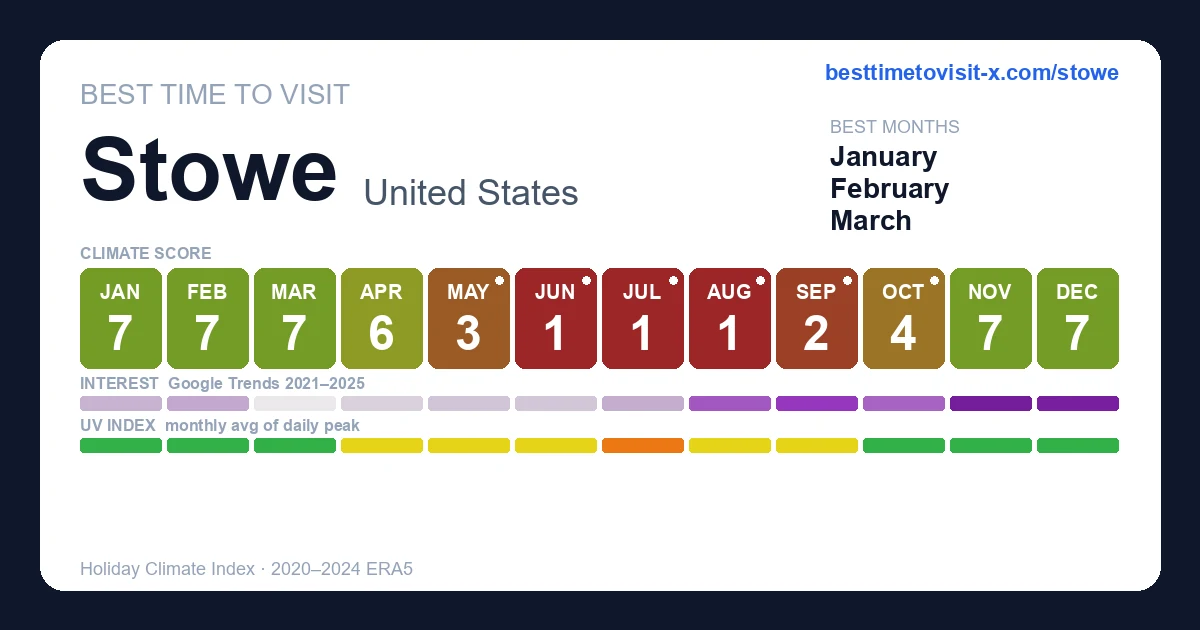
| Jan | -11–-2 | -6 | 14 | 208 | 14.9 | 72% | 13 | 95 | 1 | Busy | 7 |
| Feb | -12–0 | -5 | 13 | 171 | 13.2 | 64% | 15 | 127 | 2 | Busy | 7 |
| Mar | -6–5 | 1 | 14 | 182 | 13.0 | 60% | 16 | 158 | 3 | Quiet | 7 |
| Apr | 1–11 | 8 | 13 | 185 | 14.2 | 56% | 16 | 171 | 4 | Quiet | 6 |
| May | 8–19 | 17 | 11 | 126 | 11.5 | 52% | 14 | 247 | 5 | Quiet | 3 |
| Jun | 13–24 | 24 | 14 | 179 | 12.8 | 59% | 13 | 234 | 5 | Quiet | 1 |
| Jul | 16–26 | 28 | 17 | 202 | 11.9 | 65% | 12 | 256 | 6 | Quiet | 1 |
| Aug | 15–25 | 26 | 16 | 181 | 11.3 | 67% | 12 | 240 | 5 | Moderate | 1 |
| Sep | 11–21 | 21 | 9 | 119 | 13.2 | 67% | 13 | 203 | 4 | Moderate | 2 |
| Oct | 6–15 | 13 | 12 | 169 | 14.1 | 69% | 13 | 151 | 3 | Busy | 4 |
| Nov | -2–7 | 4 | 14 | 156 | 11.1 | 66% | 15 | 123 | 1 | Moderate | 7 |
| Dec | -7–2 | -2 | 15 | 203 | 13.5 | 72% | 14 | 91 | 1 | Peak | 7 |
UV Index in Stowe by Month
UV index in Stowe peaks at 6 (high) in July, dropping to 1 (low) in December. July have high UV — SPF 30+ and sunglasses recommended.
Best months in detail
February
7/10-12–0°C (feels -5°C) · 13 rain days (171h) · 127 sun hours · 64% humidity · Busy crowd · UV 2 (low)
November
7/10-2–7°C (feels 4°C) · 14 rain days (156h) · 123 sun hours · 66% humidity · Moderate crowd · UV 1 (low)
March
7/10-6–5°C (feels 1°C) · 14 rain days (182h) · 158 sun hours · 60% humidity · Quiet crowd · UV 3 (low) · sunniest 1 in 10 days reach 4 (moderate)
Every month
Show the other 9 months in detail
January
7/10-11–-2°C (feels -6°C) · 14 rain days (208h) · 95 sun hours · 72% humidity · Busy crowd · UV 1 (low)
April
6/101–11°C (feels 8°C) · 13 rain days (185h) · 171 sun hours · 56% humidity · Quiet crowd · UV 4 (moderate) · sunniest 1 in 10 days reach 6 (high)
May
3/108–19°C (feels 17°C) · 11 rain days (126h) · 247 sun hours · 52% humidity · Quiet crowd · UV 5 (moderate) · sunniest 1 in 10 days reach 7 (high)
June
1/1013–24°C · 14 rain days (179h) · 234 sun hours · 59% humidity · Quiet crowd · UV 5 (moderate) · sunniest 1 in 10 days reach 8 (high)
July
1/1016–26°C (feels 28°C) · 17 rain days (202h) · 256 sun hours · 65% humidity · Quiet crowd · UV 6 (high) · sunniest 1 in 10 days reach 8 (high)
August
1/1015–25°C (feels 26°C) · 16 rain days (181h) · 240 sun hours · 67% humidity · Moderate crowd · UV 5 (moderate) · sunniest 1 in 10 days reach 7 (high)
September
2/1011–21°C · 9 rain days (119h) · 203 sun hours · 67% humidity · Moderate crowd · UV 4 (moderate) · sunniest 1 in 10 days reach 6 (moderate)
October
4/106–15°C (feels 13°C) · 12 rain days (169h) · 151 sun hours · 69% humidity · Busy crowd · UV 3 (low) · sunniest 1 in 10 days reach 4 (moderate)
December
7/10-7–2°C (feels -2°C) · 15 rain days (203h) · 91 sun hours · 72% humidity · Peak crowd · UV 1 (low)
Vermont shuts its highest peak from April 15 to Memorial Day
Vermont's Department of Forests, Parks and Recreation defines mud season as the roughly six-week period between snowmelt and Memorial Day, when saturated soils are easily damaged and some trails are closed by the land manager. The state's hiking guidance names the peaks it applies to first: Camel's Hump and Mount Mansfield trails are closed from April 15 through the Friday of Memorial Day weekend, with standing advice to stay below 3,000 feet through April and May.
That is one seasonal closure with a fixed end date, not a rolling weekly ban. What is reissued weekly is the status of everything else: the department points hikers to Trail Finder, where each trail carries an open, caution or closed flag refreshed on Fridays as the melt moves uphill. Mansfield's summit ridge holds rare alpine tundra, which is why its dates are fixed in advance.
The other Vermont rule is older, and narrower than it is usually described. 10 V.S.A. § 488 reads: "No person may erect or maintain outdoor advertising visible to the travelling public except as provided in this chapter." It was added by Act 333 of the 1967 adjourned session and took effect on 23 March 1968. It sits inside a chapter titled Tourist Information Services: the state did not simply delete billboards, it substituted its own official directional signs. On-premises signs of up to 150 square feet remain legal, so what Vermont banned is off-premises advertising, not signage.
Sources: Vermont Department of Forests, Parks and Recreation — Mud Season , 10 V.S.A. § 488 — Prohibition of other outdoor advertising
What is mud season in Vermont?
The Department of Forests, Parks and Recreation defines it as the roughly six-week period between snowmelt and Memorial Day, when meltwater and lingering ice leave soils saturated and trails easily damaged. Its start moves with the melt each year, usually the second half of March or early April, so it is never a fixed calendar window.
Are Vermont hiking trails closed in spring?
At elevation, yes. Camel's Hump and Mount Mansfield trails are closed from April 15 through the Friday of Memorial Day weekend, and hikers are asked to stay below 3,000 feet during April and May. Lower trails are judged individually and flagged open, caution or closed, with the status refreshed each Friday.
Does Vermont have billboards?
Not off-premises ones. 10 V.S.A. § 488 states that no person may erect or maintain outdoor advertising visible to the travelling public except as the chapter allows; it took effect on 23 March 1968. On-premises signs of up to 150 square feet are still permitted, so inns and shops can sign themselves — roadside advertising is what is gone.
When is peak foliage in Stowe?
Typically the last week of September and the first or second week of October, according to Vermont's state tourism board. Colour starts earlier at higher elevations and in the north, moving down into the valleys and south as September ends. Leaves can persist into late October in a mild year.
What is the best time to visit Stowe?
Late September into mid-October for foliage, which is peak season and priced accordingly; January to March for skiing, with the resort averaging around 224 inches of snow a year; and June to August for hiking, once the high trails reopen on the Saturday of Memorial Day weekend. April and early May are the months to avoid.
How high is Mount Mansfield?
Roughly 4,400 feet, making it Vermont's highest peak. Its summit ridge carries rare alpine tundra, which is part of why the spring closure is fixed in advance — the vegetation is fragile and slow to recover from foot traffic on saturated ground. The state asks hikers to stay below 3,000 feet during April and May.
How many days do you need in Stowe?
Three. One for the village and the Stowe Recreation Path, one for the mountain — hiking, the gondola or skiing depending on season — and one for Smugglers' Notch, the Ben & Jerry's factory or a drive through the surrounding hills. Foliage weekends need booking months ahead.
What is the Long Trail?
A footpath running the length of Vermont along the Green Mountains, established in 1910 and billed as the oldest long-distance hiking trail in the United States. It is maintained by the Green Mountain Club. Its higher sections, including the Mansfield ridge, are exactly what the spring closure takes offline.
Is Stowe good for skiing?
Yes — Stowe Mountain Resort has a summit of 3,719 feet and a 2,360-foot vertical drop, with average annual snowfall around 224 inches, which is high for the eastern United States. Ski operations were acquired by Vail Resorts in February 2017, so it sits within that pass ecosystem.
When is Stowe least crowded?
Late April through May, though that is because the high trails are closed and there is genuinely less to do. Early December before the ski season fills, and the first half of September before foliage, are the better quiet windows with everything still open.
Frequently asked questions about visiting Stowe
When is the best time to visit Stowe?
February is the highest-scoring month (7/10 on the Holiday Climate Index). Typical conditions: -12–0°C (13 rainy days). The top three months by score are February, November, March.
What is the worst time to visit Stowe?
July is the lowest-scoring month (1/10, capped by extreme heat). Typical conditions: 16–26°C (17 rainy days).
Is Stowe too hot in summer?
6 months (May, June, July, August, September, October) trip the heat deal-breaker in our scoring: apparent temperature crosses the comfort cap, so even with clear skies and low rain the score is held down. Plan around it if heat tolerance is low.
When are crowds lowest in Stowe?
Search-interest seasonality (Google Trends 2021-2025) is lowest in April and peaks in December. Interest tracks both in-trip visitors and lead-time planners, so treat it as a "destination is on people's minds" signal rather than literal arrivals.
Which months in Stowe have good weather but fewer tourists?
March (climate 7/10, crowd index 38) and April (climate 6/10, crowd index 0) — shoulder months with above-average climate and below-median search-interest. Often the best value-for-weather trade.
What is the UV index in Stowe by month?
UV peaks at 6 (high) in July and is lowest in December at 1 (low). Monthly peak values: Jan 1, Feb 2, Mar 3, Apr 4, May 5, Jun 5, Jul 6, Aug 5, Sep 4, Oct 3, Nov 1, Dec 1.
What is the UV index in Stowe in July?
July is the peak UV month in Stowe, with a daily-peak UV index of 6 (high). Apply SPF 30+, wear sunglasses, and seek shade during midday hours.
How high can UV get in Stowe on the sunniest days?
Most days look like the monthly average, but on the sunniest ~1 in 10 days UV climbs higher than the mean suggests. June is the worst case: typical days average UV 5 (moderate), but the top 10% of days reach UV 8 (high) — and even higher. Months where the sunniest days routinely exceed the typical reading: March, April, May, June, July, August, September, October. Plan sun protection for the worst case, not the average.
Is air quality in Stowe bad for travelers?
PM2.5 (fine-particle pollution) exceeds the WHO sensitive-group guideline (15 µg/m³) in 3 months: June, July, August. The worst month is June with a typical-day mean of 12 µg/m³ (moderate); on the worst 10% of days PM2.5 reaches 20 µg/m³ (unhealthy for sensitive) and higher. People with asthma, heart conditions, or sensitive children may want to avoid these months or limit outdoor activity. Source: CAMS via Open-Meteo.