Best time to visit Bohinj
Re-score for me — drag the dial — every chart on the page recolours live for your heat limit 27°C
Default 27 °C is the upper edge of the Holiday Climate Index "ideal comfort" band (Scott, Rutty, Amelung & Tang, 2016). Above this, most warm-tourism travellers report measurable discomfort.
Greyed factors are scored normally — extreme heat overrides them, so a clear sky or low rain can't lift the period.
Greyed factors are scored normally — extreme heat overrides them, so a clear sky or low rain can't lift the period.
Greyed factors are scored normally — extreme heat overrides them, so a clear sky or low rain can't lift the period.
Greyed factors are scored normally — extreme heat overrides them, so a clear sky or low rain can't lift the period.
Greyed factors are scored normally — extreme heat overrides them, so a clear sky or low rain can't lift the period.
Greyed factors are scored normally — extreme heat overrides them, so a clear sky or low rain can't lift the period.
Greyed factors are scored normally — extreme heat overrides them, so a clear sky or low rain can't lift the period.
Greyed factors are scored normally — extreme heat overrides them, so a clear sky or low rain can't lift the period.
Greyed factors are scored normally — extreme heat overrides them, so a clear sky or low rain can't lift the period.
Greyed factors are scored normally — extreme heat overrides them, so a clear sky or low rain can't lift the period.
Greyed factors are scored normally — extreme heat overrides them, so a clear sky or low rain can't lift the period.
Greyed factors are scored normally — extreme heat overrides them, so a clear sky or low rain can't lift the period.
Greyed factors are scored normally — extreme heat overrides them, so a clear sky or low rain can't lift the period.
Greyed factors are scored normally — extreme heat overrides them, so a clear sky or low rain can't lift the period.
Greyed factors are scored normally — extreme heat overrides them, so a clear sky or low rain can't lift the period.
Greyed factors are scored normally — extreme heat overrides them, so a clear sky or low rain can't lift the period.
Greyed factors are scored normally — extreme heat overrides them, so a clear sky or low rain can't lift the period.
Greyed factors are scored normally — extreme heat overrides them, so a clear sky or low rain can't lift the period.
Greyed factors are scored normally — extreme heat overrides them, so a clear sky or low rain can't lift the period.
Greyed factors are scored normally — extreme heat overrides them, so a clear sky or low rain can't lift the period.
Greyed factors are scored normally — extreme heat overrides them, so a clear sky or low rain can't lift the period.
Greyed factors are scored normally — extreme heat overrides them, so a clear sky or low rain can't lift the period.
Greyed factors are scored normally — extreme heat overrides them, so a clear sky or low rain can't lift the period.
Greyed factors are scored normally — extreme heat overrides them, so a clear sky or low rain can't lift the period.
Greyed factors are scored normally — extreme heat overrides them, so a clear sky or low rain can't lift the period.
Greyed factors are scored normally — extreme heat overrides them, so a clear sky or low rain can't lift the period.
Greyed factors are scored normally — extreme heat overrides them, so a clear sky or low rain can't lift the period.
Greyed factors are scored normally — extreme heat overrides them, so a clear sky or low rain can't lift the period.
Greyed factors are scored normally — extreme heat overrides them, so a clear sky or low rain can't lift the period.
Greyed factors are scored normally — extreme heat overrides them, so a clear sky or low rain can't lift the period.
Greyed factors are scored normally — extreme heat overrides them, so a clear sky or low rain can't lift the period.
Greyed factors are scored normally — extreme heat overrides them, so a clear sky or low rain can't lift the period.
Greyed factors are scored normally — extreme heat overrides them, so a clear sky or low rain can't lift the period.
Greyed factors are scored normally — extreme heat overrides them, so a clear sky or low rain can't lift the period.
Greyed factors are scored normally — extreme heat overrides them, so a clear sky or low rain can't lift the period.
Greyed factors are scored normally — extreme heat overrides them, so a clear sky or low rain can't lift the period.
Greyed factors are scored normally — extreme heat overrides them, so a clear sky or low rain can't lift the period.
Greyed factors are scored normally — extreme heat overrides them, so a clear sky or low rain can't lift the period.
Greyed factors are scored normally — extreme heat overrides them, so a clear sky or low rain can't lift the period.
Greyed factors are scored normally — extreme heat overrides them, so a clear sky or low rain can't lift the period.
Greyed factors are scored normally — extreme heat overrides them, so a clear sky or low rain can't lift the period.
Greyed factors are scored normally — extreme heat overrides them, so a clear sky or low rain can't lift the period.
Greyed factors are scored normally — extreme heat overrides them, so a clear sky or low rain can't lift the period.
Greyed factors are scored normally — extreme heat overrides them, so a clear sky or low rain can't lift the period.
Greyed factors are scored normally — extreme heat overrides them, so a clear sky or low rain can't lift the period.
Greyed factors are scored normally — extreme heat overrides them, so a clear sky or low rain can't lift the period.
Greyed factors are scored normally — extreme heat overrides them, so a clear sky or low rain can't lift the period.
Greyed factors are scored normally — extreme heat overrides them, so a clear sky or low rain can't lift the period.
Greyed factors are scored normally — extreme heat overrides them, so a clear sky or low rain can't lift the period.
Greyed factors are scored normally — extreme heat overrides them, so a clear sky or low rain can't lift the period.
How is this scored? HCI / Steadman / CCI gate — full methodology and citations below.
Compare with another destination
Add as many as you like — stacked below the main strips above. Each row is just the recent-window score strip and (for beach destinations) sea-temperature strip.
Tours in Bohinj
24 top-rated tours via Viator. Booking links earn this site a commission at no cost to you.
- 1
 Lake Bled and Bohinj with Savica waterfall included
 - 2
 A day in Alpine Slovenia: Lakes Bled, Bohinj & Vintgar Gorge
 - 3
 From Bled: Triglav National Park Tour
 - 4
 Canyoning Bled Slovenia Triglav National Park Tour + Free Photos
 - 5
 8-Hour Lake Bled, Lake Bohinj and Waterfall Savica Tour
 - 6
 Canyoning Lake Bled Slovenia - Free Photos and Videos
 - 7
 7 Alpine Wonders: Winter Edition
 - 8
 Scenic train, Emerald River, Triglav National Park & Soča valley
 - 9
 Bled and Bohinj Valley Canyoning with Hotel Pickup & Free Photos
 - 10
 Bled & Bohinj lakes with Skofja Loka | Private trip from Ljubljana
 - 11
 Private Biking Tour in Bohinj Valley
 - 12
 From Ljubljana: Triglav National Park Tour (Private)
 - 13
 Tandem Paragliding Flight Above Lake Bohinj in Julian Alps
 - 14
 Small Group Guided Kayaking Tour on Lake Bohinj
 - 15
 Lake Bled & Lake Bohinj & Vintgar Gorge Tour from Ljubljana
 - 16
 Bled to Lake Bohinj Trip
 - 17
 3-Day Private Trekking Adventure from Bohinj to Soča Valley
 - 18
 Bled & Bohinj Lake Trip
 - 19
 Magic of Alps, Triglav NP with Lake Bohinj & Waterfall Savica, HD Trip from Ljub
 - 20
 Private Bohinj & Vogel Tour from Bled
 - 21
 Lake Bled, Bohinj & Triglav National Park – Private Alpine Tour
 - 22
 From Vienna to Dubrovnik via Slovenia in 13 days. Private tour in modern A/C van
 - 23Private Bled & Bohinj Tour from Ljubljana
- 24
 Bled & Bohinj Lakes,Alpine Fairytale with Triglav National Park panoramic drives
Last refreshed 2026-08-13.
Similar climatesBled95% · Innsbruck91% · Zell am See90%
Other destinations with the most-alike year-round climate to Bohinj (apparent temperature, rain hours, sunshine — matched within the same trip-profile). The ±N chip compares each match's typical score for the current month against Bohinj's. Based on the 2020-2024 climatology, not this year's actual weather.
Month-by-month
| Month | Temp °C | Feels °C | Rain days | Rain h | Rain h/day | Humidity | Wind km/h | Sun h | UV | Interest | Score |
|---|---|---|---|---|---|---|---|---|---|---|---|
| Jan | -1–6 | 2 | 10 | 147 | 14.7 | 73% | 11 | 130 | 1 | Quiet | 8 |
| Feb | 1–8 | 5 | 9 | 147 | 16.3 | 73% | 12 | 140 | 2 | Quiet | 8 |
| Mar | 1–10 | 7 | 12 | 175 | 14.6 | 64% | 12 | 192 | 3 | Quiet | 7 |
| Apr | 4–13 | 11 | 12 | 170 | 14.2 | 63% | 13 | 211 | 4 | Quiet | 5 |
| May | 9–17 | 17 | 20 | 262 | 13.1 | 71% | 12 | 224 | 4 | Quiet | 1 |
| Jun | 14–23 | 24 | 16 | 183 | 11.4 | 66% | 12 | 275 | 6 | Moderate | 1 |
| Jul | 16–25 | 27 | 15 | 147 | 9.8 | 63% | 11 | 299 | 6 | Peak | 1 |
| Aug | 16–25 | 27 | 15 | 164 | 10.9 | 65% | 11 | 264 | 6 | Peak | 1 |
| Sep | 12–20 | 20 | 13 | 185 | 14.2 | 70% | 11 | 214 | 4 | Quiet | 2 |
| Oct | 9–16 | 15 | 14 | 228 | 16.3 | 79% | 12 | 157 | 2 | Quiet | 2 |
| Nov | 3–10 | 8 | 11 | 139 | 12.6 | 77% | 11 | 136 | 1 | Quiet | 7 |
| Dec | 0–6 | 3 | 12 | 185 | 15.4 | 82% | 10 | 91 | 1 | Quiet | 7 |
UV Index in Bohinj by Month
UV index in Bohinj peaks at 6 (high) in July, dropping to 1 (low) in January. July have high UV — SPF 30+ and sunglasses recommended.
Best months in detail
January
8/10-1–6°C (feels 2°C) · 10 rain days (147h) · 130 sun hours · 73% humidity · Quiet crowd · UV 1 (low)
February
8/101–8°C (feels 5°C) · 9 rain days (147h) · 140 sun hours · 73% humidity · Quiet crowd · UV 2 (low)
November
7/103–10°C (feels 8°C) · 11 rain days (139h) · 136 sun hours · 77% humidity · Quiet crowd · UV 1 (low)
Every month
Show the other 9 months in detail
March
7/101–10°C (feels 7°C) · 12 rain days (175h) · 192 sun hours · 64% humidity · Quiet crowd · UV 3 (low) · sunniest 1 in 10 days reach 4 (moderate)
April
5/104–13°C (feels 11°C) · 12 rain days (170h) · 211 sun hours · 63% humidity · Quiet crowd · UV 4 (moderate) · sunniest 1 in 10 days reach 6 (moderate)
May
1/109–17°C · 20 rain days (262h) · 224 sun hours · 71% humidity · Quiet crowd · UV 4 (moderate) · sunniest 1 in 10 days reach 6 (high)
June
1/1014–23°C · 16 rain days (183h) · 275 sun hours · 66% humidity · Moderate crowd · UV 6 (moderate) · sunniest 1 in 10 days reach 8 (high)
July
1/1016–25°C (feels 27°C) · 15 rain days (147h) · 299 sun hours · 63% humidity · Peak crowd · UV 6 (high) · sunniest 1 in 10 days reach 8 (very high)
August
1/1016–25°C (feels 27°C) · 15 rain days (164h) · 264 sun hours · 65% humidity · Peak crowd · UV 6 (moderate) · sunniest 1 in 10 days reach 8 (high)
September
2/1012–20°C · 13 rain days (185h) · 214 sun hours · 70% humidity · Quiet crowd · UV 4 (moderate) · sunniest 1 in 10 days reach 6 (moderate)
October
2/109–16°C · 14 rain days (228h) · 157 sun hours · 79% humidity · Quiet crowd · UV 2 (low) · sunniest 1 in 10 days reach 3 (moderate)
December
7/100–6°C (feels 3°C) · 12 rain days (185h) · 91 sun hours · 82% humidity · Quiet crowd · UV 1 (low)
A law change reset who may charge you to see Savica
For part of 2026 Slovenia's most photographed waterfall was free, and not by design. The December 2025 amendment to the Nature Conservation Act removed the legal basis under which the Bohinj tourist society had charged for entry to Savica for some seventy years. Under the new rules only a protected-area manager or a contracted caretaker may take money at a natural feature. None existed for Savica, so the gate simply stopped selling tickets in the spring.
The gap closed on 24 July 2026, when Triglav National Park, the Turizem Bohinj institute and the municipality signed the first caretaker contract of its kind in the park. From 1 August 2026 entry costs 4 EUR from the age of 16, is free for children up to and including 15, and free for everyone on the first Sunday of the month. The entry point also keeps hours of its own: 08:00 to 19:00 in August and September, 09:00 to 17:00 in October, 09:00 to 16:00 in November and December, and it closes in heavy rain, storm, snowfall, black ice, high water or rockfall risk.
The valley below is managed by pricing rather than prohibition. There is no car ban at the lake and no compulsory shuttle, but motorhomes, campervans and caravans are barred from the state road between the Ukanc junction and the Savica car park from 1 July to 31 August, parking is legal only in marked bays, and eight seasonal bus lines run on a flat 2 EUR 24-hour ticket.
Sources: Triglav National Park - new visitor management at the Savica waterfall , Promet Bohinj - parking and traffic regime, Municipality of Bohinj
What is the best time to visit Bohinj?
Late June or September. Search interest hits 100 in July and 99 in August but only 51 in June and 32 in September, so the shoulder weeks are genuinely quieter. Rainfall works against autumn, though: the 1991-2020 record puts September at 167 mm, October at 169 mm and November at 172 mm, against 145 mm in July.
Do you have to pay to see the Savica waterfall?
Yes, again, since 1 August 2026. Entry is 4 EUR from the age of 16 and free for children up to and including 15. Everyone gets in free on the first Sunday of each month, and the Julian Alps Bohinj card includes the fee. Holders of the EU disability card and licensed guides with organised groups also go free.
What time does the Savica entry point close?
It shuts at 19:00 in August and September, 17:00 in October, and 16:00 in November and December, opening at 08:00 in late summer and 09:00 from October. It also closes without notice in heavy rain, storms, snowfall, black ice, high water, or when there is a landslide or rockfall risk on the path.
Why was the Savica waterfall free earlier in 2026?
The December 2025 amendment to Slovenia's Nature Conservation Act abolished the legal basis under which the Bohinj tourist society had collected entrance money for around seventy years. Only a protected-area manager or a contracted caretaker may charge now, and no caretaker had been appointed, so entry lapsed until the contract was signed on 24 July 2026.
Is the Vogel cable car running?
Not this autumn. The operator's notice on vogel.si states that Vogel is out of service from 21 September 2026 until roughly the end of November for major work on the aerial tramway. When it does run in summer the cable car works 08:00 to 18:00, the Orlove glave chairlift 09:00 to 16:00 and the Zadnji Vogel gondola 09:00 to 15:00.
Can you drive to Lake Bohinj, or is the road closed?
You can drive. There is no seasonal closure of the lake road to cars and no compulsory shuttle, but parking is permitted only in marked bays and most lots are metered. The one dated vehicle ban is on motorhomes, campervans and caravans, which may not use the state road from the Ukanc junction to the Savica car park between 1 July and 31 August.
How do the Bohinj summer buses work?
Eight seasonal lines run under the Za cvetoci Bohinj marking on a flat Bohinj 24h ticket costing 2 EUR from first activation. Lines 1 and 2 serve the lake from 25 June to 31 August, line 3 runs weekends in June and September, and line 6 climbs to Pokljuka from 25 June to 13 September. Lines 7 and 8 are on demand.
Where can you park in Bohinj for several days?
Free multi-day car parking is at P23 Kobla in Bohinjska Bistrica and P32 Nomenj, with cheap multi-day space at P14 Senozeta in Srednja vas. Those, plus P13, are the four lots with an organised shuttle in summer. Sleeping in a campervan is allowed only at the campsites, at P23 for up to 12 hours and at P14 for up to 24.
How long is the walk to the Savica waterfall?
Short but steep from the car park below the falls, on a well-built path with a great many steps, so it is not passable with a pram or a wheelchair. Reaching the car park on foot takes about an hour from Hotel Zlatorog in Ukanc, or roughly two and a half hours from Ribcev Laz. Swimming in the pool is prohibited.
How many days do you need in Bohinj?
Three, if you want the valley rather than the postcard. One for the lake circuit and Ribcev Laz, one for Savica and the Vogel ridge, and one for the Mostnica gorge and the Voje valley behind Stara Fuzina. Note that the Voje-Vogar-Blato forest road is tolled separately and is not covered by the Julian Alps Bohinj card.
Frequently asked questions about visiting Bohinj
When is the best time to visit Bohinj?
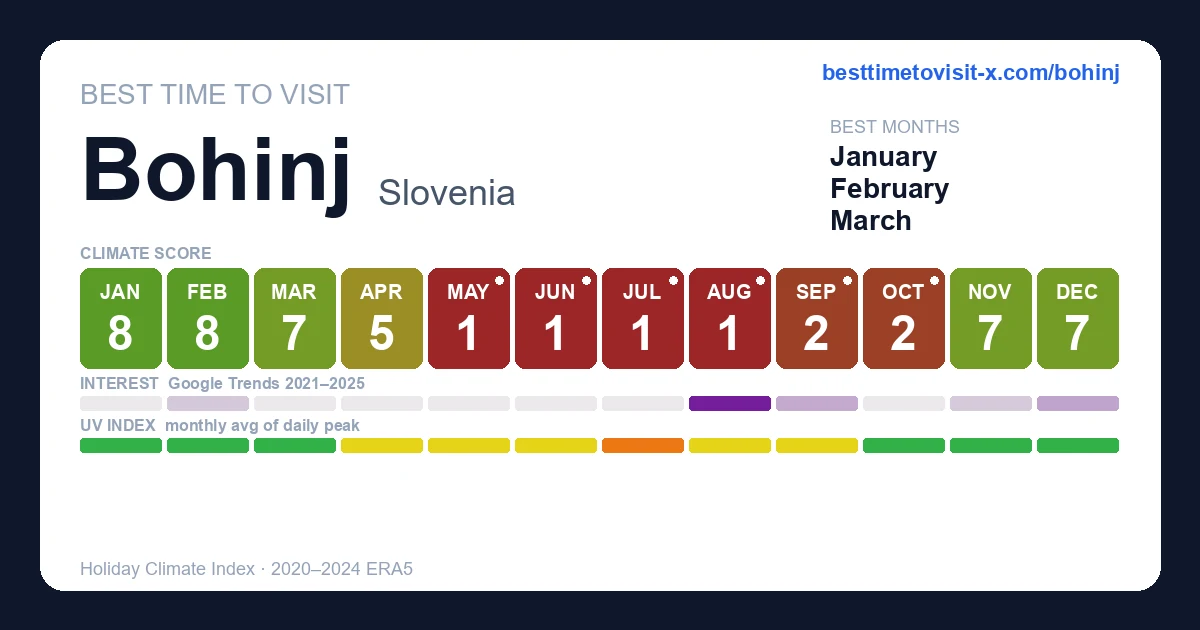
January is the highest-scoring month (8/10 on the Holiday Climate Index). Typical conditions: -1–6°C (10 rainy days). The top three months by score are January, February, November.
What is the worst time to visit Bohinj?
June is the lowest-scoring month (1/10, capped by extreme heat). Typical conditions: 14–23°C (16 rainy days).
Is Bohinj too hot in summer?
6 months (May, June, July, August, September, October) trip the heat deal-breaker in our scoring: apparent temperature crosses the comfort cap, so even with clear skies and low rain the score is held down. Plan around it if heat tolerance is low.
When are crowds lowest in Bohinj?
Search-interest seasonality (Google Trends 2021-2025) is lowest in March and peaks in July. Interest tracks both in-trip visitors and lead-time planners, so treat it as a "destination is on people's minds" signal rather than literal arrivals.
Which months in Bohinj have good weather but fewer tourists?
January (climate 8/10, crowd index 5) and February (climate 8/10, crowd index 5) — shoulder months with above-average climate and below-median search-interest. Often the best value-for-weather trade.
What is the UV index in Bohinj by month?
UV peaks at 6 (high) in July and is lowest in January at 1 (low). Monthly peak values: Jan 1, Feb 2, Mar 3, Apr 4, May 4, Jun 6, Jul 6, Aug 6, Sep 4, Oct 2, Nov 1, Dec 1.
What is the UV index in Bohinj in July?
July is the peak UV month in Bohinj, with a daily-peak UV index of 6 (high). Apply SPF 30+, wear sunglasses, and seek shade during midday hours.
How high can UV get in Bohinj on the sunniest days?
Most days look like the monthly average, but on the sunniest ~1 in 10 days UV climbs higher than the mean suggests. July is the worst case: typical days average UV 6 (high), but the top 10% of days reach UV 8 (very high) — and even higher. Months where the sunniest days routinely exceed the typical reading: March, April, May, June, July, August, September, October. Plan sun protection for the worst case, not the average.
Is air quality in Bohinj bad for travelers?
PM2.5 (fine-particle pollution) exceeds the WHO sensitive-group guideline (15 µg/m³) in 2 months: February, March. The worst month is February with a typical-day mean of 10 µg/m³ (fair); on the worst 10% of days PM2.5 reaches 19 µg/m³ (unhealthy for sensitive) and higher. People with asthma, heart conditions, or sensitive children may want to avoid these months or limit outdoor activity. Source: CAMS via Open-Meteo.