Best time to visit Gstaad
Re-score for me — drag the dial — every chart on the page recolours live for your heat limit 27°C
Default 27 °C is the upper edge of the Holiday Climate Index "ideal comfort" band (Scott, Rutty, Amelung & Tang, 2016). Above this, most warm-tourism travellers report measurable discomfort.
Greyed factors are scored normally — extreme heat overrides them, so a clear sky or low rain can't lift the period.
Greyed factors are scored normally — extreme heat overrides them, so a clear sky or low rain can't lift the period.
Greyed factors are scored normally — extreme heat overrides them, so a clear sky or low rain can't lift the period.
Greyed factors are scored normally — extreme heat overrides them, so a clear sky or low rain can't lift the period.
Greyed factors are scored normally — extreme heat overrides them, so a clear sky or low rain can't lift the period.
Greyed factors are scored normally — extreme heat overrides them, so a clear sky or low rain can't lift the period.
Greyed factors are scored normally — extreme heat overrides them, so a clear sky or low rain can't lift the period.
Greyed factors are scored normally — extreme heat overrides them, so a clear sky or low rain can't lift the period.
Greyed factors are scored normally — extreme heat overrides them, so a clear sky or low rain can't lift the period.
Greyed factors are scored normally — extreme heat overrides them, so a clear sky or low rain can't lift the period.
Greyed factors are scored normally — extreme heat overrides them, so a clear sky or low rain can't lift the period.
Greyed factors are scored normally — extreme heat overrides them, so a clear sky or low rain can't lift the period.
Greyed factors are scored normally — extreme heat overrides them, so a clear sky or low rain can't lift the period.
Greyed factors are scored normally — extreme heat overrides them, so a clear sky or low rain can't lift the period.
Greyed factors are scored normally — extreme heat overrides them, so a clear sky or low rain can't lift the period.
Greyed factors are scored normally — extreme heat overrides them, so a clear sky or low rain can't lift the period.
Greyed factors are scored normally — extreme heat overrides them, so a clear sky or low rain can't lift the period.
Greyed factors are scored normally — extreme heat overrides them, so a clear sky or low rain can't lift the period.
Greyed factors are scored normally — extreme heat overrides them, so a clear sky or low rain can't lift the period.
Greyed factors are scored normally — extreme heat overrides them, so a clear sky or low rain can't lift the period.
Greyed factors are scored normally — extreme heat overrides them, so a clear sky or low rain can't lift the period.
Greyed factors are scored normally — extreme heat overrides them, so a clear sky or low rain can't lift the period.
Greyed factors are scored normally — extreme heat overrides them, so a clear sky or low rain can't lift the period.
Greyed factors are scored normally — extreme heat overrides them, so a clear sky or low rain can't lift the period.
Greyed factors are scored normally — extreme heat overrides them, so a clear sky or low rain can't lift the period.
Greyed factors are scored normally — extreme heat overrides them, so a clear sky or low rain can't lift the period.
Greyed factors are scored normally — extreme heat overrides them, so a clear sky or low rain can't lift the period.
Greyed factors are scored normally — extreme heat overrides them, so a clear sky or low rain can't lift the period.
Greyed factors are scored normally — extreme heat overrides them, so a clear sky or low rain can't lift the period.
Greyed factors are scored normally — extreme heat overrides them, so a clear sky or low rain can't lift the period.
Greyed factors are scored normally — extreme heat overrides them, so a clear sky or low rain can't lift the period.
Greyed factors are scored normally — extreme heat overrides them, so a clear sky or low rain can't lift the period.
Greyed factors are scored normally — extreme heat overrides them, so a clear sky or low rain can't lift the period.
Greyed factors are scored normally — extreme heat overrides them, so a clear sky or low rain can't lift the period.
Greyed factors are scored normally — extreme heat overrides them, so a clear sky or low rain can't lift the period.
Greyed factors are scored normally — extreme heat overrides them, so a clear sky or low rain can't lift the period.
Greyed factors are scored normally — extreme heat overrides them, so a clear sky or low rain can't lift the period.
Greyed factors are scored normally — extreme heat overrides them, so a clear sky or low rain can't lift the period.
Greyed factors are scored normally — extreme heat overrides them, so a clear sky or low rain can't lift the period.
Greyed factors are scored normally — extreme heat overrides them, so a clear sky or low rain can't lift the period.
Greyed factors are scored normally — extreme heat overrides them, so a clear sky or low rain can't lift the period.
Greyed factors are scored normally — extreme heat overrides them, so a clear sky or low rain can't lift the period.
Greyed factors are scored normally — extreme heat overrides them, so a clear sky or low rain can't lift the period.
Greyed factors are scored normally — extreme heat overrides them, so a clear sky or low rain can't lift the period.
How is this scored? HCI / Steadman / CCI gate — full methodology and citations below.
Compare with another destination
Add as many as you like — stacked below the main strips above. Each row is just the recent-window score strip and (for beach destinations) sea-temperature strip.
Similar climatesVerbier95% · Chamonix94% · Wengen94%
Other destinations with the most-alike year-round climate to Gstaad (apparent temperature, rain hours, sunshine — matched within the same trip-profile). The ±N chip compares each match's typical score for the current month against Gstaad's. Based on the 2020-2024 climatology, not this year's actual weather.
Month-by-month
| Month | Temp °C | Feels °C | Rain days | Rain h | Rain h/day | Humidity | Wind km/h | Sun h | UV | Interest | Score |
|---|---|---|---|---|---|---|---|---|---|---|---|
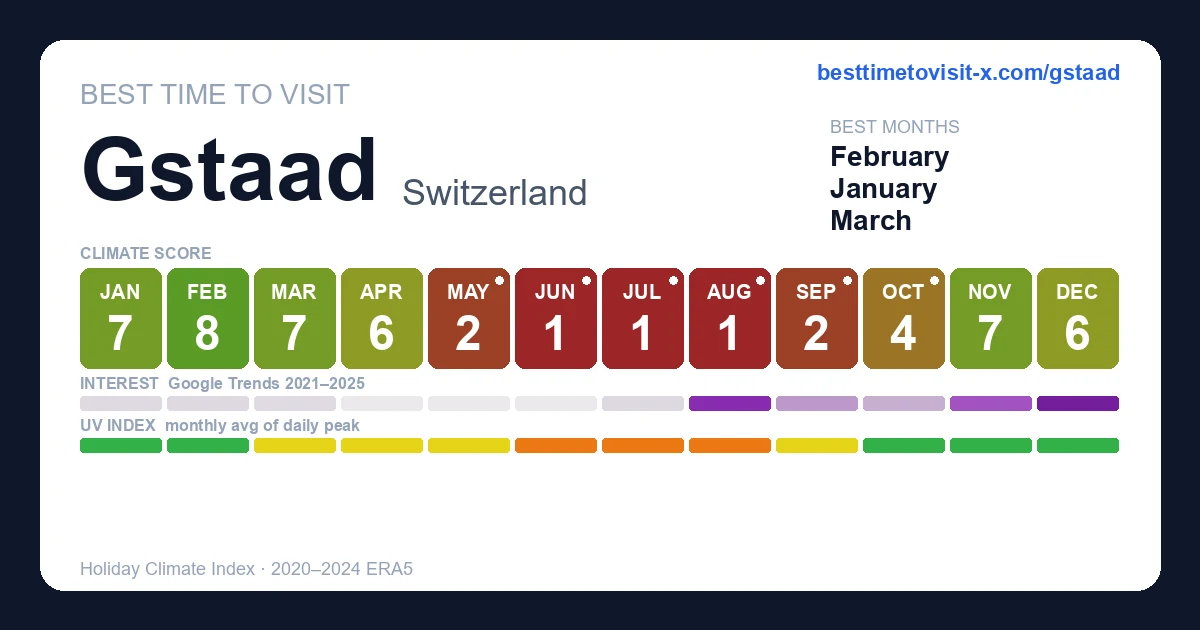
| Jan | -6–4 | 1 | 13 | 194 | 14.9 | 73% | 9 | 132 | 1 | Quiet | 7 |
| Feb | -4–7 | 4 | 13 | 162 | 12.5 | 69% | 10 | 151 | 2 | Quiet | 8 |
| Mar | -3–8 | 5 | 13 | 179 | 13.8 | 61% | 11 | 197 | 3 | Quiet | 7 |
| Apr | 0–11 | 8 | 13 | 206 | 15.8 | 59% | 11 | 218 | 5 | Quiet | 6 |
| May | 4–15 | 13 | 20 | 263 | 13.2 | 67% | 11 | 234 | 5 | Quiet | 2 |
| Jun | 9–20 | 19 | 20 | 244 | 12.2 | 66% | 10 | 262 | 7 | Quiet | 1 |
| Jul | 11–21 | 22 | 17 | 213 | 12.5 | 64% | 11 | 288 | 7 | Peak | 1 |
| Aug | 11–21 | 21 | 15 | 178 | 11.9 | 64% | 10 | 259 | 6 | Quiet | 1 |
| Sep | 7–18 | 17 | 15 | 189 | 12.6 | 70% | 10 | 216 | 4 | Quiet | 2 |
| Oct | 3–15 | 13 | 13 | 163 | 12.5 | 69% | 10 | 176 | 3 | Quiet | 4 |
| Nov | -2–9 | 6 | 14 | 186 | 13.3 | 72% | 10 | 132 | 1 | Quiet | 7 |
| Dec | -5–5 | 2 | 16 | 244 | 15.3 | 75% | 9 | 110 | 1 | Quiet | 6 |
UV Index in Gstaad by Month
UV index in Gstaad peaks at 7 (high) in July, dropping to 1 (low) in December. June, July, August have high UV — SPF 30+ and sunglasses recommended.
Best months in detail
February
8/10-4–7°C (feels 4°C) · 13 rain days (162h) · 151 sun hours · 69% humidity · Quiet crowd · UV 2 (low)
January
7/10-6–4°C (feels 1°C) · 13 rain days (194h) · 132 sun hours · 73% humidity · Quiet crowd · UV 1 (low)
March
7/10-3–8°C (feels 5°C) · 13 rain days (179h) · 197 sun hours · 61% humidity · Quiet crowd · UV 3 (moderate)
Every month
Show the other 9 months in detail
April
6/100–11°C (feels 8°C) · 13 rain days (206h) · 218 sun hours · 59% humidity · Quiet crowd · UV 5 (moderate) · sunniest 1 in 10 days reach 6 (high)
May
2/104–15°C (feels 13°C) · 20 rain days (263h) · 234 sun hours · 67% humidity · Quiet crowd · UV 5 (moderate) · sunniest 1 in 10 days reach 7 (high)
June
1/109–20°C · 20 rain days (244h) · 262 sun hours · 66% humidity · Quiet crowd · UV 7 (high) · sunniest 1 in 10 days reach 9 (very high)
July
1/1011–21°C · 17 rain days (213h) · 288 sun hours · 64% humidity · Peak crowd · UV 7 (high) · sunniest 1 in 10 days reach 9 (very high)
August
1/1011–21°C · 15 rain days (178h) · 259 sun hours · 64% humidity · Quiet crowd · UV 6 (high) · sunniest 1 in 10 days reach 8 (very high)
September
2/107–18°C · 15 rain days (189h) · 216 sun hours · 70% humidity · Quiet crowd · UV 4 (moderate) · sunniest 1 in 10 days reach 6 (high)
October
4/103–15°C (feels 13°C) · 13 rain days (163h) · 176 sun hours · 69% humidity · Quiet crowd · UV 3 (low) · sunniest 1 in 10 days reach 4 (moderate)
November
7/10-2–9°C (feels 6°C) · 14 rain days (186h) · 132 sun hours · 72% humidity · Quiet crowd · UV 1 (low)
December
6/10-5–5°C (feels 2°C) · 16 rain days (244h) · 110 sun hours · 75% humidity · Quiet crowd · UV 1 (low)
Its wettest month is the month everyone comes
Gstaad's visitor peak is July, and July is also its wettest month, averaging about 190 mm. That is not a contradiction so much as a consequence: Alpine summer rain is convective, building over the mountains through the afternoon, and it is exactly the pattern that keeps the valley as green as the photographs promise.
Even February, the driest month, still records around 122 mm — as snow. There is no dry season here in the Mediterranean sense; there is a frozen one and a wet one.
The comfort window is correspondingly narrow. Only three months — June, July and August — sit in the 18-27C band, which is why the resort's identity is split between a short green season and a long white one.
Sources: Gstaad Saanenland Tourismus — official visitor information , MeteoSwiss — climate normals for Switzerland
Is Gstaad worth visiting?
For alpine scenery, walking and a genuinely upmarket resort village, yes. It is quieter and less developed than Zermatt or St Moritz, with a preserved wooden-chalet centre and a car-free main street. It is not the place for dramatic single peaks — the appeal is broad green valleys in summer and reliable snow in winter.
Is Gstaad very expensive?
Yes — it is among the most expensive resorts in Switzerland, which is already an expensive country. Hotel rates in the winter high season and around the New Year are the peak. Costs fall substantially in the May and November shoulders, and hiking, the mountain railways and the valley paths are the good value here.
Which is better, St Moritz or Gstaad?
St Moritz is larger, glossier and better known internationally, with a bigger ski area and a stronger scene. Gstaad is smaller, more discreet and more traditional in appearance, with a car-free village centre. For skiing variety, St Moritz; for a quieter alpine village with the same price level, Gstaad.
What is the wettest month in Gstaad?
July, at around 190mm, which is also the visitor peak — Alpine summer rain builds through the afternoon rather than falling all day. February is the driest at about 122mm, but that arrives as snow. There is no genuinely dry month here, which is what keeps the valley so green. Plan hikes for the morning: Alpine convective rain builds through the afternoon rather than arriving at dawn.
What month is Switzerland most beautiful?
For the Alps, late June through September, when the high trails are clear of snow and the meadows are in flower — Gstaad's comfort band covers only June, July and August. For snow scenery, January and February. The shoulder months of May and November are the weakest, with lifts closed and trails still wet.
When is the ski season in Gstaad?
Roughly mid-December to early April, depending on snow, with the most reliable conditions in January and February. The area spans several linked mountains at moderate altitude, so late-season conditions can suffer in a warm year — worth checking snow reports rather than assuming an April trip will deliver.
How cold does Gstaad get?
January lows average around -7C in the village, and considerably colder at altitude on the lifts. Summer is mild rather than warm, with July topping out near 20C, so even in high summer an evening jacket is worth having. That narrow warm band is why the hiking season is so short. Altitude matters more than the date: the village figure understates conditions at the top of the lifts considerably.
How many days do you need in Gstaad?
Three. One for the village and a valley walk, one for a mountain railway and a high trail, and one for a longer hike or a day trip toward Lake Geneva. Skiers should plan longer, since the ski area is spread across several separate mountains and moving between them takes time. Mountain railway passes are priced by duration, so decide the length of stay before buying one.
Is Gstaad good in summer?
Very, and it is arguably better value than winter. The valley has an extensive network of marked walking paths, the mountain railways run, and July and August are the only months in the comfortable temperature band. Accept that afternoons are often wet — July averages about 190mm — and plan mornings accordingly.
What is the best month to visit Gstaad?
July for hiking with everything open, or February for the most reliable snow. September is the quieter alternative in summer, with clearer air and fewer people once the school holidays end, though some mountain services begin winding down toward the end of the month. Avoid May and November entirely: the lifts are shut, the trails are wet and much of the village closes.
Frequently asked questions about visiting Gstaad
When is the best time to visit Gstaad?
February is the highest-scoring month (8/10 on the Holiday Climate Index). Typical conditions: -4–7°C (13 rainy days). The top three months by score are February, January, March.
What is the worst time to visit Gstaad?
July is the lowest-scoring month (1/10, capped by extreme heat). Typical conditions: 11–21°C (17 rainy days).
Is Gstaad too hot in summer?
6 months (May, June, July, August, September, October) trip the heat deal-breaker in our scoring: apparent temperature crosses the comfort cap, so even with clear skies and low rain the score is held down. Plan around it if heat tolerance is low.
When are crowds lowest in Gstaad?
Search-interest seasonality (Google Trends 2021-2025) is lowest in April and peaks in July. Interest tracks both in-trip visitors and lead-time planners, so treat it as a "destination is on people's minds" signal rather than literal arrivals.
Which months in Gstaad have good weather but fewer tourists?
February (climate 8/10, crowd index 19) and January (climate 7/10, crowd index 24) — shoulder months with above-average climate and below-median search-interest. Often the best value-for-weather trade.
What is the UV index in Gstaad by month?
UV peaks at 7 (high) in July and is lowest in December at 1 (low). Monthly peak values: Jan 1, Feb 2, Mar 3, Apr 5, May 5, Jun 7, Jul 7, Aug 6, Sep 4, Oct 3, Nov 1, Dec 1.
What is the UV index in Gstaad in July?
July is the peak UV month in Gstaad, with a daily-peak UV index of 7 (high). Apply SPF 30+, wear sunglasses, and seek shade during midday hours.
How high can UV get in Gstaad on the sunniest days?
Most days look like the monthly average, but on the sunniest ~1 in 10 days UV climbs higher than the mean suggests. June is the worst case: typical days average UV 7 (high), but the top 10% of days reach UV 9 (very high) — and even higher. Months where the sunniest days routinely exceed the typical reading: April, May, June, July, August, September, October. Plan sun protection for the worst case, not the average.