Best time to visit Puerto Varas
Re-score for me — drag the dial — every chart on the page recolours live for your heat limit 27°C
Default 27 °C is the upper edge of the Holiday Climate Index "ideal comfort" band (Scott, Rutty, Amelung & Tang, 2016). Above this, most warm-tourism travellers report measurable discomfort.
How is this scored? HCI / Steadman / CCI gate — full methodology and citations below.
Compare with another destination
Add as many as you like — stacked below the main strips above. Each row is just the recent-window score strip and (for beach destinations) sea-temperature strip.
Tours in Puerto Varas
6 top-rated tours via Viator. Booking links earn this site a commission at no cost to you. Map locations are approximate (centred on Puerto Varas).
- 1
 Tour Guiado en Kayak por Rio Maullin / Medío dia en Pto. Varas
 - 2
 PRIVATE-Hike to Alerce Andino National Park. Alerces Forest.
 - 3
 Puerto Montt Airport (PMC) to Puerto Varas City- Arrival Transfer
 - 4
 PRIVATE -Cochamo Hike Day trip.
 - 5
 Transfer from Puerto Varas to Puerto Montt Airport
 - 6
 Private Rock Climbing Experience in Northern Patagonia
Last refreshed 2026-06-15.
Similar climatesQueenstown83% · Taupo80% · Rotorua79%
Other destinations with the most-alike year-round climate to Puerto Varas (apparent temperature, rain hours, sunshine — matched within the same trip-profile). The ±N chip compares each match's typical score for the current month against Puerto Varas's. Based on the 2020-2024 climatology, not this year's actual weather.
Month-by-month
| Month | Temp °C | Feels °C | Rain days | Rain h | Rain h/day | Humidity | Wind km/h | Sun h | UV | Interest | Score |
|---|---|---|---|---|---|---|---|---|---|---|---|
| Jan | 11–19 | 16 | 12 | 150 | 12.5 | 66% | 25 | 274 | 9 | Peak | 7 |
| Feb | 12–19 | 17 | 9 | 103 | 11.4 | 65% | 25 | 240 | 7 | Busy | 8 |
| Mar | 10–17 | 14 | 12 | 145 | 12.1 | 71% | 25 | 211 | 4 | Quiet | 6 |
| Apr | 9–14 | 12 | 16 | 243 | 15.2 | 78% | 24 | 149 | 3 | Quiet | 4 |
| May | 7–12 | 8 | 16 | 252 | 15.8 | 81% | 24 | 134 | 1 | Quiet | 3 |
| Jun | 5–10 | 6 | 21 | 323 | 15.4 | 82% | 29 | 101 | 1 | Quiet | 2 |
| Jul | 5–9 | 5 | 20 | 298 | 14.9 | 82% | 26 | 113 | 1 | Quiet | 2 |
| Aug | 4–10 | 6 | 19 | 282 | 14.8 | 79% | 24 | 139 | 2 | Quiet | 2 |
| Sep | 5–11 | 8 | 18 | 251 | 13.9 | 74% | 23 | 171 | 3 | Quiet | 3 |
| Oct | 6–13 | 10 | 14 | 179 | 12.8 | 69% | 24 | 219 | 5 | Quiet | 5 |
| Nov | 8–15 | 13 | 15 | 204 | 13.6 | 70% | 24 | 218 | 6 | Moderate | 5 |
| Dec | 10–17 | 14 | 11 | 138 | 12.5 | 67% | 25 | 268 | 8 | Busy | 7 |
UV Index in Puerto Varas by Month
UV index in Puerto Varas peaks at 9 (very high) in January, dropping to 1 (low) in June. January reach very high or extreme levels — apply SPF 50+, wear a hat and protective clothing, and limit direct sun between 11:00 and 17:00.
Best months in detail
February
8/1012–19°C (feels 17°C) · 9 rain days (103h) · 240 sun hours · 65% humidity · Busy crowd · UV 7 (high) · sunniest 1 in 10 days reach 11 (very high)
January
7/1011–19°C (feels 16°C) · 12 rain days (150h) · 274 sun hours · 66% humidity · Peak crowd · UV 9 (very high) · sunniest 1 in 10 days reach 12 (extreme)
December
7/1010–17°C (feels 14°C) · 11 rain days (138h) · 268 sun hours · 67% humidity · Busy crowd · UV 8 (high) · sunniest 1 in 10 days reach 12 (extreme)
Every month
Show the other 9 months in detail
March
6/1010–17°C (feels 14°C) · 12 rain days (145h) · 211 sun hours · 71% humidity · Quiet crowd · UV 4 (moderate) · sunniest 1 in 10 days reach 7 (high)
April
4/109–14°C (feels 12°C) · 16 rain days (243h) · 149 sun hours · 78% humidity · Quiet crowd · UV 3 (low) · sunniest 1 in 10 days reach 5 (moderate)
May
3/107–12°C (feels 8°C) · 16 rain days (252h) · 134 sun hours · 81% humidity · Quiet crowd · UV 1 (low)
June
2/105–10°C (feels 6°C) · 21 rain days (323h) · 101 sun hours · 82% humidity · Quiet crowd · UV 1 (low)
July
2/105–9°C (feels 5°C) · 20 rain days (298h) · 113 sun hours · 82% humidity · Quiet crowd · UV 1 (low)
August
2/104–10°C (feels 6°C) · 19 rain days (282h) · 139 sun hours · 79% humidity · Quiet crowd · UV 2 (low) · sunniest 1 in 10 days reach 3 (moderate)
September
3/105–11°C (feels 8°C) · 18 rain days (251h) · 171 sun hours · 74% humidity · Quiet crowd · UV 3 (low) · sunniest 1 in 10 days reach 4 (moderate)
October
5/106–13°C (feels 10°C) · 14 rain days (179h) · 219 sun hours · 69% humidity · Quiet crowd · UV 5 (moderate) · sunniest 1 in 10 days reach 7 (high)
November
5/108–15°C (feels 13°C) · 15 rain days (204h) · 218 sun hours · 70% humidity · Moderate crowd · UV 6 (high) · sunniest 1 in 10 days reach 10 (very high)
Calbuco's 2015 eruption still means no camping in the park
CONAF's own page for Vicente Perez Rosales National Park, the oldest in Chile, created on 17 August 1926 and covering around 253,000 hectares, lists no camping areas at all. The stated reason is that the water network at the sites was damaged by the eruption of Volcan Calbuco. That was in April 2015. Eleven years on, camping anywhere near the lake and the falls is a private-sector matter, in the Ensenada and Petrohue sectors and at the Volcan Osorno mountain centre.
The volcano responsible is not the one on the postcards. SERNAGEOMIN's 2023 ranking of specific risk across Chile's active volcanic systems places Calbuco second out of 87, behind only Villarrica; Osorno, the symmetrical cone everyone photographs across Lago Llanquihue, sits eighth. Calbuco erupted on 22 April 2015 after fewer than three hours of precursory seismicity and with no clear ground deformation, threw ash more than 15 km up, and forced a 20 km exclusion zone.
Both volcanoes currently sit at green technical alert. Worth knowing, though, that SERNAGEOMIN's alerts page states real-time display of alert levels is not available on its website, so there is no live dashboard to check on the morning you set out.
Sources: CONAF - Parque Nacional Vicente Perez Rosales , SERNAGEOMIN - Ranking de riesgo especifico de volcanes activos de Chile 2023
When is the best time to visit Puerto Varas?
December to February. January is the driest month at about 81 mm over ten wet days, against 265 mm over twenty in June, and average highs reach roughly 19C. Late March still works and is quieter. Nothing here gets hot: even at midsummer the daily mean sits near 15C, so pack for a cool, bright, showery day.
Does it rain all year in Puerto Varas?
Yes. The record here totals around 1,915 mm a year spread across roughly 180 wet days, so rain is a constant rather than a season. June is wettest at about 265 mm over twenty days, and even January, the driest month, still averages ten. A waterproof shell beats an umbrella, because the wind off Lago Llanquihue is steady.
Can you camp in Vicente Perez Rosales National Park?
Not with CONAF. Its own page for the park lists no camping areas, stating that the water network at the sites was damaged by the Calbuco eruption. Camping and refuges near the park are privately run, in the Ensenada and Petrohue sectors and at the Volcan Osorno mountain centre, so book a bed rather than assuming a pitch will be there.
What are the opening hours for Saltos del Petrohue?
There are two seasons. From December to March the sector opens daily 09:00 to 18:00 with last entry at 17:30; from March to November it runs 09:00 to 17:00. Tickets are sold through the official Pases Parques site, and the operator notes that hours and days can change with weather or safety conditions in the protected area.
Is Puerto Varas safe with two volcanoes nearby?
Both Osorno and Calbuco currently sit at green technical alert, and the only Chilean volcano carrying a raised alert on SERNAGEOMIN's published alerts page is Nevados de Chillan, hundreds of kilometres north. The hazard is real but monitored: Calbuco ranks second of 87 active systems in SERNAGEOMIN's specific risk ranking, with Osorno eighth.
How much warning did the 2015 Calbuco eruption give?
Under three hours. Calbuco erupted on 22 April 2015 after a very short burst of precursory seismicity and with no clear ground deformation, sending ash more than 15 km up and prompting a 20 km exclusion zone. It is the reason a green alert level is not the same thing as a guarantee, and why official instructions override plans.
Can you drive up Volcan Osorno in winter?
Usually, but with conditions attached. CONAF posts access notices for the Osorno road on the park page, and in mid-August 2026 the route was open with snow chains compulsory from 12 August. The mountain and ski centre operates through the southern winter, roughly from late June, and shuts at short notice in bad weather.
How many days do you need in Puerto Varas?
Two or three. One for Saltos del Petrohue and Lago Todos los Santos along Ruta 225-CH; one for Volcan Osorno, whether for the road, the chairlifts or the view back across Lago Llanquihue; and a third for the lakeshore towns of Frutillar and Puerto Octay, or a rafting trip on the Rio Petrohue.
Why does Puerto Varas look German?
Because it was settled by Germans under a state programme. Vicente Perez Rosales was appointed official colonisation agent for the Llanquihue basin in 1850 and recruited German families to the lakeshore over the following decades. The national park up the road carries his name; the shingled houses and the kuchen carry theirs.
Which national park is closest to Puerto Varas?
Vicente Perez Rosales, the oldest in Chile, created on 17 August 1926 and covering around 253,000 hectares of lake, forest and volcano. It is reached along Ruta 225-CH east through Ensenada, roughly an hour from town, and CONAF places it about 72 km east of Puerto Montt, whose El Tepual airport is the nearest by air.
Frequently asked questions about visiting Puerto Varas
When is the best time to visit Puerto Varas?
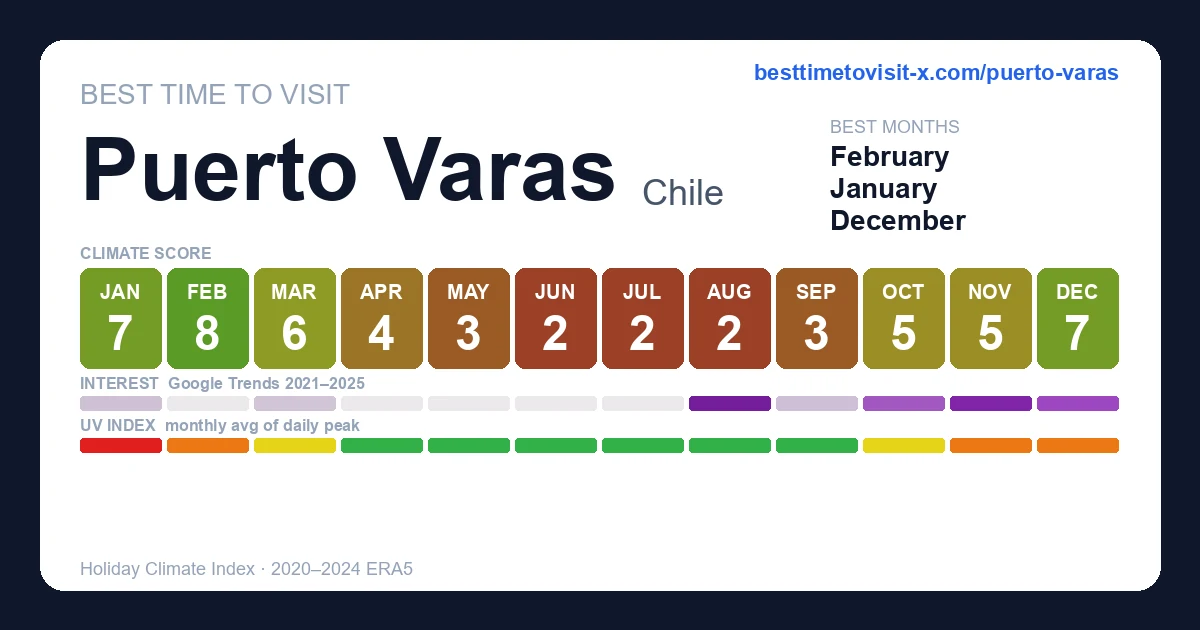
February is the highest-scoring month (8/10 on the Holiday Climate Index). Typical conditions: 12–19°C (9 rainy days). The top three months by score are February, January, December.
What is the worst time to visit Puerto Varas?
June is the lowest-scoring month (2/10). Typical conditions: 5–10°C (21 rainy days).
When are crowds lowest in Puerto Varas?
Search-interest seasonality (Google Trends 2021-2025) is lowest in June and peaks in January. Interest tracks both in-trip visitors and lead-time planners, so treat it as a "destination is on people's minds" signal rather than literal arrivals.
Which months in Puerto Varas have good weather but fewer tourists?
March (climate 6/10, crowd index 28) — shoulder months with above-average climate and below-median search-interest. Often the best value-for-weather trade.
What is the UV index in Puerto Varas by month?
UV peaks at 9 (very high) in January and is lowest in June at 1 (low). Monthly peak values: Jan 9, Feb 7, Mar 4, Apr 3, May 1, Jun 1, Jul 1, Aug 2, Sep 3, Oct 5, Nov 6, Dec 8. January reach very high or extreme levels — apply SPF 50+, wear a hat and protective clothing, and limit direct sun between 11:00 and 17:00.
What is the UV index in Puerto Varas in January?
January is the peak UV month in Puerto Varas, with a daily-peak UV index of 9 (very high). At this level, sunburn can occur in under 20 minutes on unprotected fair skin. Apply SPF 50+, wear protective clothing and a hat, and avoid direct midday sun (11:00–17:00).
How high can UV get in Puerto Varas on the sunniest days?
Most days look like the monthly average, but on the sunniest ~1 in 10 days UV climbs higher than the mean suggests. January is the worst case: typical days average UV 9 (very high), but the top 10% of days reach UV 12 (extreme) — and even higher. Months where the sunniest days routinely exceed the typical reading: January, February, March, April, August, September, October, November, December. Plan sun protection for the worst case, not the average.