Best time to visit Liberia
Re-score for me — drag the dial — every chart on the page recolours live for your heat limit 27°C
Default 27 °C is the upper edge of the Holiday Climate Index "ideal comfort" band (Scott, Rutty, Amelung & Tang, 2016). Above this, most warm-tourism travellers report measurable discomfort.
Greyed factors are scored normally — extreme heat overrides them, so a clear sky or low rain can't lift the period.
Greyed factors are scored normally — extreme heat overrides them, so a clear sky or low rain can't lift the period.
Greyed factors are scored normally — extreme heat overrides them, so a clear sky or low rain can't lift the period.
Greyed factors are scored normally — extreme heat overrides them, so a clear sky or low rain can't lift the period.
Greyed factors are scored normally — extreme heat overrides them, so a clear sky or low rain can't lift the period.
Greyed factors are scored normally — extreme heat overrides them, so a clear sky or low rain can't lift the period.
Greyed factors are scored normally — extreme heat overrides them, so a clear sky or low rain can't lift the period.
Greyed factors are scored normally — extreme heat overrides them, so a clear sky or low rain can't lift the period.
Greyed factors are scored normally — extreme heat overrides them, so a clear sky or low rain can't lift the period.
Greyed factors are scored normally — extreme heat overrides them, so a clear sky or low rain can't lift the period.
Greyed factors are scored normally — extreme heat overrides them, so a clear sky or low rain can't lift the period.
Greyed factors are scored normally — extreme heat overrides them, so a clear sky or low rain can't lift the period.
Greyed factors are scored normally — extreme heat overrides them, so a clear sky or low rain can't lift the period.
Greyed factors are scored normally — extreme heat overrides them, so a clear sky or low rain can't lift the period.
Greyed factors are scored normally — extreme heat overrides them, so a clear sky or low rain can't lift the period.
Greyed factors are scored normally — extreme heat overrides them, so a clear sky or low rain can't lift the period.
Greyed factors are scored normally — extreme heat overrides them, so a clear sky or low rain can't lift the period.
Greyed factors are scored normally — extreme heat overrides them, so a clear sky or low rain can't lift the period.
Greyed factors are scored normally — extreme heat overrides them, so a clear sky or low rain can't lift the period.
Greyed factors are scored normally — extreme heat overrides them, so a clear sky or low rain can't lift the period.
Greyed factors are scored normally — extreme heat overrides them, so a clear sky or low rain can't lift the period.
Greyed factors are scored normally — extreme heat overrides them, so a clear sky or low rain can't lift the period.
Greyed factors are scored normally — extreme heat overrides them, so a clear sky or low rain can't lift the period.
Greyed factors are scored normally — extreme heat overrides them, so a clear sky or low rain can't lift the period.
Greyed factors are scored normally — extreme heat overrides them, so a clear sky or low rain can't lift the period.
Greyed factors are scored normally — extreme heat overrides them, so a clear sky or low rain can't lift the period.
Greyed factors are scored normally — extreme heat overrides them, so a clear sky or low rain can't lift the period.
Greyed factors are scored normally — extreme heat overrides them, so a clear sky or low rain can't lift the period.
Greyed factors are scored normally — extreme heat overrides them, so a clear sky or low rain can't lift the period.
Greyed factors are scored normally — extreme heat overrides them, so a clear sky or low rain can't lift the period.
Greyed factors are scored normally — extreme heat overrides them, so a clear sky or low rain can't lift the period.
Greyed factors are scored normally — extreme heat overrides them, so a clear sky or low rain can't lift the period.
Greyed factors are scored normally — extreme heat overrides them, so a clear sky or low rain can't lift the period.
Greyed factors are scored normally — extreme heat overrides them, so a clear sky or low rain can't lift the period.
Greyed factors are scored normally — extreme heat overrides them, so a clear sky or low rain can't lift the period.
Greyed factors are scored normally — extreme heat overrides them, so a clear sky or low rain can't lift the period.
Greyed factors are scored normally — extreme heat overrides them, so a clear sky or low rain can't lift the period.
Greyed factors are scored normally — extreme heat overrides them, so a clear sky or low rain can't lift the period.
Greyed factors are scored normally — extreme heat overrides them, so a clear sky or low rain can't lift the period.
Greyed factors are scored normally — extreme heat overrides them, so a clear sky or low rain can't lift the period.
Greyed factors are scored normally — extreme heat overrides them, so a clear sky or low rain can't lift the period.
Greyed factors are scored normally — extreme heat overrides them, so a clear sky or low rain can't lift the period.
Greyed factors are scored normally — extreme heat overrides them, so a clear sky or low rain can't lift the period.
Greyed factors are scored normally — extreme heat overrides them, so a clear sky or low rain can't lift the period.
Greyed factors are scored normally — extreme heat overrides them, so a clear sky or low rain can't lift the period.
Greyed factors are scored normally — extreme heat overrides them, so a clear sky or low rain can't lift the period.
Greyed factors are scored normally — extreme heat overrides them, so a clear sky or low rain can't lift the period.
Greyed factors are scored normally — extreme heat overrides them, so a clear sky or low rain can't lift the period.
Greyed factors are scored normally — extreme heat overrides them, so a clear sky or low rain can't lift the period.
Greyed factors are scored normally — extreme heat overrides them, so a clear sky or low rain can't lift the period.
Greyed factors are scored normally — extreme heat overrides them, so a clear sky or low rain can't lift the period.
Greyed factors are scored normally — extreme heat overrides them, so a clear sky or low rain can't lift the period.
Greyed factors are scored normally — extreme heat overrides them, so a clear sky or low rain can't lift the period.
Greyed factors are scored normally — extreme heat overrides them, so a clear sky or low rain can't lift the period.
Greyed factors are scored normally — extreme heat overrides them, so a clear sky or low rain can't lift the period.
Greyed factors are scored normally — extreme heat overrides them, so a clear sky or low rain can't lift the period.
Greyed factors are scored normally — extreme heat overrides them, so a clear sky or low rain can't lift the period.
Greyed factors are scored normally — extreme heat overrides them, so a clear sky or low rain can't lift the period.
Greyed factors are scored normally — extreme heat overrides them, so a clear sky or low rain can't lift the period.
Greyed factors are scored normally — extreme heat overrides them, so a clear sky or low rain can't lift the period.
Greyed factors are scored normally — extreme heat overrides them, so a clear sky or low rain can't lift the period.
Greyed factors are scored normally — extreme heat overrides them, so a clear sky or low rain can't lift the period.
Greyed factors are scored normally — extreme heat overrides them, so a clear sky or low rain can't lift the period.
Greyed factors are scored normally — extreme heat overrides them, so a clear sky or low rain can't lift the period.
Greyed factors are scored normally — extreme heat overrides them, so a clear sky or low rain can't lift the period.
Greyed factors are scored normally — extreme heat overrides them, so a clear sky or low rain can't lift the period.
Greyed factors are scored normally — extreme heat overrides them, so a clear sky or low rain can't lift the period.
Greyed factors are scored normally — extreme heat overrides them, so a clear sky or low rain can't lift the period.
Greyed factors are scored normally — extreme heat overrides them, so a clear sky or low rain can't lift the period.
Greyed factors are scored normally — extreme heat overrides them, so a clear sky or low rain can't lift the period.
Greyed factors are scored normally — extreme heat overrides them, so a clear sky or low rain can't lift the period.
Greyed factors are scored normally — extreme heat overrides them, so a clear sky or low rain can't lift the period.
Greyed factors are scored normally — extreme heat overrides them, so a clear sky or low rain can't lift the period.
Greyed factors are scored normally — extreme heat overrides them, so a clear sky or low rain can't lift the period.
Greyed factors are scored normally — extreme heat overrides them, so a clear sky or low rain can't lift the period.
Greyed factors are scored normally — extreme heat overrides them, so a clear sky or low rain can't lift the period.
Greyed factors are scored normally — extreme heat overrides them, so a clear sky or low rain can't lift the period.
Greyed factors are scored normally — extreme heat overrides them, so a clear sky or low rain can't lift the period.
Greyed factors are scored normally — extreme heat overrides them, so a clear sky or low rain can't lift the period.
Greyed factors are scored normally — extreme heat overrides them, so a clear sky or low rain can't lift the period.
Greyed factors are scored normally — extreme heat overrides them, so a clear sky or low rain can't lift the period.
Greyed factors are scored normally — extreme heat overrides them, so a clear sky or low rain can't lift the period.
Greyed factors are scored normally — extreme heat overrides them, so a clear sky or low rain can't lift the period.
Greyed factors are scored normally — extreme heat overrides them, so a clear sky or low rain can't lift the period.
Greyed factors are scored normally — extreme heat overrides them, so a clear sky or low rain can't lift the period.
Greyed factors are scored normally — extreme heat overrides them, so a clear sky or low rain can't lift the period.
Greyed factors are scored normally — extreme heat overrides them, so a clear sky or low rain can't lift the period.
Greyed factors are scored normally — extreme heat overrides them, so a clear sky or low rain can't lift the period.
Greyed factors are scored normally — extreme heat overrides them, so a clear sky or low rain can't lift the period.
Greyed factors are scored normally — extreme heat overrides them, so a clear sky or low rain can't lift the period.
Greyed factors are scored normally — extreme heat overrides them, so a clear sky or low rain can't lift the period.
Greyed factors are scored normally — extreme heat overrides them, so a clear sky or low rain can't lift the period.
Greyed factors are scored normally — extreme heat overrides them, so a clear sky or low rain can't lift the period.
Greyed factors are scored normally — extreme heat overrides them, so a clear sky or low rain can't lift the period.
Greyed factors are scored normally — extreme heat overrides them, so a clear sky or low rain can't lift the period.
Greyed factors are scored normally — extreme heat overrides them, so a clear sky or low rain can't lift the period.
How is this scored? HCI / Steadman / CCI gate — full methodology and citations below.
Compare with another destination
Add as many as you like — stacked below the main strips above. Each row is just the recent-window score strip and (for beach destinations) sea-temperature strip.
Tours in Liberia
6 top-rated tours via Viator. Booking links earn this site a commission at no cost to you. Map locations are approximate (centred on Liberia).
- 1
 Tropical Rainforest, Hanging Bridges And Jungle Sloths Sanctuary
 - 2
 Private transfer from Liberia Airport
 - 3
 Private Transportation Guanacaste Liberia Airport
 - 4
 RoundTrip Private Transfer - Liberia Airport to your selected location
 - 5
 Sloth Watching, Coffee, Chocolate & Waterfall Experience
 - 6
 Nicaragua Full Day Tour from Costa Rica
Last refreshed 2026-06-08.
Similar climatesPanama City83% · San Jose82% · Bangkok82%
Other destinations with the most-alike year-round climate to Liberia (apparent temperature, rain hours, sunshine — matched within the same trip-profile). The ±N chip compares each match's typical score for the current month against Liberia's. Based on the 2020-2024 climatology, not this year's actual weather.
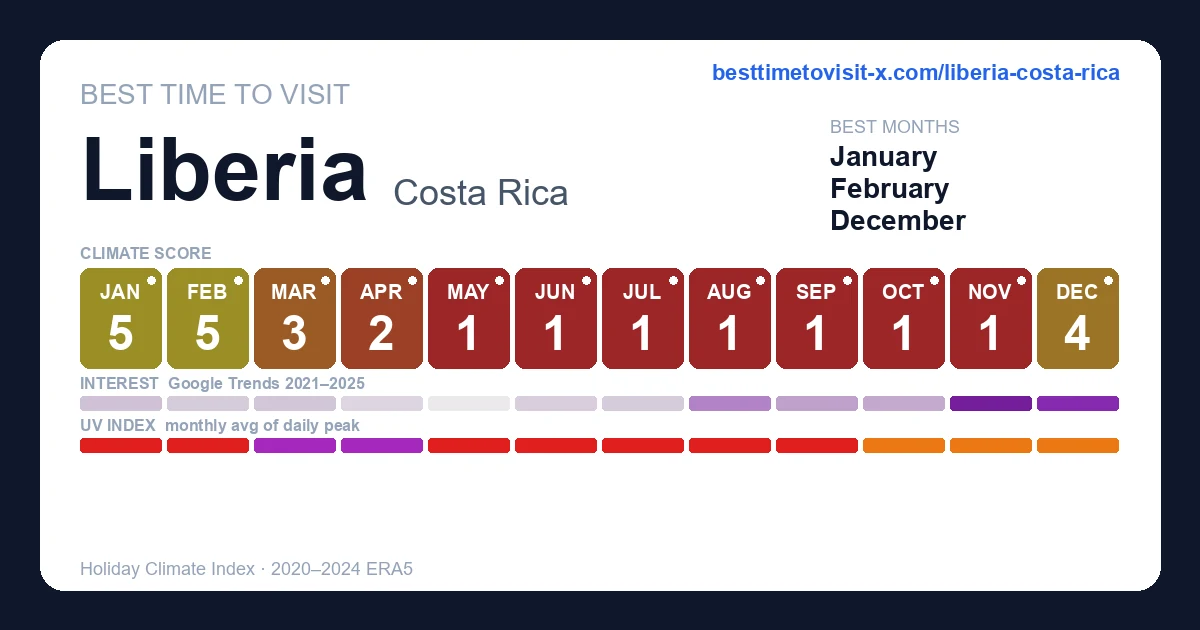
Month-by-month
| Month | Temp °C | Feels °C | Rain days | Rain h | Rain h/day | Humidity | Wind km/h | Sun h | UV | Interest | Score |
|---|---|---|---|---|---|---|---|---|---|---|---|
| Jan | 23–32 | 34 | 2 | 34 | 17.0 | 52% | 22 | 256 | 9 | Busy | 5 |
| Feb | 23–33 | 34 | 0 | 12 | — | 46% | 27 | 245 | 11 | Moderate | 5 |
| Mar | 23–35 | 36 | 5 | 39 | 7.8 | 43% | 23 | 266 | 12 | Moderate | 3 |
| Apr | 24–35 | 38 | 11 | 98 | 8.9 | 47% | 19 | 247 | 12 | Quiet | 2 |
| May | 24–33 | 38 | 23 | 234 | 10.2 | 64% | 15 | 219 | 10 | Quiet | 1 |
| Jun | 23–30 | 35 | 27 | 355 | 13.1 | 78% | 13 | 181 | 8 | Quiet | 1 |
| Jul | 23–31 | 36 | 22 | 234 | 10.6 | 73% | 14 | 212 | 9 | Quiet | 1 |
| Aug | 23–30 | 36 | 27 | 315 | 11.7 | 77% | 13 | 197 | 9 | Quiet | 1 |
| Sep | 23–30 | 36 | 28 | 340 | 12.1 | 79% | 12 | 186 | 9 | Quiet | 1 |
| Oct | 23–30 | 35 | 29 | 354 | 12.2 | 81% | 12 | 186 | 8 | Quiet | 1 |
| Nov | 23–29 | 34 | 22 | 303 | 13.8 | 79% | 12 | 183 | 7 | Peak | 1 |
| Dec | 22–31 | 34 | 4 | 60 | 15.0 | 62% | 15 | 236 | 8 | Peak | 4 |
UV Index in Liberia by Month
UV index in Liberia peaks at 12 (extreme) in March, dropping to 7 (high) in November. January, February, March, April, May, June, July, August, September reach very high or extreme levels — apply SPF 50+, wear a hat and protective clothing, and limit direct sun between 11:00 and 17:00.
Best months in detail
January
5/1023–32°C (feels 34°C) · 2 rain days (34h) · 256 sun hours · 52% humidity · Busy crowd · UV 9 (very high)
February
5/1023–33°C · 0 rain days (12h) · 245 sun hours · 46% humidity · Moderate crowd · UV 11 (very high) · sunniest 1 in 10 days reach 12 (extreme)
December
4/1022–31°C (feels 34°C) · 4 rain days (60h) · 236 sun hours · 62% humidity · Peak crowd · UV 8 (high) · sunniest 1 in 10 days reach 9 (very high)
Every month
Show the other 9 months in detail
March
3/1023–35°C (feels 36°C) · 5 rain days (39h) · 266 sun hours · 43% humidity · Moderate crowd · UV 12 (extreme)
April
2/1024–35°C (feels 38°C) · 11 rain days (98h) · 247 sun hours · 47% humidity · Quiet crowd · UV 12 (extreme)
May
1/1024–33°C (feels 38°C) · 23 rain days (234h) · 219 sun hours · 64% humidity · Quiet crowd · UV 10 (very high) · sunniest 1 in 10 days reach 12 (extreme)
June
1/1023–30°C (feels 35°C) · 27 rain days (355h) · 181 sun hours · 78% humidity · Quiet crowd · UV 8 (very high) · sunniest 1 in 10 days reach 10 (very high)
July
1/1023–31°C (feels 36°C) · 22 rain days (234h) · 212 sun hours · 73% humidity · Quiet crowd · UV 9 (very high) · sunniest 1 in 10 days reach 11 (very high)
August
1/1023–30°C (feels 36°C) · 27 rain days (315h) · 197 sun hours · 77% humidity · Quiet crowd · UV 9 (very high) · sunniest 1 in 10 days reach 11 (extreme)
September
1/1023–30°C (feels 36°C) · 28 rain days (340h) · 186 sun hours · 79% humidity · Quiet crowd · UV 9 (very high) · sunniest 1 in 10 days reach 11 (very high)
October
1/1023–30°C (feels 35°C) · 29 rain days (354h) · 186 sun hours · 81% humidity · Quiet crowd · UV 8 (high) · sunniest 1 in 10 days reach 10 (very high)
November
1/1023–29°C (feels 34°C) · 22 rain days (303h) · 183 sun hours · 79% humidity · Peak crowd · UV 7 (high) · sunniest 1 in 10 days reach 9 (very high)
Guanacaste's mid-July dry spell is measured, not folklore
IMN uses Liberia as its type station for the Pacific regime, and the shape it shows is a rainy season from May to November with a marked dip in the middle. Our figures hold it: June 279mm, July 169mm, August 216mm, and July carries more sunshine than June, 304 hours against 287. The dip has a name in Costa Rica - the veranillo, or canicula.
IMN's study of veranillos measures it rather than describing it. The study maps four bands of intensity across the Pacific slope; the strongest, zone I, covers the central part of Guanacaste province and the shores of the Gulf of Nicoya, and there the probability of a run of five dry days exceeds 50% between 12 July and 14 August. In the lower Central Valley the same odds hold only from 10 to 14 August. It is a rainfall feature, not a heat one: April remains the hottest month at 33.7C.
The consequence on the ground is a clock. IMN records that Pacific-slope rain falls predominantly in the afternoon and the first hours of the night, and Rincon de la Vieja is run to match. SINAC gives the waterfall trail to La Cangreja and Catarata Escondida an 08:00 to 12:00 entry window in the December to April dry season, and states that during the May to November rains the sector administration may regulate access to it. Las Pailas is closed on Mondays, Santa Maria on Tuesdays and Wednesdays.
Sources: IMN - Estudio sobre veranillos en Costa Rica , SINAC - Parque Nacional Rincon de la Vieja (horarios y senderos) , Area de Conservacion Guanacaste - online ticketing for Rincon de la Vieja , SINAC - Parque Nacional Santa Rosa (tarifas y horario)
What is the best month to visit Liberia?
February for certainty, July for value. February records 2mm of rain and 327 hours of sun at 31C. July costs less and is busier with wildlife, and IMN's veranillo study gives central Guanacaste better than even odds of a five-day rainless run at some point between 12 July and 14 August.
What is the veranillo and can I plan around it?
It is the mid-rainy-season dry spell on Costa Rica's Pacific slope, defined by IMN's study as five to fifteen consecutive days with no rain or with ineffective rain. You can plan around the window but not the dates: the odds pass 50% for zone I between 12 July and 14 August, which is a month-long window, not a fixed week.
Is Rincon de la Vieja National Park open every day?
No, and the two sectors close on different days. Las Pailas, the sector with the mud pots and the waterfalls, opens Tuesday to Sunday, 08:00 to 15:00, and is closed on Mondays. Santa Maria opens Thursday to Monday, 08:00 to 15:30, and is closed on Tuesdays and Wednesdays.
How dry is the Guanacaste dry season really?
Close to absolute. Our figures give January 3mm on one wet day, February 2mm, March 3mm and December 14mm, against 382mm in October. SINAC's own park page defines the dry season as December to April and the rains as May to November, and applies different trail rules to each.
Why is April hotter than July in Liberia?
April closes the dry season with 343 hours of sun and only 31mm of rain, and the mean maximum reaches 33.7C. By July the rains have brought daily cloud, so the mean maximum falls to 29.5C even though July is drier than the months either side of it. The veranillo shows up in the rain figures, not the thermometer.
Do I need to buy Rincon de la Vieja tickets in advance?
Yes. The park is one of eleven sold through SINAC's online reservation system, and tickets are no longer sold at the entrance. Non-resident adults pay $16.95 and children aged 2 to 12 pay $5.65, tax included. Tickets are not refunded if weather spoils the visit or if you fail to arrive.
Can I hike to the Rincon de la Vieja crater?
No. SINAC states that the Sendero Crater Activo is closed because of volcanic activity, with no reopening date given. What remains open in the Las Pailas sector is the 3.5km loop past the boiling mud pots and fumaroles, and the longer trail out to the La Cangreja and Escondida waterfalls.
What else is worth the drive from Liberia?
Santa Rosa National Park, north on the Interamericana, which holds the Casona battlefield museum of 20 March 1856 inside a tropical dry forest, plus a coastal sector. SINAC lists hours of 08:00 to 15:30 and the same $16.95 adult fee, with camping at $4 per person per night on top of the day ticket.
Why does the waterfall trail close at noon?
Because of when the rain arrives. IMN records that on the Pacific slope rain falls predominantly in the afternoon and the first hours of the night, and the round trip to La Cangreja and Escondida runs about 10km. SINAC sets the last entry at 12:00 in the dry season and may restrict it further from May to November.
When is Liberia at its busiest?
November and December, at 100 and 92 on our crowd index, which is when the rains stop - November drops to 114mm from October's 382mm. January and February stay high at 71 and 62. May is the emptiest month of the year and the point at which the wet season arrives, jumping from 31mm in April to 245mm.
Frequently asked questions about visiting Liberia
When is the best time to visit Liberia?
January is the highest-scoring month (5/10 on the Holiday Climate Index). Typical conditions: 23–32°C (2 rainy days). The top three months by score are January, February, December.
What is the worst time to visit Liberia?
September is the lowest-scoring month (1/10, capped by extreme heat). Typical conditions: 23–30°C (28 rainy days).
Is Liberia too hot in summer?
12 months (January, February, March, April, May, June, July, August, September, October, November, December) trip the heat deal-breaker in our scoring: apparent temperature crosses the comfort cap, so even with clear skies and low rain the score is held down. Plan around it if heat tolerance is low.
When are crowds lowest in Liberia?
Search-interest seasonality (Google Trends 2021-2025) is lowest in May and peaks in November. Interest tracks both in-trip visitors and lead-time planners, so treat it as a "destination is on people's minds" signal rather than literal arrivals.
What is the UV index in Liberia by month?
UV peaks at 12 (extreme) in March and is lowest in November at 7 (high). Monthly peak values: Jan 9, Feb 11, Mar 12, Apr 12, May 10, Jun 8, Jul 9, Aug 9, Sep 9, Oct 8, Nov 7, Dec 8. January, February, March, April, May, June, July, August, September reach very high or extreme levels — apply SPF 50+, wear a hat and protective clothing, and limit direct sun between 11:00 and 17:00.
What is the UV index in Liberia in March?
March is the peak UV month in Liberia, with a daily-peak UV index of 12 (extreme). At this level, sunburn can occur in under 20 minutes on unprotected fair skin. Apply SPF 50+, wear protective clothing and a hat, and avoid direct midday sun (11:00–17:00).
How high can UV get in Liberia on the sunniest days?
Most days look like the monthly average, but on the sunniest ~1 in 10 days UV climbs higher than the mean suggests. February is the worst case: typical days average UV 11 (very high), but the top 10% of days reach UV 12 (extreme) — and even higher. Months where the sunniest days routinely exceed the typical reading: February, May, June, July, August, September, October, November, December. Plan sun protection for the worst case, not the average.