Best time to visit San Jose
Re-score for me — drag the dial — every chart on the page recolours live for your heat limit 27°C
Default 27 °C is the upper edge of the Holiday Climate Index "ideal comfort" band (Scott, Rutty, Amelung & Tang, 2016). Above this, most warm-tourism travellers report measurable discomfort.
How is this scored? HCI / Steadman / CCI gate — full methodology and citations below.
Compare with another destination
Add as many as you like — stacked below the main strips above. Each row is just the recent-window score strip and (for beach destinations) sea-temperature strip.
Tours in San Jose
8 top-rated tours via Viator. Booking links earn this site a commission at no cost to you. Map locations are approximate (centred on San Jose).
- 1
 Arenal Volcano Full-Day Combo Tour with Lunch and Dinner
 - 2
 Arenal Volcano Experience Full-Day Tour from San Jose
 - 3
 Full Day Poas Volcano, La Paz Waterfall Gardens and Coffee Plantation Experience
 - 4
 San Jose: Bites and Sights Walking Food Tour including Markets
 - 5
 San Jose By Night: Farm to Table Dinner & Cocktail Class
 - 6
 Manuel Antonio National Park Sightseeing and Wildlife Day Tour from San Jose
 - 7
 San Jose Walking Nature Tour: Sloths, Birds and Trees
 - 8
 Zip Line, Rappel, Hiking La Carpintera Tour in San Jose
Last refreshed 2026-06-08.
Similar climatesBoquete87% · Panama City83% · Liberia82%
Other destinations with the most-alike year-round climate to San Jose (apparent temperature, rain hours, sunshine — matched within the same trip-profile). The ±N chip compares each match's typical score for the current month against San Jose's. Based on the 2020-2024 climatology, not this year's actual weather.
Month-by-month
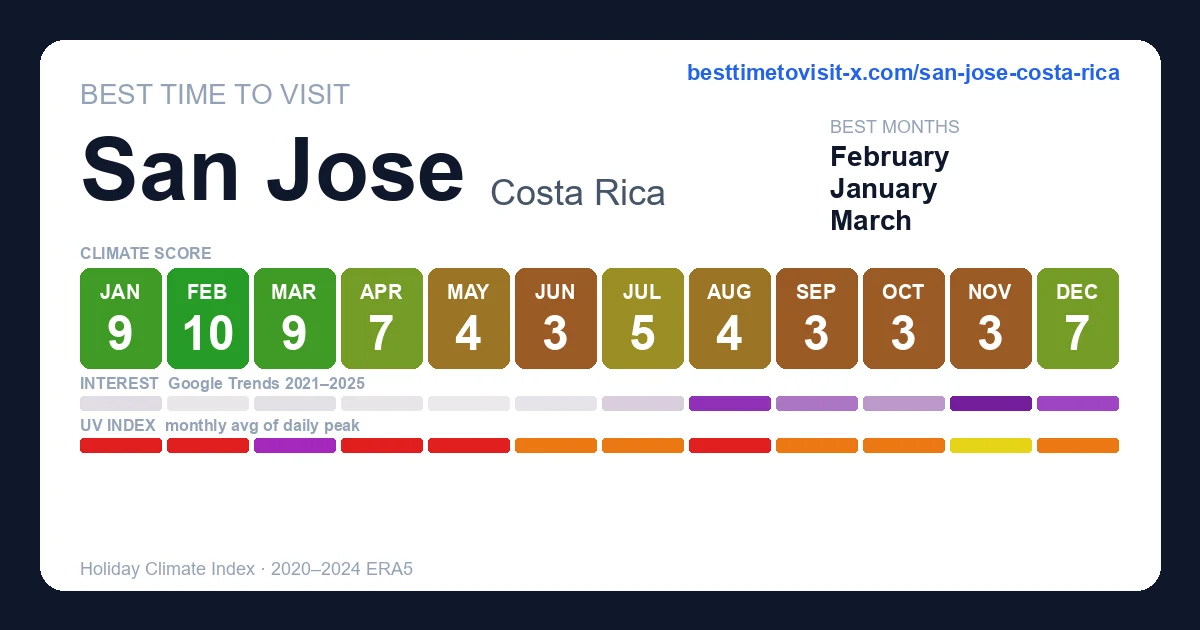
| Month | Temp °C | Feels °C | Rain days | Rain h | Rain h/day | Humidity | Wind km/h | Sun h | UV | Interest | Score |
|---|---|---|---|---|---|---|---|---|---|---|---|
| Jan | 16–25 | 26 | 6 | 70 | 11.7 | 60% | 16 | 252 | 9 | Busy | 9 |
| Feb | 16–26 | 26 | 4 | 41 | 10.3 | 53% | 17 | 241 | 10 | Moderate | 10 |
| Mar | 16–27 | 27 | 9 | 85 | 9.4 | 53% | 15 | 261 | 11 | Moderate | 9 |
| Apr | 16–27 | 28 | 17 | 149 | 8.8 | 61% | 14 | 231 | 10 | Quiet | 7 |
| May | 17–26 | 29 | 25 | 260 | 10.4 | 74% | 12 | 212 | 8 | Quiet | 4 |
| Jun | 17–24 | 27 | 28 | 337 | 12.0 | 83% | 10 | 182 | 7 | Quiet | 3 |
| Jul | 17–25 | 27 | 25 | 258 | 10.3 | 76% | 12 | 198 | 7 | Quiet | 5 |
| Aug | 16–25 | 28 | 28 | 305 | 10.9 | 79% | 11 | 197 | 8 | Moderate | 4 |
| Sep | 16–25 | 28 | 29 | 312 | 10.8 | 82% | 11 | 187 | 8 | Quiet | 3 |
| Oct | 16–24 | 27 | 29 | 351 | 12.1 | 84% | 11 | 186 | 7 | Quiet | 3 |
| Nov | 16–23 | 26 | 26 | 338 | 13.0 | 83% | 11 | 174 | 6 | Peak | 3 |
| Dec | 16–24 | 25 | 12 | 156 | 13.0 | 67% | 14 | 231 | 7 | Busy | 7 |
UV Index in San Jose by Month
UV index in San Jose peaks at 11 (extreme) in March, dropping to 6 (moderate) in November. January, February, March, April, May, August reach very high or extreme levels — apply SPF 50+, wear a hat and protective clothing, and limit direct sun between 11:00 and 17:00.
Best months in detail
February
10/1016–26°C · 4 rain days (41h) · 241 sun hours · 53% humidity · Moderate crowd · UV 10 (very high) · sunniest 1 in 10 days reach 13 (extreme)
January
9/1016–25°C · 6 rain days (70h) · 252 sun hours · 60% humidity · Busy crowd · UV 9 (very high) · sunniest 1 in 10 days reach 11 (extreme)
March
9/1016–27°C · 9 rain days (85h) · 261 sun hours · 53% humidity · Moderate crowd · UV 11 (extreme) · sunniest 1 in 10 days reach 14 (extreme)
Every month
Show the other 9 months in detail
April
7/1016–27°C (feels 28°C) · 17 rain days (149h) · 231 sun hours · 61% humidity · Quiet crowd · UV 10 (very high) · sunniest 1 in 10 days reach 14 (extreme)
May
4/1017–26°C (feels 29°C) · 25 rain days (260h) · 212 sun hours · 74% humidity · Quiet crowd · UV 8 (very high) · sunniest 1 in 10 days reach 12 (extreme)
June
3/1017–24°C (feels 27°C) · 28 rain days (337h) · 182 sun hours · 83% humidity · Quiet crowd · UV 7 (high) · sunniest 1 in 10 days reach 10 (very high)
July
5/1017–25°C (feels 27°C) · 25 rain days (258h) · 198 sun hours · 76% humidity · Quiet crowd · UV 7 (high) · sunniest 1 in 10 days reach 11 (very high)
August
4/1016–25°C (feels 28°C) · 28 rain days (305h) · 197 sun hours · 79% humidity · Moderate crowd · UV 8 (very high) · sunniest 1 in 10 days reach 11 (very high)
September
3/1016–25°C (feels 28°C) · 29 rain days (312h) · 187 sun hours · 82% humidity · Quiet crowd · UV 8 (high) · sunniest 1 in 10 days reach 10 (very high)
October
3/1016–24°C (feels 27°C) · 29 rain days (351h) · 186 sun hours · 84% humidity · Quiet crowd · UV 7 (high) · sunniest 1 in 10 days reach 9 (very high)
November
3/1016–23°C (feels 26°C) · 26 rain days (338h) · 174 sun hours · 83% humidity · Peak crowd · UV 6 (moderate) · sunniest 1 in 10 days reach 9 (very high)
December
7/1016–24°C (feels 25°C) · 12 rain days (156h) · 231 sun hours · 67% humidity · Busy crowd · UV 7 (high) · sunniest 1 in 10 days reach 10 (very high)
Your volcano ticket is timed, online-only and never refunded for cloud
San Jose's own weather is the least of a trip. IMN puts the Valle Central at a mean altitude of 1,100m, with an annual mean of 20C and little variation through the year, and our figures agree: monthly means run from 19.6C to 21.3C. What moves through the year is cloud, not heat. March is both the sunniest month, at 342 hours, and the warmest, at 26C. October is the wettest, 431mm falling on 30 days, with sunshine down to 230 hours.
That matters because the day trips booked from the capital are the volcano craters, and SINAC sells entry to them through its online system only. Irazu opens daily 08:00 to 16:00, but last entry to the crater sector is 14:00 and to the Prusia sector 13:00. Poas runs 08:00 to 16:00 and, in SINAC's own words, "access is granted just by the booking system". Tickets carry a stated time slot, and SINAC asks that you arrive inside it.
The part that catches people is in the reservation system's own terms. Asked whether a visitor gets a refund when cloud or rain makes the attraction impossible to see or reach, SINAC answers no: "environmental conditions are unstable in Costa Rica and within protected areas". There is no refund either if you simply cannot go. IMN's description of the Pacific regime, which the Valle Central belongs to, is that rain falls predominantly in the afternoon and the first hours of the night. Buy the earliest slot.
Sources: SINAC - Parque Nacional Volcan Irazu (tarifas y horario) , SINAC - online reservation system, terms and FAQ , SINAC - Poas Volcano National Park (hours and booking) , IMN - Estudio sobre veranillos en Costa Rica
What is the best month to visit San Jose?
February. Rainfall is at its annual low, 66mm across 11 days, humidity drops to 59% and there are 309 hours of sun, so the volcano rims north and east of the city stand a real chance of being clear. March is sunnier still, 342 hours, but it is also the warmest month at 26C and the haziest end of the dry season.
Is the rainy season a reason to avoid San Jose?
Not on its own. IMN's description of the Pacific regime, which the Valle Central belongs to, is that rain falls predominantly in the afternoon and the first hours of the night. October records 431mm across 30 days, so almost every day sees rain, but the mornings are usually workable and that is when tours run.
Do I need to book Costa Rica national park tickets in advance?
For eleven parks, yes, and they are not sold at the gate. SINAC's online system covers Poas, Irazu (crater and Prusia sectors), Manuel Antonio, Braulio Carrillo (Barva sector), Tapanti, Tortuguero, Isla San Lucas, Chirripo, Volcan Tenorio, Rincon de la Vieja and Carara. Tickets carry a time slot you are expected to keep.
Can I get a refund if the volcano crater is clouded over?
No. SINAC states it directly in the reservation system's FAQ: if cloud, rain or other conditions make the attraction impossible to see or walk to, there is no refund, because "environmental conditions are unstable in Costa Rica and within protected areas". Nor is there a refund if you bought a ticket and could not go.
Why is March hotter than July in San Jose?
Sunshine, not latitude. March closes the dry season with 342 hours of sun and a mean maximum of 26.4C. July sits inside the rainy season with 246 hours and 24.0C, because daily cloud caps the afternoon warming. The altitude of the Valle Central, 1,100m on IMN's figure, keeps the whole range narrow either way.
Should I fly into San Jose or Liberia?
It depends which climate you are buying. Liberia sits in the Pacifico Seco, where December to March average 2mm to 14mm of rain a month. San Jose in the same months still records 162mm in December and 95mm in January, and is the shorter run to Arenal, the Caribbean coast and the Central Valley coffee country.
Does the mid-year veranillo dry spell reach San Jose?
Barely. IMN's veranillo study places the lower Valle Central in zone II and the mountains around it in zone III, where the dry spell is broken by occasional rain. For zone II the odds of a five-day rainless run pass 50% only between 10 and 14 August; in central Guanacaste that window runs from 12 July to 14 August.
Which is the better day trip, Irazu or Poas?
Irazu if you want the longer day: it has two sectors, craters and the Prusia forest, with last entry at 14:00 and 13:00 respectively. Poas is the shorter, steeper visit, 08:00 to 16:00, booking system only. Both cost $16.95 for non-resident adults and $5.65 for children aged 2 to 12, tax included.
When is San Jose at its busiest?
November tops our crowd index at 100, with December at 67 and January at 72, so the pressure builds before the rain has fully stopped - November still records 319mm over 25 days. May and June are the emptiest months by a wide margin, and also the point at which the wet season arrives in earnest, 358mm and 381mm.
What should I pack for San Jose?
A light layer for the evenings and a rain shell. Overnight minimums sit near 17C all year and daytime maximums never average above 26.4C, so nothing heavy is needed, but from May to November an afternoon downpour is the norm rather than the exception. Closed shoes are required on the volcano trails.
Frequently asked questions about visiting San Jose
When is the best time to visit San Jose?
February is the highest-scoring month (10/10 on the Holiday Climate Index). Typical conditions: 16–26°C (4 rainy days). The top three months by score are February, January, March.
What is the worst time to visit San Jose?
October is the lowest-scoring month (3/10). Typical conditions: 16–24°C (29 rainy days).
When are crowds lowest in San Jose?
Search-interest seasonality (Google Trends 2021-2025) is lowest in May and peaks in November. Interest tracks both in-trip visitors and lead-time planners, so treat it as a "destination is on people's minds" signal rather than literal arrivals.
What is the UV index in San Jose by month?
UV peaks at 11 (extreme) in March and is lowest in November at 6 (moderate). Monthly peak values: Jan 9, Feb 10, Mar 11, Apr 10, May 8, Jun 7, Jul 7, Aug 8, Sep 8, Oct 7, Nov 6, Dec 7. January, February, March, April, May, August reach very high or extreme levels — apply SPF 50+, wear a hat and protective clothing, and limit direct sun between 11:00 and 17:00.
What is the UV index in San Jose in March?
March is the peak UV month in San Jose, with a daily-peak UV index of 11 (extreme). At this level, sunburn can occur in under 20 minutes on unprotected fair skin. Apply SPF 50+, wear protective clothing and a hat, and avoid direct midday sun (11:00–17:00).
How high can UV get in San Jose on the sunniest days?
Most days look like the monthly average, but on the sunniest ~1 in 10 days UV climbs higher than the mean suggests. March is the worst case: typical days average UV 11 (extreme), but the top 10% of days reach UV 14 (extreme) — and even higher. Months where the sunniest days routinely exceed the typical reading: January, February, March, April, May, June, July, August, September, October, November, December. Plan sun protection for the worst case, not the average.
Is air quality in San Jose bad for travelers?
PM2.5 (fine-particle pollution) exceeds the WHO sensitive-group guideline (15 µg/m³) in 1 month: April. The worst month is May with a typical-day mean of 10 µg/m³ (moderate); on the worst 10% of days PM2.5 reaches 15 µg/m³ (moderate) and higher. People with asthma, heart conditions, or sensitive children may want to avoid these months or limit outdoor activity. Source: CAMS via Open-Meteo.