Best time to visit Tossa de Mar
Re-score for me — drag the dial — every chart recolours live for your heat & sea limits 27°C · sea 29°C
Default 27 °C is the upper edge of the Holiday Climate Index "ideal comfort" band (Scott, Rutty, Amelung & Tang, 2016). Above this, most warm-tourism travellers report measurable discomfort.
Default 29 °C is the Beach Climate Index "bathtub" line (Morgan et al.) — where the sea stops being refreshing and starts feeling like a warm bath.
Greyed factors are scored normally — extreme heat overrides them, so a clear sky or low rain can't lift the period.
Greyed factors are scored normally — extreme heat overrides them, so a clear sky or low rain can't lift the period.
Greyed factors are scored normally — extreme heat overrides them, so a clear sky or low rain can't lift the period.
Greyed factors are scored normally — extreme heat overrides them, so a clear sky or low rain can't lift the period.
Greyed factors are scored normally — extreme heat overrides them, so a clear sky or low rain can't lift the period.
Greyed factors are scored normally — extreme heat overrides them, so a clear sky or low rain can't lift the period.
Greyed factors are scored normally — extreme heat overrides them, so a clear sky or low rain can't lift the period.
Greyed factors are scored normally — extreme heat overrides them, so a clear sky or low rain can't lift the period.
Greyed factors are scored normally — extreme heat overrides them, so a clear sky or low rain can't lift the period.
Greyed factors are scored normally — extreme heat overrides them, so a clear sky or low rain can't lift the period.
Greyed factors are scored normally — extreme heat overrides them, so a clear sky or low rain can't lift the period.
Greyed factors are scored normally — extreme heat overrides them, so a clear sky or low rain can't lift the period.
How is this scored? HCI / Steadman / CCI gate — full methodology and citations below.
Compare with another destination
Add as many as you like — stacked below the main strips above. Each row is just the recent-window score strip and (for beach destinations) sea-temperature strip.
Similar climatesLloret de Mar99% · Barcelona96% · Sitges96%
Other destinations with the most-alike year-round climate to Tossa de Mar (apparent temperature, rain hours, sunshine — matched within the same trip-profile). The ±N chip compares each match's typical score for the current month against Tossa de Mar's. Based on the 2020-2024 climatology, not this year's actual weather.
Month-by-month
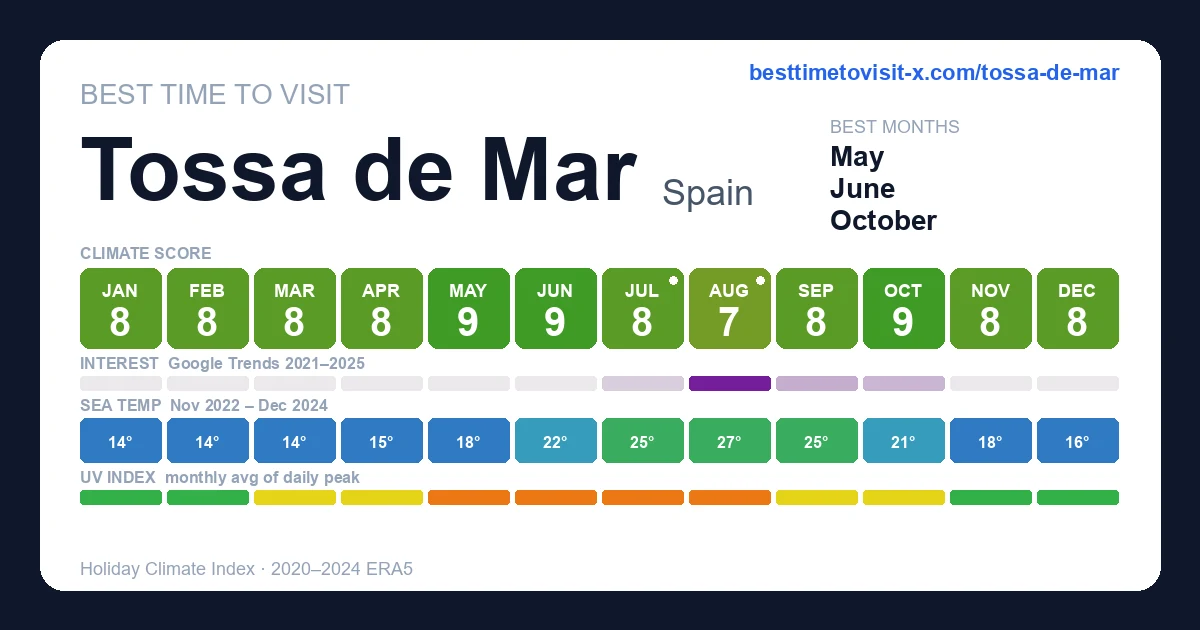
| Month | Temp °C | Feels °C | Rain days | Rain h | Rain h/day | Humidity | Wind km/h | Sun h | UV | Interest | Score |
|---|---|---|---|---|---|---|---|---|---|---|---|
| Jan | 5–13 | 11 | 5 | 55 | 11.0 | 67% | 18 | 178 | 2 | Quiet | 8 |
| Feb | 7–15 | 13 | 6 | 62 | 10.3 | 69% | 18 | 181 | 2 | Quiet | 8 |
| Mar | 9–16 | 14 | 8 | 97 | 12.1 | 67% | 19 | 210 | 4 | Quiet | 8 |
| Apr | 10–18 | 16 | 8 | 109 | 13.6 | 62% | 19 | 225 | 6 | Busy | 8 |
| May | 14–22 | 21 | 7 | 75 | 10.7 | 61% | 17 | 273 | 6 | Busy | 9 |
| Jun | 18–26 | 26 | 7 | 72 | 10.3 | 61% | 17 | 284 | 7 | Peak | 9 |
| Jul | 21–29 | 30 | 3 | 29 | 9.7 | 56% | 18 | 308 | 8 | Peak | 8 |
| Aug | 21–29 | 31 | 6 | 57 | 9.5 | 58% | 17 | 283 | 7 | Peak | 7 |
| Sep | 18–26 | 26 | 11 | 99 | 9.0 | 64% | 18 | 226 | 5 | Moderate | 8 |
| Oct | 15–22 | 22 | 9 | 91 | 10.1 | 69% | 18 | 206 | 3 | Quiet | 9 |
| Nov | 11–18 | 16 | 9 | 95 | 10.6 | 69% | 19 | 159 | 2 | Quiet | 8 |
| Dec | 7–15 | 13 | 7 | 55 | 7.9 | 71% | 17 | 170 | 1 | Quiet | 8 |
UV Index in Tossa de Mar by Month
UV index in Tossa de Mar peaks at 8 (high) in July, dropping to 1 (low) in December. May, June, July, August have high UV — SPF 30+ and sunglasses recommended.
Best months in detail
June
9/1018–26°C · 7 rain days (72h) · 284 sun hours · 61% humidity · Peak crowd · UV 7 (high) · sunniest 1 in 10 days reach 9 (very high)
May
9/1014–22°C · 7 rain days (75h) · 273 sun hours · 61% humidity · Busy crowd · UV 6 (high)
October
9/1015–22°C · 9 rain days (91h) · 206 sun hours · 69% humidity · Quiet crowd · UV 3 (moderate)
Every month
Show the other 9 months in detail
January
8/105–13°C (feels 11°C) · 5 rain days (55h) · 178 sun hours · 67% humidity · Quiet crowd · UV 2 (low)
February
8/107–15°C (feels 13°C) · 6 rain days (62h) · 181 sun hours · 69% humidity · Quiet crowd · UV 2 (low) · sunniest 1 in 10 days reach 3 (moderate)
March
8/109–16°C (feels 14°C) · 8 rain days (97h) · 210 sun hours · 67% humidity · Quiet crowd · UV 4 (moderate)
April
8/1010–18°C (feels 16°C) · 8 rain days (109h) · 225 sun hours · 62% humidity · Busy crowd · UV 6 (moderate) · sunniest 1 in 10 days reach 7 (high)
July
8/1021–29°C (feels 30°C) · 3 rain days (29h) · 308 sun hours · 56% humidity · Peak crowd · UV 8 (high) · sunniest 1 in 10 days reach 9 (very high)
August
7/1021–29°C (feels 31°C) · 6 rain days (57h) · 283 sun hours · 58% humidity · Peak crowd · UV 7 (high) · sunniest 1 in 10 days reach 8 (very high)
September
8/1018–26°C · 11 rain days (99h) · 226 sun hours · 64% humidity · Moderate crowd · UV 5 (moderate) · sunniest 1 in 10 days reach 7 (high)
November
8/1011–18°C (feels 16°C) · 9 rain days (95h) · 159 sun hours · 69% humidity · Quiet crowd · UV 2 (low)
December
8/107–15°C (feels 13°C) · 7 rain days (55h) · 170 sun hours · 71% humidity · Quiet crowd · UV 1 (low)
One man walks 40 km out of town every 20 January, and has for 500 years
Tossa's most important day falls in the month our climate score rates worst. After plague struck in the 15th century the town vowed an annual pilgrimage to Sant Sebastia, and it has been kept ever since.
Every 20 January a Pare Pelegri, chosen fresh each year, sets out before dawn and walks 40 km to the chapel at Santa Coloma de Farners — some walkers barefoot — arriving after sunset to families waiting with candles. On the 21st he walks back and processes through the walled Vila Vella. Hundreds accompany him. In 2021 he walked the route alone under pandemic rules rather than break the vow.
What makes a January visit practical is that Tossa's headline sight has no season at all: the Vila Vella, declared a national monument in 1931 and described by the town as the only surviving fortified medieval town on the Catalan coast, is free, unstaffed and open at any hour.
Sources: Oficina de Turisme de Tossa de Mar — El Pelegri de Tossa , Oficina de Turisme de Tossa de Mar — the walled Vila Vella
What is the best month to visit Costa Brava?
June and September. Both give warm sea and settled weather without August's peak near 29C, which in Tossa's case roughly triples the resident population. May and early October are quieter still and fine for walking the coastal paths, though the water is cool at both ends.
Is Tossa de Mar too touristy?
In July and August, decidedly — the town is small and its seasonal population increase is among the highest in Catalonia. Outside those months it reverts to a working town of around 6,000. The Vila Vella is free and unstaffed at any hour, so even in peak season an early morning walk through the walls is quiet.
Does it rain a lot in Tossa de Mar?
Not by volume, but the wet season is pronounced: October is wettest at around 100mm while July drops to about 38mm. Autumn storms on this coast can be intense and short. Winter is mild rather than cold, with January lows near 5C and daytime temperatures usually in the low teens.
What is the Pelegri de Tossa?
An annual pilgrimage fulfilling a vow made after plague in the 15th century. Every 20 January a Pare Pelegri walks 40 km from Tossa to the Sant Sebastia chapel at Santa Coloma de Farners, setting off before dawn and arriving after dark, then returns on the 21st. Hundreds walk with him.
Is the Vila Vella in Tossa free?
Yes — the walled medieval quarter is free, unstaffed and accessible at any hour, year-round, with no gate or ticket. It was declared a national historic-artistic monument in 1931 and the town describes it as the only surviving fortified medieval town on the Catalan coast. Its early-13th-century walls are largely intact.
Which month is hottest in Tossa de Mar?
August, at about 29C by day, with the sea at its warmest in late August and September. January is coldest with lows around 5C. The swimming season effectively runs June to September, since the Mediterranean here lags the air temperature and June water is still cool for many people.
How many days do you need in Tossa de Mar?
Two. One for the Vila Vella, the main beach and the coastal path towards Cala Pola; a second for a boat along the Costa Brava coves or a trip to Girona, about an hour inland. It is small enough to see quickly but pleasant enough to stay longer.
Is there a tourist tax in Tossa de Mar?
Catalonia levies a regional tourist tax charged per person per night by establishment type, capped at seven nights, and it does not vary by season. Municipalities outside Barcelona may add a surcharge only if they pass their own ordinance — Barcelona is currently the only one doing so, and no Tossa surcharge is in force that we could confirm.
Is Tossa de Mar worth visiting?
Yes, and it is the most distinctive town on this stretch of coast because of the intact medieval walls, which no other Catalan coastal town retains. Add a good beach directly below them and a compact centre. It is busy in high summer, so aim for June, September or — for the pilgrimage — January.
What closes in Tossa de Mar out of season?
Beachfront xiringuitos and seasonal restaurants shut from roughly November to March, though the main hotels largely stay open. The Museu Municipal, which opened in 1935 as Spain's first contemporary-art museum, is closed for renovation with no announced reopening date, so check before relying on it as an indoor option.
Frequently asked questions about visiting Tossa de Mar
When is the best time to visit Tossa de Mar?
June is the highest-scoring month (9/10 on the Holiday Climate Index). Typical conditions: 18–26°C (7 rainy days). The top three months by score are June, May, October.
What is the worst time to visit Tossa de Mar?
August is the lowest-scoring month (7/10, capped by extreme heat). Typical conditions: 21–29°C (6 rainy days).
Is Tossa de Mar too hot in summer?
2 months (July, August) trip the heat deal-breaker in our scoring: apparent temperature crosses the comfort cap, so even with clear skies and low rain the score is held down. Plan around it if heat tolerance is low.
When are crowds lowest in Tossa de Mar?
Search-interest seasonality (Google Trends 2021-2025) is lowest in November and peaks in June. Interest tracks both in-trip visitors and lead-time planners, so treat it as a "destination is on people's minds" signal rather than literal arrivals.
Which months in Tossa de Mar have good weather but fewer tourists?
October (climate 9/10, crowd index 9) and January (climate 8/10, crowd index 11) — shoulder months with above-average climate and below-median search-interest. Often the best value-for-weather trade.
What is the UV index in Tossa de Mar by month?
UV peaks at 8 (high) in July and is lowest in December at 1 (low). Monthly peak values: Jan 2, Feb 2, Mar 4, Apr 6, May 6, Jun 7, Jul 8, Aug 7, Sep 5, Oct 3, Nov 2, Dec 1.
What is the UV index in Tossa de Mar in July?
July is the peak UV month in Tossa de Mar, with a daily-peak UV index of 8 (high). Apply SPF 30+, wear sunglasses, and seek shade during midday hours.
How high can UV get in Tossa de Mar on the sunniest days?
Most days look like the monthly average, but on the sunniest ~1 in 10 days UV climbs higher than the mean suggests. July is the worst case: typical days average UV 8 (high), but the top 10% of days reach UV 9 (very high) — and even higher. Months where the sunniest days routinely exceed the typical reading: February, April, June, July, August, September. Plan sun protection for the worst case, not the average.
Is air quality in Tossa de Mar bad for travelers?
PM2.5 (fine-particle pollution) exceeds the WHO sensitive-group guideline (15 µg/m³) in 4 months: January, February, March, December. The worst month is February with a typical-day mean of 11 µg/m³ (moderate); on the worst 10% of days PM2.5 reaches 22 µg/m³ (unhealthy for sensitive) and higher. People with asthma, heart conditions, or sensitive children may want to avoid these months or limit outdoor activity. Source: CAMS via Open-Meteo.