Best time to visit Smoky Mountains
Re-score for me — drag the dial — every chart on the page recolours live for your heat limit 27°C
Default 27 °C is the upper edge of the Holiday Climate Index "ideal comfort" band (Scott, Rutty, Amelung & Tang, 2016). Above this, most warm-tourism travellers report measurable discomfort.
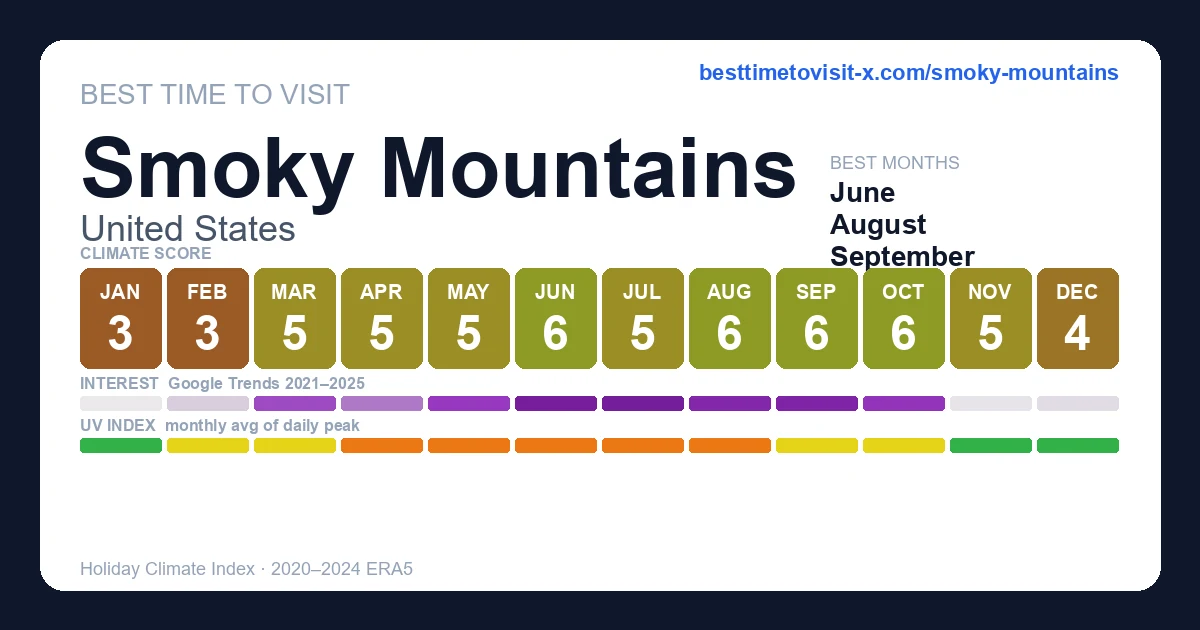
How is this scored? HCI / Steadman / CCI gate — full methodology and citations below.
Compare with another destination
Add as many as you like — stacked below the main strips above. Each row is just the recent-window score strip and (for beach destinations) sea-temperature strip.
Tours in Smoky Mountains
15 top-rated tours via Viator. Booking links earn this site a commission at no cost to you.
- 1
 Self-Guided Audio Driving Tour in Great Smoky Mountains
 - 2
 Great Smoky Mountains National Park Self-Guided Driving Tour
 - 3
 Great Smoky Mountains & Cades Cove Self-Guided Driving Tours
 - 4
 3-Hour Nantahala River Fully Guided Rafting Experience
 - 5
 Chasing Waterfalls: A Smoky Mountain Guided Hike
 - 6Cades Cove Sightseeing Self-Guided Driving Audio Tour
- 7
 River Magic: An Easy Smoky Mountain Guided Walk
 - 8
 Sharing Nature with Children: Hands-On Smoky Mountain Discovery
 - 9
 Museum of the Cherokee People Admission Ticket
 - 10
 Best of the Smokies: Full-Day Private Guided Adventure
 - 11
 The Mountains Are Calling Driving Tour to Newfound Gap
 - 12
 Fall Color Quest: Smoky Mountain Fall Foliage Hike
 - 13
 Great Smoky Mountains National Park Self-Guided Audio Tour
 - 14
 Clingmans Dome (Kuwochi) Self Guided Walking Audio Tour
 - 15
 Discover the Great Smoky Mountains: A Self-Guided Tour
Last refreshed 2026-08-13.
Similar climatesFüssen91% · Bern88% · Salzburg88%
Other destinations with the most-alike year-round climate to Smoky Mountains (apparent temperature, rain hours, sunshine — matched within the same trip-profile). The ±N chip compares each match's typical score for the current month against Smoky Mountains's. Based on the 2020-2024 climatology, not this year's actual weather.
Month-by-month
| Month | Temp °C | Feels °C | Rain days | Rain h | Rain h/day | Humidity | Wind km/h | Sun h | UV | Interest | Score |
|---|---|---|---|---|---|---|---|---|---|---|---|
| Jan | -6–3 | -1 | 15 | 233 | 15.5 | 69% | 18 | 133 | 2 | Quiet | 3 |
| Feb | -3–6 | 2 | 15 | 201 | 13.4 | 65% | 18 | 132 | 3 | Quiet | 3 |
| Mar | 0–10 | 6 | 13 | 177 | 13.6 | 59% | 19 | 187 | 5 | Busy | 5 |
| Apr | 2–12 | 9 | 15 | 178 | 11.9 | 57% | 18 | 212 | 7 | Moderate | 5 |
| May | 8–16 | 14 | 17 | 215 | 12.6 | 64% | 15 | 240 | 7 | Busy | 5 |
| Jun | 12–20 | 20 | 18 | 203 | 11.3 | 62% | 13 | 269 | 8 | Peak | 6 |
| Jul | 14–22 | 23 | 24 | 253 | 10.5 | 67% | 11 | 272 | 8 | Peak | 5 |
| Aug | 13–22 | 22 | 21 | 227 | 10.8 | 69% | 11 | 259 | 7 | Peak | 6 |
| Sep | 10–19 | 18 | 15 | 181 | 12.1 | 66% | 12 | 225 | 6 | Peak | 6 |
| Oct | 5–14 | 12 | 11 | 148 | 13.5 | 61% | 14 | 210 | 5 | Busy | 6 |
| Nov | 0–9 | 6 | 11 | 125 | 11.4 | 61% | 15 | 172 | 3 | Quiet | 5 |
| Dec | -3–6 | 2 | 14 | 184 | 13.1 | 65% | 17 | 141 | 2 | Quiet | 4 |
UV Index in Smoky Mountains by Month
UV index in Smoky Mountains peaks at 8 (high) in July, dropping to 2 (low) in December. April, May, June, July, August have high UV — SPF 30+ and sunglasses recommended.
Best months in detail
June
6/1012–20°C · 18 rain days (203h) · 269 sun hours · 62% humidity · Peak crowd · UV 8 (high) · sunniest 1 in 10 days reach 9 (very high)
September
6/1010–19°C · 15 rain days (181h) · 225 sun hours · 66% humidity · Peak crowd · UV 6 (moderate) · sunniest 1 in 10 days reach 8 (high)
October
6/105–14°C (feels 12°C) · 11 rain days (148h) · 210 sun hours · 61% humidity · Busy crowd · UV 5 (moderate) · sunniest 1 in 10 days reach 6 (high)
Every month
Show the other 9 months in detail
January
3/10-6–3°C (feels -1°C) · 15 rain days (233h) · 133 sun hours · 69% humidity · Quiet crowd · UV 2 (low) · sunniest 1 in 10 days reach 3 (moderate)
February
3/10-3–6°C (feels 2°C) · 15 rain days (201h) · 132 sun hours · 65% humidity · Quiet crowd · UV 3 (moderate)
March
5/100–10°C (feels 6°C) · 13 rain days (177h) · 187 sun hours · 59% humidity · Busy crowd · UV 5 (moderate) · sunniest 1 in 10 days reach 7 (high)
April
5/102–12°C (feels 9°C) · 15 rain days (178h) · 212 sun hours · 57% humidity · Moderate crowd · UV 7 (high) · sunniest 1 in 10 days reach 9 (very high)
May
5/108–16°C (feels 14°C) · 17 rain days (215h) · 240 sun hours · 64% humidity · Busy crowd · UV 7 (high) · sunniest 1 in 10 days reach 9 (very high)
July
5/1014–22°C · 24 rain days (253h) · 272 sun hours · 67% humidity · Peak crowd · UV 8 (high) · sunniest 1 in 10 days reach 10 (very high)
August
6/1013–22°C · 21 rain days (227h) · 259 sun hours · 69% humidity · Peak crowd · UV 7 (high) · sunniest 1 in 10 days reach 9 (very high)
November
5/100–9°C (feels 6°C) · 11 rain days (125h) · 172 sun hours · 61% humidity · Quiet crowd · UV 3 (low) · sunniest 1 in 10 days reach 4 (moderate)
December
4/10-3–6°C (feels 2°C) · 14 rain days (184h) · 141 sun hours · 65% humidity · Quiet crowd · UV 2 (low)
Cades Cove closes to cars every Wednesday all summer
The Smokies are the most visited national park in the United States, and the park manages that pressure with the calendar rather than with tickets. The 11-mile Cades Cove Loop Road — the single most congested drive in the park — is closed to motor vehicles every Wednesday from 6 May through 30 September, reserved for pedestrians and cyclists.
The other date-bound event is the synchronous fireflies, one of the few places in the world where the species flashes in unison. Access is by lottery on recreation.gov: the park issues 120 vehicle reservations per night, 960 in total for the event, which runs for a short window in late spring that shifts each year with the season.
Neither of these appears in a temperature chart, and both can define a trip.
Sources: NPS — Cades Cove vehicle-free days , NPS — Synchronous fireflies, Great Smoky Mountains
What is the best time for fall colors in the Smoky Mountains?
Mid-October to early November for the mid and lower elevations, which is the classic display. Colour starts higher up in late September and works downhill, so the park offers a long season — but it also draws the year's heaviest traffic, especially at weekends.
How many days do you need in the Smoky Mountains?
Three days. One for Cades Cove and the valley's historic buildings, one for Newfound Gap Road and Clingmans Dome, and one for waterfalls around Roaring Fork or the Tennessee side trails. The park spans two states and moving between areas takes longer than the distances suggest.
What is the prettiest part of the Smoky Mountains?
Cades Cove for the broad valley, wildlife at dawn and dusk, and preserved homesteads against the ridges. For long-range views, Newfound Gap Road and Clingmans Dome. For water and forest, the Roaring Fork Motor Nature Trail and the trails around Tremont.
When to avoid the Smoky Mountains?
October weekends, when leaf-peeping traffic can bring Cades Cove and Newfound Gap Road close to gridlock, and the mid-summer school holidays. If you must come then, be moving before 8am — the crowding is concentrated in the middle of the day. Cades Cove Loop Road is also closed to cars every Wednesday from 6 May to 30 September, which is ideal if you cycle.
What is the best month for Great Smoky Mountains?
October for autumn colour, which is the park's signature season, or May and June for wildflowers and waterfalls at full flow. July is warmest at about 22C but also the wettest month at around 155 mm, with regular afternoon thunderstorms. October pairs the best colour with the driest conditions of the year.
What is the rainiest month in the Smoky Mountains?
July, at around 155 mm, driven by afternoon thunderstorms; October is the driest at about 97 mm. This is a temperate rainforest and no month is genuinely dry, which is what sustains the park's famous mist. Higher elevations receive substantially more rain than the valley figures suggest.
What month are bears most active in the Smoky Mountains?
Spring through autumn, with a marked increase in autumn as bears feed heavily on acorns before winter. The park has one of the densest black bear populations in the eastern United States. Store food properly, never approach for a photograph, and treat roadside sightings as the traffic hazard they are in Cades Cove.
When not to visit Gatlinburg?
October weekends and the mid-summer school holidays, when the gateway towns and the park road through them can approach gridlock. If autumn colour is the goal, come midweek and be moving before 8am. The crowding is heavily concentrated in the middle of the day and at the main Cades Cove and Newfound Gap access points.
What's the cheapest month to go to Gatlinburg?
January and February, when gateway lodging drops sharply after the holidays. The park stays open, the bare trees open up long views normally hidden by foliage, and the trails are quiet. The trade-off is cold — January lows average around −6C — and Clingmans Dome Road and some higher routes close for winter.
What not to miss in the Smoky Mountains?
The Cades Cove loop at dawn for wildlife and preserved homesteads, Clingmans Dome for the highest view in the park, the Roaring Fork Motor Nature Trail for waterfalls and old-growth forest, and Newfound Gap Road for the drive across the ridge. If you cycle, Cades Cove is closed to cars every Wednesday from 6 May to 30 September.
Why is Great Smoky Mountains the most visited national park?
Position and price. It sits within a day's drive of a large share of the US population, has no entrance fee, and two major roads run through it, so it is unusually easy to reach and to sample. That accessibility is also why October weekends can approach gridlock — the visitor numbers are concentrated into a few roads and viewpoints.
Is Gatlinburg or Pigeon Forge better for visiting the park?
Gatlinburg sits directly at the park entrance, so it is closer for early starts and you can reach trailheads faster. Pigeon Forge is a few miles further out, larger and cheaper, with more family attractions. If your priority is being in the park at dawn — which is when Cades Cove is at its best — Gatlinburg wins on those few miles.
Frequently asked questions about visiting Smoky Mountains
When is the best time to visit Smoky Mountains?
June is the highest-scoring month (6/10 on the Holiday Climate Index). Typical conditions: 12–20°C (18 rainy days). The top three months by score are June, September, October.
What is the worst time to visit Smoky Mountains?
January is the lowest-scoring month (3/10). Typical conditions: -6–3°C (15 rainy days).
When are crowds lowest in Smoky Mountains?
Search-interest seasonality (Google Trends 2021-2025) is lowest in January and peaks in July. Interest tracks both in-trip visitors and lead-time planners, so treat it as a "destination is on people's minds" signal rather than literal arrivals.
What is the UV index in Smoky Mountains by month?
UV peaks at 8 (high) in July and is lowest in December at 2 (low). Monthly peak values: Jan 2, Feb 3, Mar 5, Apr 7, May 7, Jun 8, Jul 8, Aug 7, Sep 6, Oct 5, Nov 3, Dec 2.
What is the UV index in Smoky Mountains in July?
July is the peak UV month in Smoky Mountains, with a daily-peak UV index of 8 (high). Apply SPF 30+, wear sunglasses, and seek shade during midday hours.
How high can UV get in Smoky Mountains on the sunniest days?
Most days look like the monthly average, but on the sunniest ~1 in 10 days UV climbs higher than the mean suggests. July is the worst case: typical days average UV 8 (high), but the top 10% of days reach UV 10 (very high) — and even higher. Months where the sunniest days routinely exceed the typical reading: January, March, April, May, June, July, August, September, October, November. Plan sun protection for the worst case, not the average.
Is air quality in Smoky Mountains bad for travelers?
PM2.5 (fine-particle pollution) exceeds the WHO sensitive-group guideline (15 µg/m³) in 1 month: June. The worst month is June with a typical-day mean of 11 µg/m³ (moderate); on the worst 10% of days PM2.5 reaches 18 µg/m³ (unhealthy for sensitive) and higher. People with asthma, heart conditions, or sensitive children may want to avoid these months or limit outdoor activity. Source: CAMS via Open-Meteo.