Best time to visit Rhodes
Re-score for me — drag the dial — every chart recolours live for your heat & sea limits 27°C · sea 29°C
Default 27 °C is the upper edge of the Holiday Climate Index "ideal comfort" band (Scott, Rutty, Amelung & Tang, 2016). Above this, most warm-tourism travellers report measurable discomfort.
Default 29 °C is the Beach Climate Index "bathtub" line (Morgan et al.) — where the sea stops being refreshing and starts feeling like a warm bath.
Greyed factors are scored normally — extreme heat overrides them, so a clear sky or low rain can't lift the period.
Greyed factors are scored normally — extreme heat overrides them, so a clear sky or low rain can't lift the period.
Greyed factors are scored normally — extreme heat overrides them, so a clear sky or low rain can't lift the period.
Greyed factors are scored normally — extreme heat overrides them, so a clear sky or low rain can't lift the period.
Greyed factors are scored normally — extreme heat overrides them, so a clear sky or low rain can't lift the period.
Greyed factors are scored normally — extreme heat overrides them, so a clear sky or low rain can't lift the period.
Greyed factors are scored normally — extreme heat overrides them, so a clear sky or low rain can't lift the period.
Greyed factors are scored normally — extreme heat overrides them, so a clear sky or low rain can't lift the period.
Greyed factors are scored normally — extreme heat overrides them, so a clear sky or low rain can't lift the period.
Greyed factors are scored normally — extreme heat overrides them, so a clear sky or low rain can't lift the period.
Greyed factors are scored normally — extreme heat overrides them, so a clear sky or low rain can't lift the period.
Greyed factors are scored normally — extreme heat overrides them, so a clear sky or low rain can't lift the period.
Greyed factors are scored normally — extreme heat overrides them, so a clear sky or low rain can't lift the period.
Greyed factors are scored normally — extreme heat overrides them, so a clear sky or low rain can't lift the period.
Greyed factors are scored normally — extreme heat overrides them, so a clear sky or low rain can't lift the period.
Greyed factors are scored normally — extreme heat overrides them, so a clear sky or low rain can't lift the period.
Greyed factors are scored normally — extreme heat overrides them, so a clear sky or low rain can't lift the period.
Greyed factors are scored normally — extreme heat overrides them, so a clear sky or low rain can't lift the period.
Greyed factors are scored normally — extreme heat overrides them, so a clear sky or low rain can't lift the period.
How is this scored? HCI / Steadman / CCI gate — full methodology and citations below.
Compare with another destination
Add as many as you like — stacked below the main strips above. Each row is just the recent-window score strip and (for beach destinations) sea-temperature strip.
Tours in Rhodes
15 top-rated tours via Viator. Booking links earn this site a commission at no cost to you. Map locations are approximate (centred on Rhodes).
- 1
 Makarounas Fishing Boat Trip with swimming stop and BBQ on board
 - 2
 Athens cruise: Agistri, Moni/Metopi, Aegina with lunch & drinks
 - 3
 Rhodes Day Cruise (with lunch & unlimited drinks) 5,5 Hours
 - 4
 1 Hour Private Photoshoot in Rhodes
 - 5
 4x4 Buggy Adventures - Off-road Polaris Experience
 - 6
 Bay to Bay Cruise in Lindos
 - 7
 Hippo Classic Ride With Swim
 - 8
 3-Hours Sunset Catamaran Cruise with Dinner all Inclusive
 - 9
 Private daily Cruise or Sunset for Swimming Max 15 persons
 - 10
 Rhodes Exclusive Swim Cruise Cocktail Open bar & Gourmet Buffet
 - 11
 From Rhodes: Easy Morning Transfer to Lindos & 4 Hours Free Time
 - 12
 Sun & Sea All Inclusive 3 Hour Swimming Cruise (WITH PICK UP SERVICE)
 - 13
 Rhodes Bay to Bay Swim Cruise-Greek Buffet w/wine included
 - 14
 From Rhodes: Lindos Evening Escape & 4 Hours Free Time
 - 15
 Rhodes Private Walking Tour with a Professional Guide
Last refreshed 2026-05-30.
Similar climatesBodrum97% · Kaş96% · Kos96%
Other destinations with the most-alike year-round climate to Rhodes (apparent temperature, rain hours, sunshine — matched within the same trip-profile). The ±N chip compares each match's typical score for the current month against Rhodes's. Based on the 2020-2024 climatology, not this year's actual weather.
Month-by-month
| Month | Temp °C | Feels °C | Rain days | Rain h | Rain h/day | Humidity | Wind km/h | Sun h | UV | Interest | Score |
|---|---|---|---|---|---|---|---|---|---|---|---|
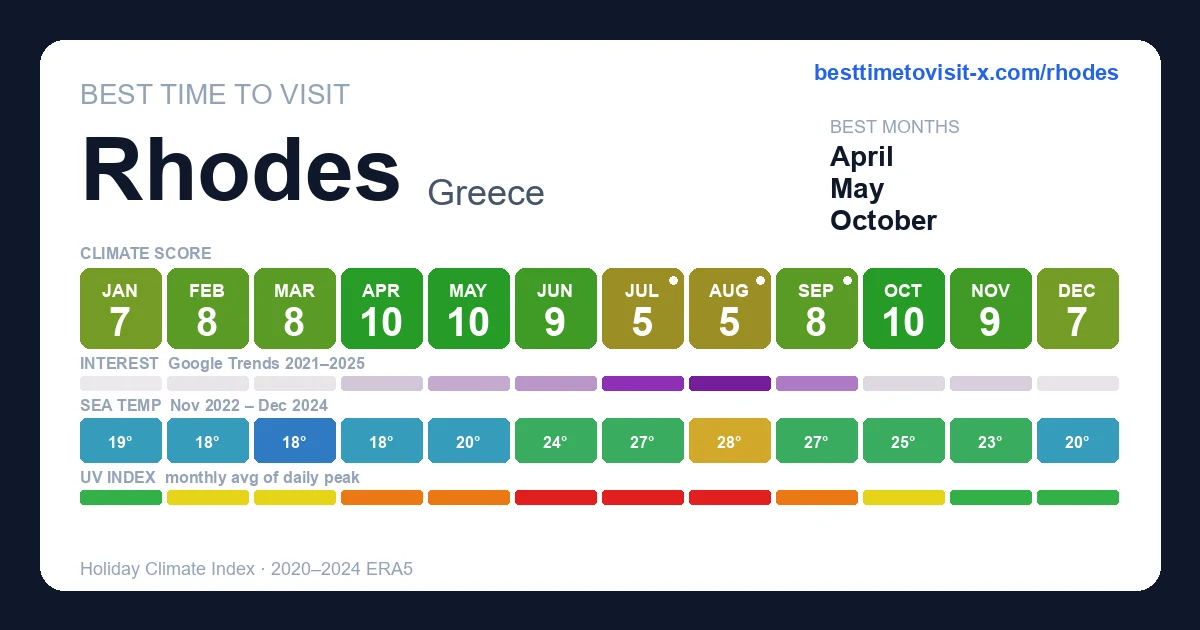
| Jan | 11–16 | 12 | 11 | 130 | 11.8 | 62% | 23 | 184 | 2 | Quiet | 7 |
| Feb | 11–16 | 13 | 7 | 78 | 11.1 | 59% | 23 | 195 | 3 | Quiet | 8 |
| Mar | 12–17 | 14 | 7 | 91 | 13.0 | 57% | 24 | 235 | 4 | Quiet | 8 |
| Apr | 15–21 | 19 | 4 | 38 | 9.5 | 53% | 24 | 251 | 6 | Peak | 10 |
| May | 18–26 | 24 | 3 | 33 | 11.0 | 47% | 23 | 302 | 7 | Moderate | 10 |
| Jun | 22–30 | 29 | 1 | 15 | 15.0 | 45% | 24 | 311 | 9 | Busy | 9 |
| Jul | 25–34 | 34 | 0 | 2 | — | 37% | 23 | 322 | 10 | Peak | 5 |
| Aug | 26–33 | 34 | 0 | 4 | — | 43% | 24 | 298 | 9 | Peak | 5 |
| Sep | 24–30 | 30 | 1 | 10 | 10.0 | 44% | 23 | 267 | 7 | Moderate | 8 |
| Oct | 20–26 | 26 | 3 | 34 | 11.3 | 50% | 18 | 237 | 5 | Quiet | 10 |
| Nov | 16–21 | 20 | 6 | 80 | 13.3 | 57% | 19 | 200 | 3 | Quiet | 9 |
| Dec | 13–18 | 16 | 11 | 156 | 14.2 | 67% | 21 | 189 | 2 | Quiet | 7 |
UV Index in Rhodes by Month
UV index in Rhodes peaks at 10 (very high) in July, dropping to 2 (low) in January. June, July, August reach very high or extreme levels — apply SPF 50+, wear a hat and protective clothing, and limit direct sun between 11:00 and 17:00.
Best months in detail
October
10/1020–26°C · 3 rain days (34h) · 237 sun hours · 50% humidity · Quiet crowd · UV 5 (moderate) · sunniest 1 in 10 days reach 6 (high)
May
10/1018–26°C (feels 24°C) · 3 rain days (33h) · 302 sun hours · 47% humidity · Moderate crowd · UV 7 (high) · sunniest 1 in 10 days reach 9 (very high)
April
10/1015–21°C (feels 19°C) · 4 rain days (38h) · 251 sun hours · 53% humidity · Peak crowd · UV 6 (high)
Every month
Show the other 9 months in detail
January
7/1011–16°C (feels 12°C) · 11 rain days (130h) · 184 sun hours · 62% humidity · Quiet crowd · UV 2 (low)
February
8/1011–16°C (feels 13°C) · 7 rain days (78h) · 195 sun hours · 59% humidity · Quiet crowd · UV 3 (moderate)
March
8/1012–17°C (feels 14°C) · 7 rain days (91h) · 235 sun hours · 57% humidity · Quiet crowd · UV 4 (moderate)
June
9/1022–30°C · 1 rain days (15h) · 311 sun hours · 45% humidity · Busy crowd · UV 9 (very high)
July
5/1025–34°C · 0 rain days (2h) · 322 sun hours · 37% humidity · Peak crowd · UV 10 (very high)
August
5/1026–33°C · 0 rain days (4h) · 298 sun hours · 43% humidity · Peak crowd · UV 9 (very high)
September
8/1024–30°C · 1 rain days (10h) · 267 sun hours · 44% humidity · Moderate crowd · UV 7 (high)
November
9/1016–21°C (feels 20°C) · 6 rain days (80h) · 200 sun hours · 57% humidity · Quiet crowd · UV 3 (low) · sunniest 1 in 10 days reach 3 (moderate)
December
7/1013–18°C (feels 16°C) · 11 rain days (156h) · 189 sun hours · 67% humidity · Quiet crowd · UV 2 (low)
The ticket price tells you when the butterflies are actually there
Rhodes' Valley of the Butterflies runs on an insect's breeding cycle rather than on the weather, and the operator's own price list quietly encodes it. The gate is shut completely from 1 November to 11 April. It reopens at 3 euros, rises to 6 euros for the roughly fourteen weeks when the moths are actually massed on the trunks, then drops back to 3 for October.
The insect is Euplagia quadripunctaria rhodosensis, a subspecies endemic to Rhodes, drawn in by the resin of the oriental sweetgum trees that fill the gorge. It gathers from July to September and is densest in August. The adult moth does not feed at all — it lives on stored fat — which is why the site's one posted rule is silence. Clapping or whistling to make the swarm fly burns reserves the animal cannot replace.
So a May or October visit gives you an identical beach climate score and a near-empty gorge. The 3-euro ticket is the site telling you so.
Sources: Greek National Tourism Organisation — Valley of the Butterflies , Valley of the Butterflies, Rhodes — official site
What is the best month to go to Rhodes?
May, June, September or early October. All four give warm sea and comfortable sightseeing without August's peak near 29C, which is also the crowd peak. August is genuinely rainless — our records show about 0mm — so if reliable dry heat is the point, that is the month, accepting the company and the prices.
How many days in Rhodes is enough?
Four to five. One for the medieval Old Town, one for Lindos and the east coast beaches, one for the Valley of the Butterflies and the interior, and one or two for the beaches proper. The island is large — around 80 km end to end — so a hire car materially changes what you can reach.
When is the Valley of the Butterflies open?
12 April to 31 October, daily 08:00 to 18:00, closed entirely from 1 November to 11 April. Admission is tiered at 3 euros in the shoulder weeks and 6 euros through the peak of the moth season, which ends 30 September. Children under 12 enter free. The tiering tracks the insects, not the crowds.
When are the butterflies actually in the Valley of the Butterflies?
July to September, densest in August. They are not butterflies but Jersey tiger moths of a subspecies endemic to Rhodes, drawn by the resin of oriental sweetgum trees. Visit in April, May or October and the valley is a pleasant shaded gorge with very few insects in it — which is what the lower ticket price reflects.
Which is nicer, Crete or Rhodes?
Crete is far larger and more varied, with mountains, gorges and several distinct regions — it rewards two weeks. Rhodes is more compact and has the better preserved medieval town, which is UNESCO-listed. For a first Greek island trip with a hire car, Crete; for walkable history and beaches in one week, Rhodes.
How hot is Rhodes by month?
August is warmest at about 29C by day and effectively rainless, with July close behind. February is the coolest month with lows near 11C — mild, and the island stays inhabited and reachable year-round. December is the wettest month at around 113mm, which is when the winter greenery returns.
Is Rhodes Old Town worth visiting?
Yes — the medieval city is UNESCO-listed and still inhabited, with the Palace of the Grand Master and the Street of the Knights the set pieces. Roughly 6,000 people live inside its walls. Go early or in the evening: it takes heavy cruise traffic through the middle of the day in season.
When does the meltemi blow in Rhodes?
June to September, strongest from mid-July to late August. It builds through the day and peaks in the afternoon, easing overnight, so morning ferry crossings are the safer booking. High-speed craft stop sailing at around force 7, and cancellations in August are common enough to be worth planning around.
Is Rhodes affected by the 2023 wildfires?
The fires affected the south-central interior, with around 19,000 people evacuated at the time. Villages have been rebuilt and reopened and the main resort areas were not left damaged. It is not a reason to change when you go — the recovery is done, and the practical seasonality of the island is unchanged.
What is the driest month in Rhodes?
August, which records essentially no rain at all in our 1991-2020 normals. The dry season runs from roughly May to September, and the wet half of the year is concentrated between November and February, peaking in December at about 113mm. That winter rain is what makes the island green in spring.
Frequently asked questions about visiting Rhodes
When is the best time to visit Rhodes?
October is the highest-scoring month (10/10 on the Holiday Climate Index). Typical conditions: 20–26°C (3 rainy days). The top three months by score are October, May, April.
What is the worst time to visit Rhodes?
July is the lowest-scoring month (5/10, capped by extreme heat). Typical conditions: 25–34°C (0 rainy days).
Is Rhodes too hot in summer?
3 months (July, August, September) trip the heat deal-breaker in our scoring: apparent temperature crosses the comfort cap, so even with clear skies and low rain the score is held down. Plan around it if heat tolerance is low.
When are crowds lowest in Rhodes?
Search-interest seasonality (Google Trends 2021-2025) is lowest in December and peaks in July. Interest tracks both in-trip visitors and lead-time planners, so treat it as a "destination is on people's minds" signal rather than literal arrivals.
Which months in Rhodes have good weather but fewer tourists?
October (climate 10/10, crowd index 19) and November (climate 9/10, crowd index 1) — shoulder months with above-average climate and below-median search-interest. Often the best value-for-weather trade.
What is the UV index in Rhodes by month?
UV peaks at 10 (very high) in July and is lowest in January at 2 (low). Monthly peak values: Jan 2, Feb 3, Mar 4, Apr 6, May 7, Jun 9, Jul 10, Aug 9, Sep 7, Oct 5, Nov 3, Dec 2. June, July, August reach very high or extreme levels — apply SPF 50+, wear a hat and protective clothing, and limit direct sun between 11:00 and 17:00.
What is the UV index in Rhodes in July?
July is the peak UV month in Rhodes, with a daily-peak UV index of 10 (very high). At this level, sunburn can occur in under 20 minutes on unprotected fair skin. Apply SPF 50+, wear protective clothing and a hat, and avoid direct midday sun (11:00–17:00).
How high can UV get in Rhodes on the sunniest days?
Most days look like the monthly average, but on the sunniest ~1 in 10 days UV climbs higher than the mean suggests. May is the worst case: typical days average UV 7 (high), but the top 10% of days reach UV 9 (very high) — and even higher. Months where the sunniest days routinely exceed the typical reading: May, October, November. Plan sun protection for the worst case, not the average.
Is air quality in Rhodes bad for travelers?
PM2.5 (fine-particle pollution) exceeds the WHO sensitive-group guideline (15 µg/m³) in 5 months: March, May, June, July, August. The worst month is August with a typical-day mean of 12 µg/m³ (moderate); on the worst 10% of days PM2.5 reaches 16 µg/m³ (unhealthy for sensitive) and higher. People with asthma, heart conditions, or sensitive children may want to avoid these months or limit outdoor activity. Source: CAMS via Open-Meteo.