Best time to visit Hydra
Re-score for me — drag the dial — every chart recolours live for your heat & sea limits 27°C · sea 29°C
Default 27 °C is the upper edge of the Holiday Climate Index "ideal comfort" band (Scott, Rutty, Amelung & Tang, 2016). Above this, most warm-tourism travellers report measurable discomfort.
Default 29 °C is the Beach Climate Index "bathtub" line (Morgan et al.) — where the sea stops being refreshing and starts feeling like a warm bath.
Greyed factors are scored normally — extreme heat overrides them, so a clear sky or low rain can't lift the period.
Greyed factors are scored normally — extreme heat overrides them, so a clear sky or low rain can't lift the period.
Greyed factors are scored normally — extreme heat overrides them, so a clear sky or low rain can't lift the period.
Greyed factors are scored normally — extreme heat overrides them, so a clear sky or low rain can't lift the period.
Greyed factors are scored normally — extreme heat overrides them, so a clear sky or low rain can't lift the period.
Greyed factors are scored normally — extreme heat overrides them, so a clear sky or low rain can't lift the period.
Greyed factors are scored normally — extreme heat overrides them, so a clear sky or low rain can't lift the period.
Greyed factors are scored normally — extreme heat overrides them, so a clear sky or low rain can't lift the period.
Greyed factors are scored normally — extreme heat overrides them, so a clear sky or low rain can't lift the period.
Greyed factors are scored normally — extreme heat overrides them, so a clear sky or low rain can't lift the period.
Greyed factors are scored normally — extreme heat overrides them, so a clear sky or low rain can't lift the period.
Greyed factors are scored normally — extreme heat overrides them, so a clear sky or low rain can't lift the period.
Greyed factors are scored normally — extreme heat overrides them, so a clear sky or low rain can't lift the period.
Greyed factors are scored normally — extreme heat overrides them, so a clear sky or low rain can't lift the period.
Greyed factors are scored normally — extreme heat overrides them, so a clear sky or low rain can't lift the period.
Greyed factors are scored normally — extreme heat overrides them, so a clear sky or low rain can't lift the period.
Greyed factors are scored normally — extreme heat overrides them, so a clear sky or low rain can't lift the period.
How is this scored? HCI / Steadman / CCI gate — full methodology and citations below.
Compare with another destination
Add as many as you like — stacked below the main strips above. Each row is just the recent-window score strip and (for beach destinations) sea-temperature strip.
Similar climatesAthens98% · Spetses98% · Nafplio97%
Other destinations with the most-alike year-round climate to Hydra (apparent temperature, rain hours, sunshine — matched within the same trip-profile). The ±N chip compares each match's typical score for the current month against Hydra's. Based on the 2020-2024 climatology, not this year's actual weather.
Month-by-month
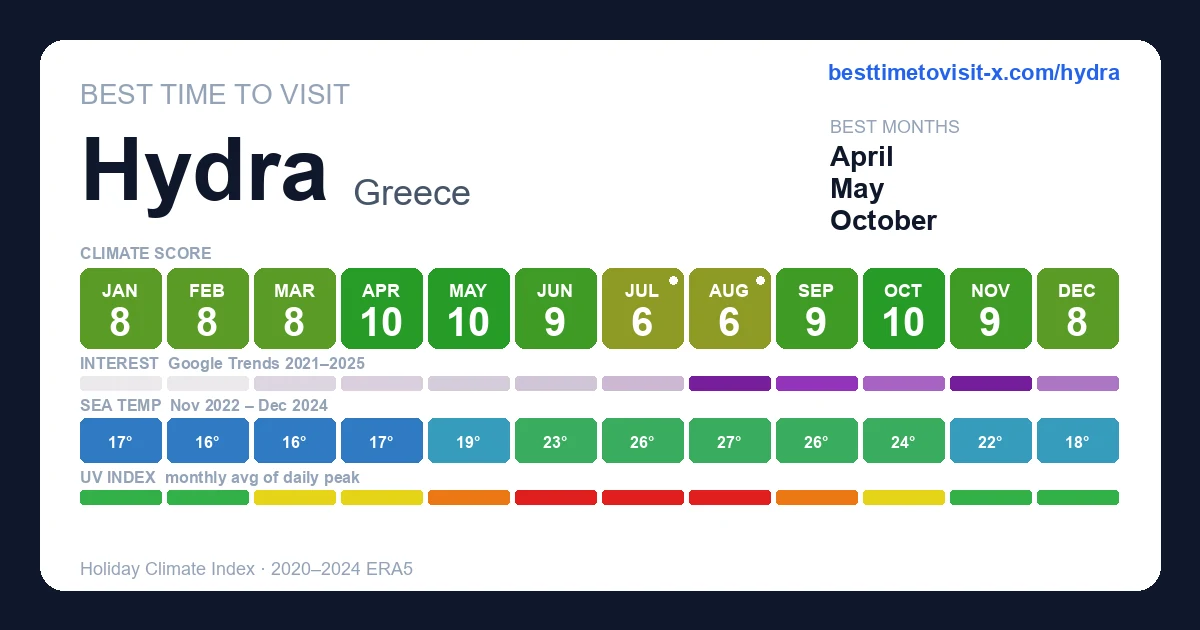
| Month | Temp °C | Feels °C | Rain days | Rain h | Rain h/day | Humidity | Wind km/h | Sun h | UV | Interest | Score |
|---|---|---|---|---|---|---|---|---|---|---|---|
| Jan | 9–14 | 11 | 8 | 79 | 9.9 | 63% | 22 | 175 | 2 | Quiet | 8 |
| Feb | 9–15 | 12 | 5 | 67 | 13.4 | 60% | 20 | 186 | 3 | Quiet | 8 |
| Mar | 10–16 | 13 | 8 | 78 | 9.8 | 55% | 19 | 223 | 4 | Quiet | 8 |
| Apr | 13–20 | 18 | 5 | 52 | 10.4 | 48% | 19 | 248 | 6 | Quiet | 10 |
| May | 17–25 | 23 | 4 | 45 | 11.3 | 45% | 16 | 279 | 7 | Quiet | 10 |
| Jun | 22–30 | 30 | 3 | 25 | 8.3 | 41% | 17 | 302 | 9 | Quiet | 9 |
| Jul | 26–34 | 33 | 1 | 12 | 12.0 | 33% | 20 | 314 | 9 | Moderate | 6 |
| Aug | 25–33 | 33 | 2 | 21 | 10.5 | 38% | 18 | 299 | 8 | Peak | 6 |
| Sep | 22–29 | 29 | 4 | 39 | 9.8 | 46% | 18 | 255 | 6 | Busy | 9 |
| Oct | 18–24 | 23 | 3 | 45 | 15.0 | 52% | 18 | 228 | 4 | Moderate | 10 |
| Nov | 14–19 | 18 | 6 | 67 | 11.2 | 61% | 20 | 182 | 3 | Busy | 9 |
| Dec | 11–16 | 14 | 9 | 100 | 11.1 | 68% | 20 | 169 | 2 | Quiet | 8 |
UV Index in Hydra by Month
UV index in Hydra peaks at 9 (very high) in July, dropping to 2 (low) in December. June, July, August reach very high or extreme levels — apply SPF 50+, wear a hat and protective clothing, and limit direct sun between 11:00 and 17:00.
Best months in detail
October
10/1018–24°C (feels 23°C) · 3 rain days (45h) · 228 sun hours · 52% humidity · Moderate crowd · UV 4 (moderate)
May
10/1017–25°C (feels 23°C) · 4 rain days (45h) · 279 sun hours · 45% humidity · Quiet crowd · UV 7 (high) · sunniest 1 in 10 days reach 8 (very high)
April
10/1013–20°C (feels 18°C) · 5 rain days (52h) · 248 sun hours · 48% humidity · Quiet crowd · UV 6 (moderate) · sunniest 1 in 10 days reach 7 (high)
Every month
Show the other 9 months in detail
January
8/109–14°C (feels 11°C) · 8 rain days (79h) · 175 sun hours · 63% humidity · Quiet crowd · UV 2 (low)
February
8/109–15°C (feels 12°C) · 5 rain days (67h) · 186 sun hours · 60% humidity · Quiet crowd · UV 3 (low) · sunniest 1 in 10 days reach 4 (moderate)
March
8/1010–16°C (feels 13°C) · 8 rain days (78h) · 223 sun hours · 55% humidity · Quiet crowd · UV 4 (moderate)
June
9/1022–30°C · 3 rain days (25h) · 302 sun hours · 41% humidity · Quiet crowd · UV 9 (very high)
July
6/1026–34°C · 1 rain days (12h) · 314 sun hours · 33% humidity · Moderate crowd · UV 9 (very high)
August
6/1025–33°C · 2 rain days (21h) · 299 sun hours · 38% humidity · Peak crowd · UV 8 (very high)
September
9/1022–29°C · 4 rain days (39h) · 255 sun hours · 46% humidity · Busy crowd · UV 6 (high)
November
9/1014–19°C (feels 18°C) · 6 rain days (67h) · 182 sun hours · 61% humidity · Busy crowd · UV 3 (low) · sunniest 1 in 10 days reach 4 (moderate)
December
8/1011–16°C (feels 14°C) · 9 rain days (100h) · 169 sun hours · 68% humidity · Quiet crowd · UV 2 (low)
Even bicycles are banned, under heritage law not traffic law
The ban is real and it does cover bicycles — but it is not a presidential decree from the 1950s. Hydra is protected as cultural heritage: ministerial decisions declared the whole settlement a historic site in 1962 and a place of special natural beauty in 1975, and a 1996 decision declared the entire island an archaeological site. The traffic ban sits inside that framework, which is why the Ministry of Culture controls it, not the municipality.
In May 2025 the Ephorate of Antiquities of Piraeus and Islands set the position out in writing to the island police: circulation of any wheeled vehicle is forbidden, bicycles included, with a handful of named exceptions. The operative traffic order is a 1991 decision of the Prefect of Piraeus, which permits the municipality four refuse vehicles. Fire engines and vehicles carrying a disabled person are exempt outright; an ambulance and a hearse were each approved one at a time. A 2017 request to let the island's own police use two motorcycles was refused.
Construction machinery is the one real loophole, and a narrow one. It needs a Ministry permit, and none are granted between May and October — explicitly so the island's mules are not left hauling building material through the tourist season. Since July 2025 the permit system runs through gov.gr, with a public register of approved vehicles and a channel for reporting the ones that are not.
Sources: Ephorate of Antiquities of Piraeus and Islands (Ministry of Culture) — terms for the possession and use of wheeled vehicles on Hydra, 8 May 2025 , Government Gazette B' 3935 of 22 July 2025 — joint ministerial decision 23216/2025 on vehicle approvals and reports for Hydra
Are bicycles allowed on Hydra?
No, and this is the detail most visitors get wrong. In May 2025 the Ephorate of Antiquities of Piraeus and Islands confirmed in writing that the prohibition covers every wheeled vehicle, bicycles included, and the Port Authority asked ferry crews to tell passengers before they board. E-scooters are named in the 2025 gazette text as well.
Is the Hydra vehicle ban a presidential decree?
No, though it is often described that way. It rests on heritage law: ministerial decisions of 1962, 1967 and 1975 declared the settlement a historic site and the island a place of special natural beauty, and a 1996 decision declared the whole island an archaeological site. The operative traffic order is a 1991 decision of the Prefect of Piraeus.
What vehicles are actually allowed on Hydra?
A named handful. The municipality runs refuse trucks and a small open truck with a crane; fire engines and vehicles carrying a disabled person are exempt outright; an ambulance and a hearse were each approved individually. A 2017 request to let the island's own police use two service motorcycles was refused. Everything else needs a permit.
Is the ban actually enforced on Hydra?
Imperfectly, which is why the rules were tightened. Residents complained through 2025 that cars, mopeds and bicycles were appearing anyway; the Port Authority issued a public notice, arrests followed, and from July 2025 permits moved onto gov.gr with a public register of approved vehicles and an online reporting channel. Enforcement falls to the police and the Port Authority.
How do you get around Hydra?
On foot, by mule or donkey, and by water taxi along the coast. The town rises in steps above a horseshoe harbour and most doors cannot be reached any other way. It is also why the Ministry of Culture refuses construction permits from May to October — to keep heavy material off the island's animals in the busy months.
How many days should you spend in Hydra?
Two nights is the sweet spot. One full day covers the harbour, the coastal path to Kamini and Vlychos, and a swim; the second lets you climb to the monasteries above the town or take a boat to a further beach. Day-trippers from Athens see only the harbour, which is the least interesting part of the island.
What is the best month to visit Hydra?
May, June or September. All three give warm sea and comfortable walking weather without August's peak near 31C, which matters on an island where every journey is on foot and uphill. September holds the warmest water of the year, around 26C. Winter is mild at around 8C but many restaurants close.
How long is the ferry from Athens to Hydra?
Roughly 90 minutes to two hours by fast hydrofoil from Piraeus, with several sailings a day in summer and a thinner winter timetable. There is no airport and no car ferry. Crossings can be cancelled in strong meltemi winds, so leave a buffer if you have a flight to catch afterwards.
Is Hydra an expensive island?
More expensive than the mainland and than larger islands, for a structural reason: everything arrives by boat and moves by mule, which raises the cost of goods and of building anything at all. Accommodation is limited, so summer rates are high. Eating away from the harbour front is noticeably cheaper.
Is Hydra too touristy?
The harbour is busy in July and August with day-trippers off the Athens hydrofoils, and the island absorbs them poorly precisely because it is small — but they leave by early evening. Stay overnight and the town empties into something genuinely quiet. Walk fifteen minutes along the coast path and the crowd disappears entirely.
Frequently asked questions about visiting Hydra
When is the best time to visit Hydra?
October is the highest-scoring month (10/10 on the Holiday Climate Index). Typical conditions: 18–24°C (3 rainy days). The top three months by score are October, May, April.
What is the worst time to visit Hydra?
July is the lowest-scoring month (6/10, capped by extreme heat). Typical conditions: 26–34°C (1 rainy day).
Is Hydra too hot in summer?
2 months (July, August) trip the heat deal-breaker in our scoring: apparent temperature crosses the comfort cap, so even with clear skies and low rain the score is held down. Plan around it if heat tolerance is low.
When are crowds lowest in Hydra?
Search-interest seasonality (Google Trends 2021-2025) is lowest in March and peaks in August. Interest tracks both in-trip visitors and lead-time planners, so treat it as a "destination is on people's minds" signal rather than literal arrivals.
Which months in Hydra have good weather but fewer tourists?
April (climate 10/10, crowd index 17) and May (climate 10/10, crowd index 20) — shoulder months with above-average climate and below-median search-interest. Often the best value-for-weather trade.
What is the UV index in Hydra by month?
UV peaks at 9 (very high) in July and is lowest in December at 2 (low). Monthly peak values: Jan 2, Feb 3, Mar 4, Apr 6, May 7, Jun 9, Jul 9, Aug 8, Sep 6, Oct 4, Nov 3, Dec 2. June, July, August reach very high or extreme levels — apply SPF 50+, wear a hat and protective clothing, and limit direct sun between 11:00 and 17:00.
What is the UV index in Hydra in July?
July is the peak UV month in Hydra, with a daily-peak UV index of 9 (very high). At this level, sunburn can occur in under 20 minutes on unprotected fair skin. Apply SPF 50+, wear protective clothing and a hat, and avoid direct midday sun (11:00–17:00).
How high can UV get in Hydra on the sunniest days?
Most days look like the monthly average, but on the sunniest ~1 in 10 days UV climbs higher than the mean suggests. May is the worst case: typical days average UV 7 (high), but the top 10% of days reach UV 8 (very high) — and even higher. Months where the sunniest days routinely exceed the typical reading: February, April, May, November. Plan sun protection for the worst case, not the average.
Is air quality in Hydra bad for travelers?
PM2.5 (fine-particle pollution) exceeds the WHO sensitive-group guideline (15 µg/m³) in 1 month: July. The worst month is July with a typical-day mean of 10 µg/m³ (moderate); on the worst 10% of days PM2.5 reaches 16 µg/m³ (unhealthy for sensitive) and higher. People with asthma, heart conditions, or sensitive children may want to avoid these months or limit outdoor activity. Source: CAMS via Open-Meteo.