Best time to visit Cagliari
Re-score for me — drag the dial — every chart recolours live for your heat & sea limits 27°C · sea 29°C
Default 27 °C is the upper edge of the Holiday Climate Index "ideal comfort" band (Scott, Rutty, Amelung & Tang, 2016). Above this, most warm-tourism travellers report measurable discomfort.
Default 29 °C is the Beach Climate Index "bathtub" line (Morgan et al.) — where the sea stops being refreshing and starts feeling like a warm bath.
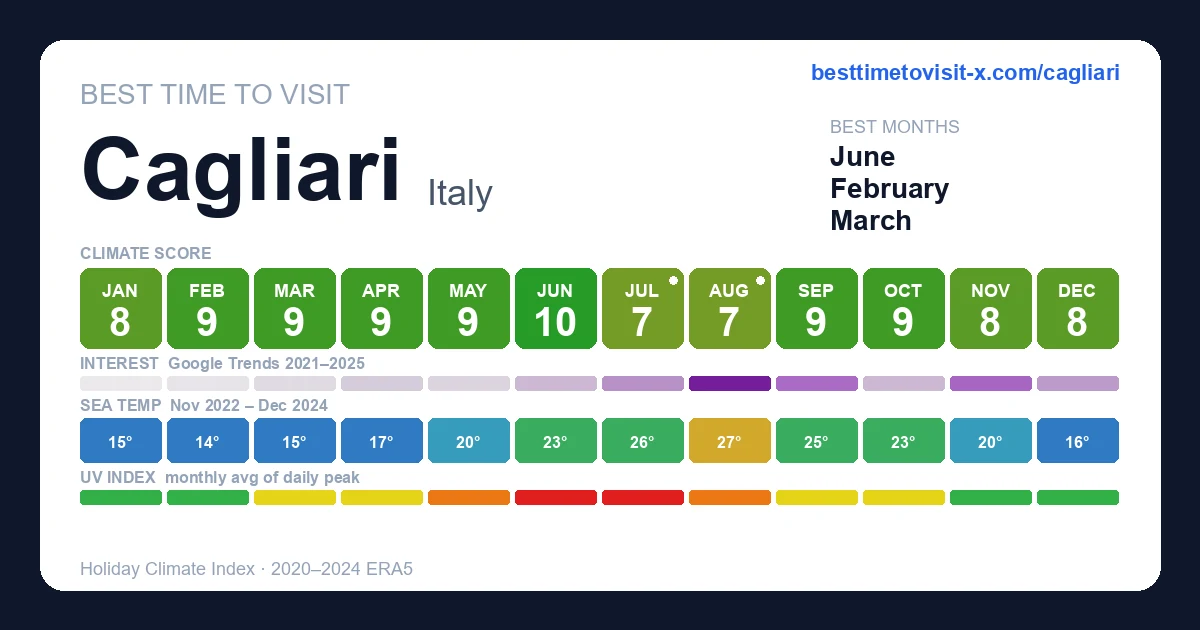
Greyed factors are scored normally — extreme heat overrides them, so a clear sky or low rain can't lift the period.
Greyed factors are scored normally — extreme heat overrides them, so a clear sky or low rain can't lift the period.
Greyed factors are scored normally — extreme heat overrides them, so a clear sky or low rain can't lift the period.
Greyed factors are scored normally — extreme heat overrides them, so a clear sky or low rain can't lift the period.
Greyed factors are scored normally — extreme heat overrides them, so a clear sky or low rain can't lift the period.
Greyed factors are scored normally — extreme heat overrides them, so a clear sky or low rain can't lift the period.
Greyed factors are scored normally — extreme heat overrides them, so a clear sky or low rain can't lift the period.
Greyed factors are scored normally — extreme heat overrides them, so a clear sky or low rain can't lift the period.
Greyed factors are scored normally — extreme heat overrides them, so a clear sky or low rain can't lift the period.
Greyed factors are scored normally — extreme heat overrides them, so a clear sky or low rain can't lift the period.
Greyed factors are scored normally — extreme heat overrides them, so a clear sky or low rain can't lift the period.
Greyed factors are scored normally — extreme heat overrides them, so a clear sky or low rain can't lift the period.
Greyed factors are scored normally — extreme heat overrides them, so a clear sky or low rain can't lift the period.
Greyed factors are scored normally — extreme heat overrides them, so a clear sky or low rain can't lift the period.
Greyed factors are scored normally — extreme heat overrides them, so a clear sky or low rain can't lift the period.
Greyed factors are scored normally — extreme heat overrides them, so a clear sky or low rain can't lift the period.
Greyed factors are scored normally — extreme heat overrides them, so a clear sky or low rain can't lift the period.
Greyed factors are scored normally — extreme heat overrides them, so a clear sky or low rain can't lift the period.
How is this scored? HCI / Steadman / CCI gate — full methodology and citations below.
Compare with another destination
Add as many as you like — stacked below the main strips above. Each row is just the recent-window score strip and (for beach destinations) sea-temperature strip.
Tours in Cagliari
17 top-rated tours via Viator. Booking links earn this site a commission at no cost to you.
- 1
 Barumini Unesco Site and Giara of Gesturi Tour from Cagliari
 - 2
 SU NURAXI BARUMINI Unesco World Heritage Site
 - 3
 Boat Tour in Cagliari Saddle of the Devil Stops Swimming Snorkeling
 - 4
 WINE TOUR with sommelier in a winery near Cagliari
 - 5
 Cagliari City Tour - Minivan Sightseeing and Walking
 - 6
 Winery And Oil Mill Tasting Tour
 - 7
 Full Day Sardinia Blue Zone Tour - The Family Experience
 - 8
 Cagliari: Day Trip to Cave of Neptune Private Experience
 - 9
 Boat tour Saddle of the Devil Aperitif and Serenade with Violinist
 - 10
 Private Half-Day Trip from Cagliari to Nora Ruins
 - 11
 Full Day-Small group: Barbagia Experience: Mamoiada and Orgosolo from Cagliari
 - 12
 Sardinia Cooking Class: Culurgiones and Panadas in Cagliari
 - 13
 Cagliari: San Pietro Island and Carloforte Private Experience
 - 14
 Private Cooking Class at Local Home in Cagliari
 - 15
 Authentic Sardinian Stuffed Pasta Cooking Class at a Local Home
 - 16
 Private Fresh Pasta Class at Local Home in Cagliari
 - 17
 Cagliari: Castelsardo and the Sardinian Pyramide
Last refreshed 2026-06-10.
Similar climatesOlbia95% · Spetses95% · Hydra95%
Other destinations with the most-alike year-round climate to Cagliari (apparent temperature, rain hours, sunshine — matched within the same trip-profile). The ±N chip compares each match's typical score for the current month against Cagliari's. Based on the 2020-2024 climatology, not this year's actual weather.
Month-by-month
| Month | Temp °C | Feels °C | Rain days | Rain h | Rain h/day | Humidity | Wind km/h | Sun h | UV | Interest | Score |
|---|---|---|---|---|---|---|---|---|---|---|---|
| Jan | 8–14 | 12 | 9 | 87 | 9.7 | 71% | 21 | 184 | 2 | Quiet | 8 |
| Feb | 9–16 | 13 | 4 | 45 | 11.3 | 65% | 21 | 199 | 3 | Quiet | 9 |
| Mar | 10–16 | 14 | 7 | 65 | 9.3 | 63% | 22 | 229 | 4 | Quiet | 9 |
| Apr | 11–19 | 17 | 7 | 75 | 10.7 | 57% | 23 | 249 | 6 | Moderate | 9 |
| May | 15–23 | 22 | 7 | 71 | 10.1 | 57% | 21 | 272 | 7 | Peak | 9 |
| Jun | 20–28 | 28 | 3 | 22 | 7.3 | 50% | 22 | 294 | 8 | Quiet | 10 |
| Jul | 23–32 | 32 | 0 | 5 | — | 46% | 23 | 312 | 9 | Quiet | 7 |
| Aug | 23–32 | 32 | 1 | 10 | 10.0 | 47% | 23 | 295 | 8 | Busy | 7 |
| Sep | 20–28 | 28 | 5 | 46 | 9.2 | 54% | 21 | 249 | 6 | Busy | 9 |
| Oct | 17–24 | 23 | 6 | 59 | 9.8 | 60% | 19 | 216 | 4 | Quiet | 9 |
| Nov | 13–19 | 18 | 9 | 94 | 10.4 | 66% | 19 | 183 | 2 | Quiet | 8 |
| Dec | 10–16 | 14 | 7 | 73 | 10.4 | 70% | 20 | 179 | 2 | Busy | 8 |
UV Index in Cagliari by Month
UV index in Cagliari peaks at 9 (very high) in July, dropping to 2 (low) in December. June, July reach very high or extreme levels — apply SPF 50+, wear a hat and protective clothing, and limit direct sun between 11:00 and 17:00.
Best months in detail
June
10/1020–28°C · 3 rain days (22h) · 294 sun hours · 50% humidity · Quiet crowd · UV 8 (very high)
October
9/1017–24°C · 6 rain days (59h) · 216 sun hours · 60% humidity · Quiet crowd · UV 4 (moderate)
May
9/1015–23°C (feels 22°C) · 7 rain days (71h) · 272 sun hours · 57% humidity · Peak crowd · UV 7 (high)
Every month
Show the other 9 months in detail
January
8/108–14°C (feels 12°C) · 9 rain days (87h) · 184 sun hours · 71% humidity · Quiet crowd · UV 2 (low)
February
9/109–16°C (feels 13°C) · 4 rain days (45h) · 199 sun hours · 65% humidity · Quiet crowd · UV 3 (low) · sunniest 1 in 10 days reach 4 (moderate)
March
9/1010–16°C (feels 14°C) · 7 rain days (65h) · 229 sun hours · 63% humidity · Quiet crowd · UV 4 (moderate)
April
9/1011–19°C (feels 17°C) · 7 rain days (75h) · 249 sun hours · 57% humidity · Moderate crowd · UV 6 (moderate) · sunniest 1 in 10 days reach 7 (high)
July
7/1023–32°C · 0 rain days (5h) · 312 sun hours · 46% humidity · Quiet crowd · UV 9 (very high)
August
7/1023–32°C · 1 rain days (10h) · 295 sun hours · 47% humidity · Busy crowd · UV 8 (high) · sunniest 1 in 10 days reach 9 (very high)
September
9/1020–28°C · 5 rain days (46h) · 249 sun hours · 54% humidity · Busy crowd · UV 6 (moderate) · sunniest 1 in 10 days reach 7 (high)
November
8/1013–19°C (feels 18°C) · 9 rain days (94h) · 183 sun hours · 66% humidity · Quiet crowd · UV 2 (low) · sunniest 1 in 10 days reach 3 (moderate)
December
8/1010–16°C (feels 14°C) · 7 rain days (73h) · 179 sun hours · 70% humidity · Busy crowd · UV 2 (low)
Its busiest week honours a debt promised in 1652
Our crowd figures for Cagliari peak in May, which is unusual for a Mediterranean beach city — and the reason is a promise made during a plague.
In July 1652, with the epidemic killing roughly half the city, Cagliari's authorities pronounced a perpetual vow: every 1 May, carry Sant'Efisio from the city to Nora and back, forever. The plague passed, and the first procession ran in 1657. It has been performed every year since — 370 consecutive editions, through wars and epidemics. During the 1943 bombing the statue crossed a ruined city on a dairy company's milk truck; in the pandemic years it travelled in a sealed vehicle with no public present.
Around 3,000 people walk in traditional dress from across Sardinia, making it the largest gathering of Sardinian costume in the year. The route runs roughly 65 km on foot over four days, 1 to 4 May.
Sources: Comune di Cagliari — official tourism portal, Festa di Sant'Efisio , Italian Ministry of Culture — IDESE intangible heritage inventory, Feast of Sant'Efisio
What is the best month to travel to Sardinia?
June or September. Both give warm sea and comfortable temperatures without August's peak near 31C, which is also when Italian domestic holidays fill the island. May is excellent for the interior and for Cagliari's Sant'Efisio festival, though the sea is still cool for swimming that early.
When is the Sant'Efisio festival in Cagliari?
1 to 4 May every year, without exception — it fulfils a perpetual vow made in 1652 during a plague, and has run annually since 1657. Around 3,000 people process in traditional dress from across Sardinia. It is the busiest week of Cagliari's year and accommodation should be booked months ahead.
How many days do you need in Cagliari?
Two to three. One for the Castello quarter, the cathedral and the Bastione di Saint Remy; one for Poetto beach and the Molentargius wetland behind it; a third for a day trip to Nora's Roman ruins or the beaches around Villasimius. Sardinia's interior needs a car and more time.
Is Cagliari worth visiting?
Yes — it is a real working city rather than a resort, with a walled hilltop quarter, a strong food scene and an 8 km city beach at Poetto that stays free and uncapped, unlike several famous Sardinian beaches which now limit numbers. It also has the island's main airport and ferry links.
Is Sardinia prettier than Sicily?
Different rather than better. Sardinia has the finer beaches and clearer water, with a rugged, thinly populated interior. Sicily has far more archaeology, bigger cities and a more layered history — Greek, Roman, Norman and Arab. Sardinia for coast and quiet; Sicily for culture and food.
Can you see flamingos in Cagliari?
Yes — the Molentargius-Saline regional park sits between Cagliari and Quartu Sant'Elena, is Ramsar-listed and has held a breeding greater flamingo colony since 1993. Nesting begins on the banks in early March. The birds are present year-round now rather than purely migratory, but the spectacle is a spring and summer nesting phenomenon.
Is Poetto beach free?
Yes, and that is increasingly unusual in Sardinia — the 8 km city beach remains free and uncapped while several of the island's famous beaches have introduced daily visitor limits, booking systems and entry charges. Paid sunbed concessions exist along Poetto, but open free sand is available throughout.
What is the wettest month in Cagliari?
November, at around 64mm, with July effectively dry at about 2mm. The pattern is strongly Mediterranean — rain concentrates from October to March and the summer is rainless. Winter is mild, with February lows around 7C, so a low-season city break works well here.
Is it better to stay in Cagliari or Olbia?
Cagliari for a city with history, food and an airport, in the south. Olbia is smaller and functions mainly as the gateway to the Costa Smeralda in the north-east, which has the glossiest resorts and the highest prices. They are about three hours apart, so the choice effectively picks which half of the island you see.
When is Cagliari least crowded?
October and November, once the Italian season ends but while the weather is still mild. Avoid 1 to 4 May unless the Sant'Efisio festival is why you are coming, and avoid August, when domestic holidays fill both the city and the beaches. Winter is very quiet and the city keeps functioning normally.
Frequently asked questions about visiting Cagliari
When is the best time to visit Cagliari?
June is the highest-scoring month (10/10 on the Holiday Climate Index). Typical conditions: 20–28°C (3 rainy days). The top three months by score are June, October, May.
What is the worst time to visit Cagliari?
July is the lowest-scoring month (7/10, capped by extreme heat). Typical conditions: 23–32°C (0 rainy days).
Is Cagliari too hot in summer?
2 months (July, August) trip the heat deal-breaker in our scoring: apparent temperature crosses the comfort cap, so even with clear skies and low rain the score is held down. Plan around it if heat tolerance is low.
When are crowds lowest in Cagliari?
Search-interest seasonality (Google Trends 2021-2025) is lowest in June and peaks in May. Interest tracks both in-trip visitors and lead-time planners, so treat it as a "destination is on people's minds" signal rather than literal arrivals.
Which months in Cagliari have good weather but fewer tourists?
June (climate 10/10, crowd index 0) and February (climate 9/10, crowd index 20) — shoulder months with above-average climate and below-median search-interest. Often the best value-for-weather trade.
What is the UV index in Cagliari by month?
UV peaks at 9 (very high) in July and is lowest in December at 2 (low). Monthly peak values: Jan 2, Feb 3, Mar 4, Apr 6, May 7, Jun 8, Jul 9, Aug 8, Sep 6, Oct 4, Nov 2, Dec 2. June, July reach very high or extreme levels — apply SPF 50+, wear a hat and protective clothing, and limit direct sun between 11:00 and 17:00.
What is the UV index in Cagliari in July?
July is the peak UV month in Cagliari, with a daily-peak UV index of 9 (very high). At this level, sunburn can occur in under 20 minutes on unprotected fair skin. Apply SPF 50+, wear protective clothing and a hat, and avoid direct midday sun (11:00–17:00).
How high can UV get in Cagliari on the sunniest days?
Most days look like the monthly average, but on the sunniest ~1 in 10 days UV climbs higher than the mean suggests. August is the worst case: typical days average UV 8 (high), but the top 10% of days reach UV 9 (very high) — and even higher. Months where the sunniest days routinely exceed the typical reading: February, April, August, September, November. Plan sun protection for the worst case, not the average.
Is air quality in Cagliari bad for travelers?
PM2.5 (fine-particle pollution) exceeds the WHO sensitive-group guideline (15 µg/m³) in 1 month: July. The worst month is July with a typical-day mean of 9 µg/m³ (fair); on the worst 10% of days PM2.5 reaches 15 µg/m³ (unhealthy for sensitive) and higher. People with asthma, heart conditions, or sensitive children may want to avoid these months or limit outdoor activity. Source: CAMS via Open-Meteo.