Best time to visit Gangneung
Re-score for me — drag the dial — every chart recolours live for your heat & sea limits 27°C · sea 29°C
Default 27 °C is the upper edge of the Holiday Climate Index "ideal comfort" band (Scott, Rutty, Amelung & Tang, 2016). Above this, most warm-tourism travellers report measurable discomfort.
Default 29 °C is the Beach Climate Index "bathtub" line (Morgan et al.) — where the sea stops being refreshing and starts feeling like a warm bath.
Greyed factors are scored normally — extreme heat overrides them, so a clear sky or low rain can't lift the period.
Greyed factors are scored normally — extreme heat overrides them, so a clear sky or low rain can't lift the period.
Greyed factors are scored normally — extreme heat overrides them, so a clear sky or low rain can't lift the period.
Greyed factors are scored normally — extreme heat overrides them, so a clear sky or low rain can't lift the period.
Greyed factors are scored normally — extreme heat overrides them, so a clear sky or low rain can't lift the period.
Greyed factors are scored normally — extreme heat overrides them, so a clear sky or low rain can't lift the period.
Greyed factors are scored normally — extreme heat overrides them, so a clear sky or low rain can't lift the period.
Greyed factors are scored normally — extreme heat overrides them, so a clear sky or low rain can't lift the period.
Greyed factors are scored normally — extreme heat overrides them, so a clear sky or low rain can't lift the period.
Greyed factors are scored normally — extreme heat overrides them, so a clear sky or low rain can't lift the period.
Greyed factors are scored normally — extreme heat overrides them, so a clear sky or low rain can't lift the period.
How is this scored? HCI / Steadman / CCI gate — full methodology and citations below.
Compare with another destination
Add as many as you like — stacked below the main strips above. Each row is just the recent-window score strip and (for beach destinations) sea-temperature strip.
Similar climatesSokcho97% · Myrtle Beach79% · Charleston79%
Other destinations with the most-alike year-round climate to Gangneung (apparent temperature, rain hours, sunshine — matched within the same trip-profile). The ±N chip compares each match's typical score for the current month against Gangneung's. Based on the 2020-2024 climatology, not this year's actual weather.
Month-by-month
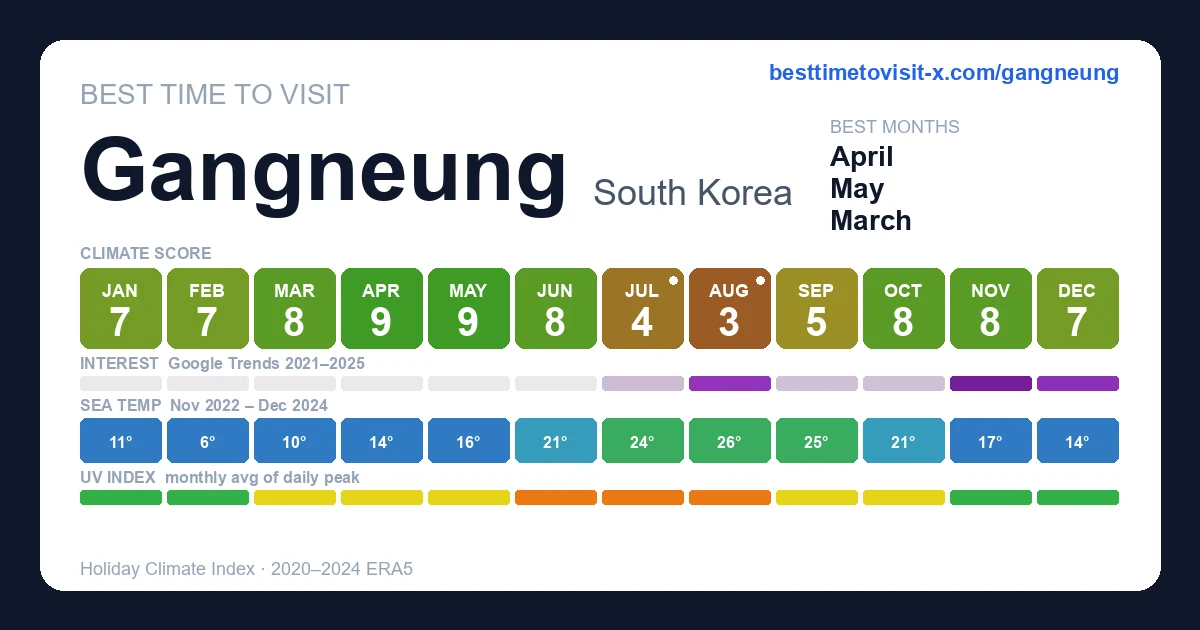
| Month | Temp °C | Feels °C | Rain days | Rain h | Rain h/day | Humidity | Wind km/h | Sun h | UV | Interest | Score |
|---|---|---|---|---|---|---|---|---|---|---|---|
| Jan | -4–5 | 0 | 6 | 87 | 14.5 | 49% | 18 | 168 | 2 | Quiet | 7 |
| Feb | -2–6 | 2 | 6 | 94 | 15.7 | 53% | 19 | 166 | 3 | Quiet | 7 |
| Mar | 2–11 | 7 | 7 | 96 | 13.7 | 56% | 19 | 197 | 4 | Quiet | 8 |
| Apr | 8–16 | 14 | 7 | 81 | 11.6 | 55% | 19 | 215 | 5 | Quiet | 9 |
| May | 13–21 | 20 | 9 | 101 | 11.2 | 57% | 19 | 228 | 6 | Quiet | 9 |
| Jun | 18–25 | 26 | 12 | 122 | 10.2 | 68% | 17 | 224 | 6 | Moderate | 8 |
| Jul | 22–27 | 31 | 17 | 192 | 11.3 | 78% | 14 | 199 | 7 | Peak | 4 |
| Aug | 23–28 | 32 | 19 | 236 | 12.4 | 74% | 14 | 191 | 6 | Peak | 3 |
| Sep | 18–24 | 25 | 16 | 236 | 14.8 | 72% | 16 | 179 | 5 | Busy | 5 |
| Oct | 11–19 | 17 | 9 | 122 | 13.6 | 61% | 15 | 170 | 3 | Moderate | 8 |
| Nov | 5–14 | 11 | 5 | 59 | 11.8 | 53% | 17 | 177 | 2 | Moderate | 8 |
| Dec | -2–6 | 1 | 3 | 45 | 15.0 | 44% | 18 | 181 | 2 | Moderate | 7 |
UV Index in Gangneung by Month
UV index in Gangneung peaks at 7 (high) in July, dropping to 2 (low) in December. June, July, August have high UV — SPF 30+ and sunglasses recommended.
Best months in detail
May
9/1013–21°C (feels 20°C) · 9 rain days (101h) · 228 sun hours · 57% humidity · Quiet crowd · UV 6 (moderate) · sunniest 1 in 10 days reach 8 (very high)
April
9/108–16°C (feels 14°C) · 7 rain days (81h) · 215 sun hours · 55% humidity · Quiet crowd · UV 5 (moderate) · sunniest 1 in 10 days reach 7 (high)
November
8/105–14°C (feels 11°C) · 5 rain days (59h) · 177 sun hours · 53% humidity · Moderate crowd · UV 2 (low) · sunniest 1 in 10 days reach 3 (moderate)
Every month
Show the other 9 months in detail
January
7/10-4–5°C (feels 0°C) · 6 rain days (87h) · 168 sun hours · 49% humidity · Quiet crowd · UV 2 (low)
February
7/10-2–6°C (feels 2°C) · 6 rain days (94h) · 166 sun hours · 53% humidity · Quiet crowd · UV 3 (low) · sunniest 1 in 10 days reach 4 (moderate)
March
8/102–11°C (feels 7°C) · 7 rain days (96h) · 197 sun hours · 56% humidity · Quiet crowd · UV 4 (moderate) · sunniest 1 in 10 days reach 5 (moderate)
June
8/1018–25°C (feels 26°C) · 12 rain days (122h) · 224 sun hours · 68% humidity · Moderate crowd · UV 6 (high) · sunniest 1 in 10 days reach 8 (very high)
July
4/1022–27°C (feels 31°C) · 17 rain days (192h) · 199 sun hours · 78% humidity · Peak crowd · UV 7 (high) · sunniest 1 in 10 days reach 9 (very high)
August
3/1023–28°C (feels 32°C) · 19 rain days (236h) · 191 sun hours · 74% humidity · Peak crowd · UV 6 (high) · sunniest 1 in 10 days reach 9 (very high)
September
5/1018–24°C (feels 25°C) · 16 rain days (236h) · 179 sun hours · 72% humidity · Busy crowd · UV 5 (moderate) · sunniest 1 in 10 days reach 7 (high)
October
8/1011–19°C (feels 17°C) · 9 rain days (122h) · 170 sun hours · 61% humidity · Moderate crowd · UV 3 (moderate) · sunniest 1 in 10 days reach 5 (moderate)
December
7/10-2–6°C (feels 1°C) · 3 rain days (45h) · 181 sun hours · 44% humidity · Moderate crowd · UV 2 (low)
Gangneung's beaches shut while the sea is warmest
Gangneung's beach season is an administrative window, not a weather one. For 2026 the city opened Gyeongpo on 4 July and closed it on 23 August - 51 days - with its seventeen other beaches, Jumunjin among them, running 10 July to the same end date. Busan kept Haeundae open from 26 June to 15 September. The water ignores the city calendar: sea surface temperatures off Gangneung averaged 26.4C in August across 2022-2024 and were still 24.6C in September, above July's 23.7C. The warmest weeks of the year fall after the beaches are handed back.
The other date to pin down moves every year. Gangneung City sets the Danoje period as the first to the eighth day of the fifth lunar month - eight days, at the Namdaecheon Danojang in Noam-dong. Because that is a lunar rule the Gregorian dates swing: 27 May to 3 June in 2025, then 15 to 22 June in 2026, nineteen days apart. Guides that print "late May" as the festival window are wrong in most years.
Spring reads well in the averages - May is the sunniest month at about 320 hours - but it is also Korea's wildfire season. The Korea Forest Service runs a spring precaution period from 1 February to 15 May, and brought the 2026 start forward twelve days to 20 January after a dry winter. That is not abstract here: on 11 April 2023 a wind-driven fire burned about 379 hectares of Gangneung and destroyed roughly 72 buildings, three of them hotels.
Sources: Gangneung City - Danoje Festival (period, venue, heritage designation) , The Korea Herald - Korea's beach season begins as summer heat sets in
When is the best time to visit Gangneung?
It depends what you came for. Sea swimming means late July to late August, when the water runs 24-26C and the beaches are staffed. Drier walking weather comes in May and October, with May the sunniest month at roughly 320 hours. Winter is cold, dry and bright: December highs near 5C, about 36 mm of rain and 243 hours of sun.
When do Gangneung's beaches officially open and close?
In 2026 Gyeongpo Beach opened on 4 July and closed on 23 August, a run of 51 days. The city's seventeen other beaches, including Jumunjin, opened on 10 July and closed on the same date. Busan by comparison ran Haeundae from 26 June to 15 September. The dates are set annually, so confirm them before booking a beach-led trip.
Can you swim in Gangneung in September?
The water is warm enough - it averaged 24.6C in September across 2022-2024, above the July figure of 23.7C - but the official season ends on 23 August, so there is no lifeguard cover or beach management after that. September has also been the second wettest month recently, at about 287 mm over 16 rain days.
When is the Gangneung Danoje Festival held?
Gangneung City gives the period as the first to the eighth day of the fifth lunar month, eight days in all, at the Namdaecheon Danojang in Noam-dong. Converted, that was 27 May to 3 June in 2025 and 15 to 22 June in 2026. Dano itself, the fifth day of the fifth lunar month, falls in the middle of the run.
What actually happens during Danoje?
It opens with the brewing of sinju, the ritual rice wine, and runs through shamanic gut rituals, the Gwanno mask drama, ssireum wrestling, tuho arrow-throwing, tug-of-war and swing contests. Alongside them sits Nanjang, which UNESCO describes as Korea's largest outdoor marketplace. The festival is Important Intangible Cultural Heritage No. 13.
Why is spring a constrained time to be in the hills near Gangneung?
Korea runs a spring wildfire precaution period from 1 February to 15 May. For 2026 the Korea Forest Service brought the start forward twelve days to 20 January after a dry winter and a 93-hectare January fire in Uiseong. On 11 April 2023 a wind-driven fire burned about 379 hectares of Gangneung and destroyed some 72 buildings, three of them hotels.
How many days do you need in Gangneung?
Two full days is the honest minimum: one for Gyeongpo beach and lagoon plus the Anmok coffee street, one for the Olympic Park and the pine coast north towards Jumunjin. Add a third if you arrive during Danoje, whose eight-day programme at the Namdaecheon ground takes an afternoon and an evening on its own.
Is Gangneung worth visiting in winter?
December is the driest month of the year here, about 36 mm spread over five days, with 243 hours of sunshine and daytime highs near 5C. It is also the windiest stretch, averaging around 17 km/h, and the sea drops to roughly 14C. The Gangneung Olympic Park venues are indoors and still in active use.
What is the Gangneung Coffee Festival?
Gangneung City runs it every October, centred on the Anmok Beach coffee street and spreading across the rest of the city, with cafes pouring beans they roast themselves. The month suits it: October averages about 15C with roughly 107 mm of rain over nine days in recent years, and the sea is still near 21C.
How wet is the Gangneung summer really?
Wetter than the beach season implies. Across 2020-2024 July averaged about 221 mm over 17 rain days and August about 325 mm over 19, against 1991-2020 norms of 224 mm and 246 mm - August has got markedly wetter. Rainfall hours run to 192 in July and 236 in August, so wet spells are long rather than passing.
Frequently asked questions about visiting Gangneung
When is the best time to visit Gangneung?
May is the highest-scoring month (9/10 on the Holiday Climate Index). Typical conditions: 13–21°C (9 rainy days). The top three months by score are May, April, November.
What is the worst time to visit Gangneung?
August is the lowest-scoring month (3/10, capped by extreme heat). Typical conditions: 23–28°C (19 rainy days).
Is Gangneung too hot in summer?
2 months (July, August) trip the heat deal-breaker in our scoring: apparent temperature crosses the comfort cap, so even with clear skies and low rain the score is held down. Plan around it if heat tolerance is low.
When are crowds lowest in Gangneung?
Search-interest seasonality (Google Trends 2021-2025) is lowest in January and peaks in August. Interest tracks both in-trip visitors and lead-time planners, so treat it as a "destination is on people's minds" signal rather than literal arrivals.
Which months in Gangneung have good weather but fewer tourists?
April (climate 9/10, crowd index 25) and May (climate 9/10, crowd index 27) — shoulder months with above-average climate and below-median search-interest. Often the best value-for-weather trade.
What is the UV index in Gangneung by month?
UV peaks at 7 (high) in July and is lowest in December at 2 (low). Monthly peak values: Jan 2, Feb 3, Mar 4, Apr 5, May 6, Jun 6, Jul 7, Aug 6, Sep 5, Oct 3, Nov 2, Dec 2.
What is the UV index in Gangneung in July?
July is the peak UV month in Gangneung, with a daily-peak UV index of 7 (high). Apply SPF 30+, wear sunglasses, and seek shade during midday hours.
How high can UV get in Gangneung on the sunniest days?
Most days look like the monthly average, but on the sunniest ~1 in 10 days UV climbs higher than the mean suggests. July is the worst case: typical days average UV 7 (high), but the top 10% of days reach UV 9 (very high) — and even higher. Months where the sunniest days routinely exceed the typical reading: February, March, April, May, June, July, August, September, October, November. Plan sun protection for the worst case, not the average.
Is air quality in Gangneung bad for travelers?
PM2.5 (fine-particle pollution) exceeds the WHO sensitive-group guideline (15 µg/m³) in 12 months: January, February, March, April, May, June, July, August, September, October, November, December. The worst month is March with a typical-day mean of 25 µg/m³ (unhealthy for sensitive); on the worst 10% of days PM2.5 reaches 41 µg/m³ (hazardous) and higher. People with asthma, heart conditions, or sensitive children may want to avoid these months or limit outdoor activity. Source: CAMS via Open-Meteo.