Best time to visit Seoul
Re-score for me — drag the dial — every chart on the page recolours live for your heat limit 27°C
Default 27 °C is the upper edge of the Holiday Climate Index "ideal comfort" band (Scott, Rutty, Amelung & Tang, 2016). Above this, most warm-tourism travellers report measurable discomfort.
Greyed factors are scored normally — extreme heat overrides them, so a clear sky or low rain can't lift the period.
Greyed factors are scored normally — extreme heat overrides them, so a clear sky or low rain can't lift the period.
Greyed factors are scored normally — extreme heat overrides them, so a clear sky or low rain can't lift the period.
Greyed factors are scored normally — extreme heat overrides them, so a clear sky or low rain can't lift the period.
Greyed factors are scored normally — extreme heat overrides them, so a clear sky or low rain can't lift the period.
Greyed factors are scored normally — extreme heat overrides them, so a clear sky or low rain can't lift the period.
Greyed factors are scored normally — extreme heat overrides them, so a clear sky or low rain can't lift the period.
Greyed factors are scored normally — extreme heat overrides them, so a clear sky or low rain can't lift the period.
Greyed factors are scored normally — extreme heat overrides them, so a clear sky or low rain can't lift the period.
Greyed factors are scored normally — extreme heat overrides them, so a clear sky or low rain can't lift the period.
Greyed factors are scored normally — extreme heat overrides them, so a clear sky or low rain can't lift the period.
Greyed factors are scored normally — extreme heat overrides them, so a clear sky or low rain can't lift the period.
Greyed factors are scored normally — extreme heat overrides them, so a clear sky or low rain can't lift the period.
Greyed factors are scored normally — extreme heat overrides them, so a clear sky or low rain can't lift the period.
Greyed factors are scored normally — extreme heat overrides them, so a clear sky or low rain can't lift the period.
Greyed factors are scored normally — extreme heat overrides them, so a clear sky or low rain can't lift the period.
How is this scored? HCI / Steadman / CCI gate — full methodology and citations below.
Compare with another destination
Add as many as you like — stacked below the main strips above. Each row is just the recent-window score strip and (for beach destinations) sea-temperature strip.
Tours in Seoul
30 top-rated tours via Viator. Booking links earn this site a commission at no cost to you. Map locations are approximate (centred on Seoul).
- 1
 Seoul Street Food Market Tour
 - 2
 Full-Day Tour in Mt. Seorak & Nami (+Rail Bike Option)
 - 3
 Mt. Seorak+Nami Island+Garden of Morning Calm Day Trip from Seoul
 - 4
 Signature DMZ Tour: Exclusive NK Defector Talk +Suspension Bridge
 - 5
 Half-Day DMZ Tour Led by a Retired Military Officer from Seoul
 - 6
 Private DMZ Insider Tour: Meet a NK Defector, 3rd Tunnel & Bridge
 - 7
 Seoul City Private Full-Day Tour Including Lunch
 - 8
 Day Trip to Nami Island with Rail bike and The Garden of Morning Calm
 - 9
 Private DMZ the 3rd Tunnel Tour from Seoul (optional Red Bridge)
 - 10
 Royal Seoul Cooking Class in a 100-Year-Old Hanok
 - 11
 Nami Island, Alpaca World and Gangchon Rail Bike Tour from Seoul
 - 12
 Official MBC Insider Live K-Drama Rehearsal & VIP Studio Tour
 - 13
 Nami Island, K-garden and Gangchon Rail Bike tour from Seoul
 - 14
 Exclusive JSA Museum Experience and DMZ Tour from Seoul
 - 15
 Best DMZ Tour Korea from Seoul (Suspension Bridge & JSA Museum)
 - 16
 DMZ Insider Tour: 3rd Tunnel, NK Defector Meet& Suspension Bridge
 - 17
 Seoul City Sightseeing Tour Including Gyeongbokgung Palace, N Seoul Tower, and Namsangol Hanok Village
 - 18
 DMZ Tour: NK Defector Meet up, 3rd Tunnel & Suspension Bridge
 - 19
 Small Group DMZ Tour with Hotel pickup : 3rd tunnel&Susp. Bridge
 - 20
 Best Seoul City Tour (Gyeongbokgung Palace,Insadong,Namsan Tower)
 - 21
 Small-Group Full-Day Royal Palace & Seoul City Tour (Pick-up)
 - 22
 Seoul: Gyeongbok Palace, Hanok Village, and Gwangjang Tour
 - 23
 Downtown Seoul Guided Food & Market Tour with 8+ Local Tastings
 - 24
 DMZ Guided Tour with N.K./Gondola/Suspension Bridge from Seoul
 - 25
 Local Home Korean Cooking Class & Market Adventure in Seoul
 - 26
 DMZ tour from Seoul; North Korean Defector Meet up & 3rd Tunnel
 - 27
 Ultimate Korea DMZ Tour from Seoul (JSA Museum & Bridge Crossing)
 - 28
 Seoul E-bike Tour
 - 29
 SEOUL / SUBURB / AIRPORT / PRIVATE VAN [Eng Speaking Driver]KOREA
 - 30
 Private Tour DMZ Peace 3rd Invasion Tunnel and Suspension Bridge
Last refreshed 2026-05-30.
Similar climatesIncheon97% · Daegu93% · Busan93%
Other destinations with the most-alike year-round climate to Seoul (apparent temperature, rain hours, sunshine — matched within the same trip-profile). The ±N chip compares each match's typical score for the current month against Seoul's. Based on the 2020-2024 climatology, not this year's actual weather.
Month-by-month
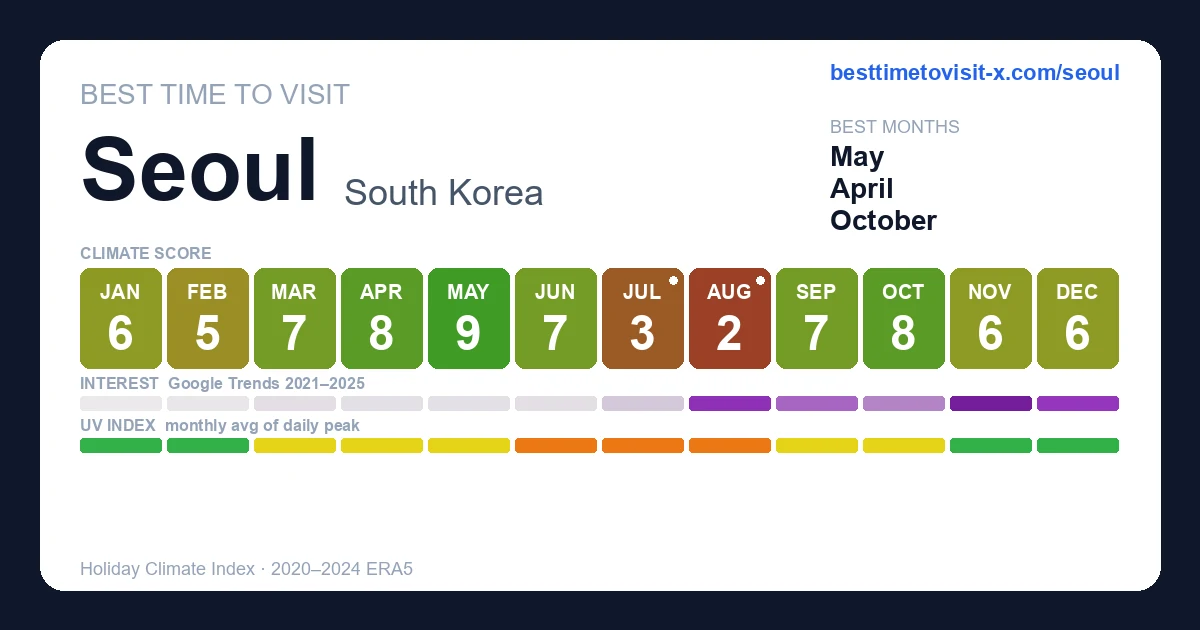
| Month | Temp °C | Feels °C | Rain days | Rain h | Rain h/day | Humidity | Wind km/h | Sun h | UV | Interest | Score |
|---|---|---|---|---|---|---|---|---|---|---|---|
| Jan | -6–3 | -2 | 4 | 52 | 13.0 | 48% | 16 | 173 | 2 | Quiet | 6 |
| Feb | -4–6 | 1 | 5 | 53 | 10.6 | 50% | 18 | 169 | 3 | Quiet | 5 |
| Mar | 1–12 | 8 | 7 | 61 | 8.7 | 50% | 18 | 204 | 4 | Quiet | 7 |
| Apr | 7–18 | 15 | 6 | 59 | 9.8 | 46% | 20 | 208 | 5 | Quiet | 8 |
| May | 12–22 | 21 | 9 | 105 | 11.7 | 54% | 19 | 220 | 5 | Quiet | 9 |
| Jun | 18–27 | 28 | 12 | 143 | 11.9 | 61% | 18 | 207 | 6 | Moderate | 7 |
| Jul | 22–29 | 32 | 20 | 260 | 13.0 | 73% | 16 | 189 | 6 | Peak | 3 |
| Aug | 23–29 | 33 | 19 | 257 | 13.5 | 74% | 16 | 198 | 6 | Peak | 2 |
| Sep | 18–26 | 27 | 11 | 150 | 13.6 | 67% | 15 | 191 | 5 | Busy | 7 |
| Oct | 9–18 | 17 | 7 | 73 | 10.4 | 62% | 14 | 190 | 3 | Busy | 8 |
| Nov | 2–12 | 9 | 7 | 71 | 10.1 | 59% | 15 | 167 | 2 | Peak | 6 |
| Dec | -6–3 | -2 | 3 | 43 | 14.3 | 52% | 16 | 171 | 2 | Busy | 6 |
UV Index in Seoul by Month
UV index in Seoul peaks at 6 (high) in June, dropping to 2 (low) in December. June, July, August have high UV — SPF 30+ and sunglasses recommended.
Best months in detail
May
9/1012–22°C (feels 21°C) · 9 rain days (105h) · 220 sun hours · 54% humidity · Quiet crowd · UV 5 (moderate) · sunniest 1 in 10 days reach 7 (high)
April
8/107–18°C (feels 15°C) · 6 rain days (59h) · 208 sun hours · 46% humidity · Quiet crowd · UV 5 (moderate) · sunniest 1 in 10 days reach 7 (high)
October
8/109–18°C (feels 17°C) · 7 rain days (73h) · 190 sun hours · 62% humidity · Busy crowd · UV 3 (moderate) · sunniest 1 in 10 days reach 5 (moderate)
Every month
Show the other 9 months in detail
January
6/10-6–3°C (feels -2°C) · 4 rain days (52h) · 173 sun hours · 48% humidity · Quiet crowd · UV 2 (low)
February
5/10-4–6°C (feels 1°C) · 5 rain days (53h) · 169 sun hours · 50% humidity · Quiet crowd · UV 3 (low) · sunniest 1 in 10 days reach 4 (moderate)
March
7/101–12°C (feels 8°C) · 7 rain days (61h) · 204 sun hours · 50% humidity · Quiet crowd · UV 4 (moderate)
June
7/1018–27°C (feels 28°C) · 12 rain days (143h) · 207 sun hours · 61% humidity · Moderate crowd · UV 6 (high) · sunniest 1 in 10 days reach 8 (very high)
July
3/1022–29°C (feels 32°C) · 20 rain days (260h) · 189 sun hours · 73% humidity · Peak crowd · UV 6 (high) · sunniest 1 in 10 days reach 9 (very high)
August
2/1023–29°C (feels 33°C) · 19 rain days (257h) · 198 sun hours · 74% humidity · Peak crowd · UV 6 (high) · sunniest 1 in 10 days reach 9 (very high)
September
7/1018–26°C (feels 27°C) · 11 rain days (150h) · 191 sun hours · 67% humidity · Busy crowd · UV 5 (moderate) · sunniest 1 in 10 days reach 7 (high)
November
6/102–12°C (feels 9°C) · 7 rain days (71h) · 167 sun hours · 59% humidity · Peak crowd · UV 2 (low) · sunniest 1 in 10 days reach 3 (moderate)
December
6/10-6–3°C (feels -2°C) · 3 rain days (43h) · 171 sun hours · 52% humidity · Busy crowd · UV 2 (low)
Seoul's wettest month has moved past the jangma window
The Korea Meteorological Administration publishes a normal for the jangma, and Seoul sits inside the central region it covers: 25 June to 26 July, 31.5 days long, with 17.7 wet days and 378.3mm of rain on the 1991-2020 average. That block is the calendar every rainy-season post reproduces. What the posts leave out is that it is a statistic rather than a forecast — the KMA stopped announcing start and end dates in 2009 and now publishes them only as after-the-season climate analysis.
The spread inside the window is the part that matters. On the KMA's own record the central-region jangma has begun as early as 17 June, in 2013, and as late as 3 July, in 2021, and has ended as early as 11 July, in 2018, and as late as 16 August, in 2020. Rainfall over the period has ranged from 138.3mm in 2014 to 856.1mm in 2020. Planning a fortnight around the average is planning around a figure hardly any single year has delivered.
Seoul's own record shows the rain moving later. On the 1991-2020 normals July is the wettest month at 318mm across 17 wet days. Over 2020-2024 August takes it, at 358mm across 19 days against July's 324mm — August up by about a third while July barely moved. August is also the month with the highest search interest in the city. The month people book because the jangma is over is now the wettest one.
Sources: Korea Meteorological Administration — jangma normals, extremes and per-station records , Korea Meteorological Administration — climate of Korea, jangma normal dates (1991-2020) , Korea Heritage Service, Royal Palaces and Tombs Centre — opening hours and closing days , Korea Heritage Service, Royal Palaces and Tombs Centre — admission fees and free entry
When is the best time to go to Seoul?
Late September to early November, and May. October averages 54mm of rain over five wet days, highs near 19C and 275 hours of sun; May brings 22C highs before the humidity climbs. Both avoid the 25 June to 26 July jangma block and the August peak, when the city takes 358mm on the 2020-2024 average.
When is the rainy season in Seoul?
The Korea Meteorological Administration's 1991-2020 normal for the central region, which includes Seoul, runs 25 June to 26 July: 31.5 days, 17.7 wet days and 378.3mm. It is an average and not a forecast — the KMA stopped issuing start and end dates in 2009 and now publishes them only once the season has finished.
Does it rain every day during the jangma?
No. The central-region normal is 17.7 wet days inside a 31.5-day window, so around 14 days stay dry. The variability is the real problem rather than the total: the KMA's own extremes for the period run from 138.3mm in 2014 to 856.1mm in 2020, and the rain now tends to arrive in short heavy bursts.
Is August a good month for Seoul?
It is the wettest and the busiest. On 2020-2024 data August brings 358mm across 19 wet days, highs of 29C, nights near 23C and 74% humidity, and it is the peak month for interest in the city. Museums, palaces and the subway absorb it well, but any plan built around outdoor time will lose days to it.
How cold does Seoul get in winter?
January averages a high of 1.6C and a low of -6.9C, with 19mm of precipitation across four days and 243 hours of sun — cold, dry and bright rather than grey. December and February sit either side at highs of 3.5C and 4.6C. It is also the emptiest stretch of the year at the palaces.
Which day are the palaces in Seoul closed?
They do not close together. The Korea Heritage Service closes Gyeongbokgung and Jongmyo on Tuesdays, and Changdeokgung, Changgyeonggung and Deoksugung on Mondays. So a Monday still takes in Gyeongbokgung and a Tuesday still works for Changdeokgung, but neither day covers both — which catches out one-day itineraries.
Do you have to book Changdeokgung's Secret Garden?
Effectively yes. Huwon is a restricted area entered in timed, guide-led sessions capped at 100 people — 50 sold online from 10:00 six days ahead until the day before, and 50 on site from 09:00 on the day. The Korea Heritage Service warns that in April, May, October and November both allocations sell out very fast.
Is the Royal Palace Pass worth buying?
It costs 6,000 won and covers the four main palaces plus Jongmyo for six months, against 3,000 won each at Gyeongbokgung and Changdeokgung and 1,000 at Changgyeonggung, Deoksugung and Jongmyo. Since 20 May 2024 it no longer includes Changdeokgung's Huwon, which is a separate 5,000-won timed ticket.
Is palace entry free if you wear hanbok?
Yes. The Korea Heritage Service lists visitors in hanbok among its free-admission categories for the palace grounds, which is why rental shops cluster around Gyeongbokgung station. Entry is also free for anyone aged 24 or under and 65 or over, and for everyone on Culture Day, the last Wednesday of each month.
When is the air quality in Seoul at its worst?
Late winter and early spring. On readings from September 2022 onwards, March is the worst month at 36.9 micrograms of PM2.5 per cubic metre, with a 90th-percentile day at 66.2. September is the cleanest at 23. The summer rain scrubs the air, which is one compensation for the jangma — July averages 25.
Frequently asked questions about visiting Seoul
When is the best time to visit Seoul?
May is the highest-scoring month (9/10 on the Holiday Climate Index). Typical conditions: 12–22°C (9 rainy days). The top three months by score are May, April, October.
What is the worst time to visit Seoul?
August is the lowest-scoring month (2/10, capped by extreme heat). Typical conditions: 23–29°C (19 rainy days).
Is Seoul too hot in summer?
2 months (July, August) trip the heat deal-breaker in our scoring: apparent temperature crosses the comfort cap, so even with clear skies and low rain the score is held down. Plan around it if heat tolerance is low.
When are crowds lowest in Seoul?
Search-interest seasonality (Google Trends 2021-2025) is lowest in January and peaks in August. Interest tracks both in-trip visitors and lead-time planners, so treat it as a "destination is on people's minds" signal rather than literal arrivals.
Which months in Seoul have good weather but fewer tourists?
May (climate 9/10, crowd index 27) and April (climate 8/10, crowd index 33) — shoulder months with above-average climate and below-median search-interest. Often the best value-for-weather trade.
What is the UV index in Seoul by month?
UV peaks at 6 (high) in June and is lowest in December at 2 (low). Monthly peak values: Jan 2, Feb 3, Mar 4, Apr 5, May 5, Jun 6, Jul 6, Aug 6, Sep 5, Oct 3, Nov 2, Dec 2.
What is the UV index in Seoul in June?
June is the peak UV month in Seoul, with a daily-peak UV index of 6 (high). Apply SPF 30+, wear sunglasses, and seek shade during midday hours.
How high can UV get in Seoul on the sunniest days?
Most days look like the monthly average, but on the sunniest ~1 in 10 days UV climbs higher than the mean suggests. July is the worst case: typical days average UV 6 (high), but the top 10% of days reach UV 9 (very high) — and even higher. Months where the sunniest days routinely exceed the typical reading: February, April, May, June, July, August, September, October, November. Plan sun protection for the worst case, not the average.
Is air quality in Seoul bad for travelers?
PM2.5 (fine-particle pollution) exceeds the WHO sensitive-group guideline (15 µg/m³) in 12 months: January, February, March, April, May, June, July, August, September, October, November, December. The worst month is March with a typical-day mean of 37 µg/m³ (hazardous); on the worst 10% of days PM2.5 reaches 66 µg/m³ (hazardous) and higher. People with asthma, heart conditions, or sensitive children may want to avoid these months or limit outdoor activity. Source: CAMS via Open-Meteo.