Best time to visit Doha
Re-score for me — drag the dial — every chart on the page recolours live for your heat limit 27°C
Default 27 °C is the upper edge of the Holiday Climate Index "ideal comfort" band (Scott, Rutty, Amelung & Tang, 2016). Above this, most warm-tourism travellers report measurable discomfort.
Greyed factors are scored normally — extreme heat overrides them, so a clear sky or low rain can't lift the period.
Greyed factors are scored normally — extreme heat overrides them, so a clear sky or low rain can't lift the period.
Greyed factors are scored normally — extreme heat overrides them, so a clear sky or low rain can't lift the period.
Greyed factors are scored normally — extreme heat overrides them, so a clear sky or low rain can't lift the period.
Greyed factors are scored normally — extreme heat overrides them, so a clear sky or low rain can't lift the period.
Greyed factors are scored normally — extreme heat overrides them, so a clear sky or low rain can't lift the period.
Greyed factors are scored normally — extreme heat overrides them, so a clear sky or low rain can't lift the period.
Greyed factors are scored normally — extreme heat overrides them, so a clear sky or low rain can't lift the period.
Greyed factors are scored normally — extreme heat overrides them, so a clear sky or low rain can't lift the period.
Greyed factors are scored normally — extreme heat overrides them, so a clear sky or low rain can't lift the period.
Greyed factors are scored normally — extreme heat overrides them, so a clear sky or low rain can't lift the period.
Greyed factors are scored normally — extreme heat overrides them, so a clear sky or low rain can't lift the period.
Greyed factors are scored normally — extreme heat overrides them, so a clear sky or low rain can't lift the period.
Greyed factors are scored normally — extreme heat overrides them, so a clear sky or low rain can't lift the period.
Greyed factors are scored normally — extreme heat overrides them, so a clear sky or low rain can't lift the period.
Greyed factors are scored normally — extreme heat overrides them, so a clear sky or low rain can't lift the period.
Greyed factors are scored normally — extreme heat overrides them, so a clear sky or low rain can't lift the period.
Greyed factors are scored normally — extreme heat overrides them, so a clear sky or low rain can't lift the period.
Greyed factors are scored normally — extreme heat overrides them, so a clear sky or low rain can't lift the period.
Greyed factors are scored normally — extreme heat overrides them, so a clear sky or low rain can't lift the period.
Greyed factors are scored normally — extreme heat overrides them, so a clear sky or low rain can't lift the period.
Greyed factors are scored normally — extreme heat overrides them, so a clear sky or low rain can't lift the period.
Greyed factors are scored normally — extreme heat overrides them, so a clear sky or low rain can't lift the period.
Greyed factors are scored normally — extreme heat overrides them, so a clear sky or low rain can't lift the period.
Greyed factors are scored normally — extreme heat overrides them, so a clear sky or low rain can't lift the period.
Greyed factors are scored normally — extreme heat overrides them, so a clear sky or low rain can't lift the period.
Greyed factors are scored normally — extreme heat overrides them, so a clear sky or low rain can't lift the period.
Greyed factors are scored normally — extreme heat overrides them, so a clear sky or low rain can't lift the period.
Greyed factors are scored normally — extreme heat overrides them, so a clear sky or low rain can't lift the period.
Greyed factors are scored normally — extreme heat overrides them, so a clear sky or low rain can't lift the period.
Greyed factors are scored normally — extreme heat overrides them, so a clear sky or low rain can't lift the period.
Greyed factors are scored normally — extreme heat overrides them, so a clear sky or low rain can't lift the period.
Greyed factors are scored normally — extreme heat overrides them, so a clear sky or low rain can't lift the period.
Greyed factors are scored normally — extreme heat overrides them, so a clear sky or low rain can't lift the period.
Greyed factors are scored normally — extreme heat overrides them, so a clear sky or low rain can't lift the period.
Greyed factors are scored normally — extreme heat overrides them, so a clear sky or low rain can't lift the period.
Greyed factors are scored normally — extreme heat overrides them, so a clear sky or low rain can't lift the period.
Greyed factors are scored normally — extreme heat overrides them, so a clear sky or low rain can't lift the period.
Greyed factors are scored normally — extreme heat overrides them, so a clear sky or low rain can't lift the period.
Greyed factors are scored normally — extreme heat overrides them, so a clear sky or low rain can't lift the period.
Greyed factors are scored normally — extreme heat overrides them, so a clear sky or low rain can't lift the period.
Greyed factors are scored normally — extreme heat overrides them, so a clear sky or low rain can't lift the period.
Greyed factors are scored normally — extreme heat overrides them, so a clear sky or low rain can't lift the period.
Greyed factors are scored normally — extreme heat overrides them, so a clear sky or low rain can't lift the period.
Greyed factors are scored normally — extreme heat overrides them, so a clear sky or low rain can't lift the period.
Greyed factors are scored normally — extreme heat overrides them, so a clear sky or low rain can't lift the period.
Greyed factors are scored normally — extreme heat overrides them, so a clear sky or low rain can't lift the period.
Greyed factors are scored normally — extreme heat overrides them, so a clear sky or low rain can't lift the period.
Greyed factors are scored normally — extreme heat overrides them, so a clear sky or low rain can't lift the period.
Greyed factors are scored normally — extreme heat overrides them, so a clear sky or low rain can't lift the period.
Greyed factors are scored normally — extreme heat overrides them, so a clear sky or low rain can't lift the period.
Greyed factors are scored normally — extreme heat overrides them, so a clear sky or low rain can't lift the period.
Greyed factors are scored normally — extreme heat overrides them, so a clear sky or low rain can't lift the period.
Greyed factors are scored normally — extreme heat overrides them, so a clear sky or low rain can't lift the period.
Greyed factors are scored normally — extreme heat overrides them, so a clear sky or low rain can't lift the period.
Greyed factors are scored normally — extreme heat overrides them, so a clear sky or low rain can't lift the period.
Greyed factors are scored normally — extreme heat overrides them, so a clear sky or low rain can't lift the period.
How is this scored? HCI / Steadman / CCI gate — full methodology and citations below.
Compare with another destination
Add as many as you like — stacked below the main strips above. Each row is just the recent-window score strip and (for beach destinations) sea-temperature strip.
Tours in Doha
15 top-rated tours via Viator. Booking links earn this site a commission at no cost to you. Map locations are approximate (centred on Doha).
- 1
 Doha City Tour And Dhow Boat Cruise (Private/Sharing)
 - 2
 Desert safari, Dune bashing, sandboarding, camel, ATV Option
 - 3
 Doha City Tour (Private Tour)
 - 4
 Qatar Gold Dune Safari, Dune Bashing,Camel Ride,Sand Boarding,Inland Sea Desert
 - 5
 Doha: Guided City Tour with Airport and Hotel Pickup
 - 6
 Doha :Half Day Desert Safari | Camel Riding | ATV | Sand Surfing
 - 7
 Doha City Tour | Souq Waqif | Courniche | The Pearl | Katara etc
 - 8
 Doha Night Desert Safari Camel Ride Dune Bashing with Transfer
 - 9
 Doha: Desert Safari | Camel ride | Sand-boarding | Quad Biking
 - 10
 Doha: Desert Safari, Sand Boarding, Camel Ride & Inland Sea Tour
 - 11
 4 Hour Desert Safari, Camel Ride & Inland Sea Beach
 - 12
 Qatar Sunset Desert Safari: Dune Bashing & Golden Sands Adventure
 - 13
 Doha:ATV,Quad or Buggy Dune Bashing,CamelRide & Sandboarding
 - 14
 Moonlight on The Gulf A Doha Dhow Cruise Adventure
 - 15
 Doha: Private Speedboat Fishing Trip with Pick & drop
Last refreshed 2026-06-08.
Similar climatesAbu Dhabi96% · Muscat91% · Nizwa91%
Other destinations with the most-alike year-round climate to Doha (apparent temperature, rain hours, sunshine — matched within the same trip-profile). The ±N chip compares each match's typical score for the current month against Doha's. Based on the 2020-2024 climatology, not this year's actual weather.
Month-by-month
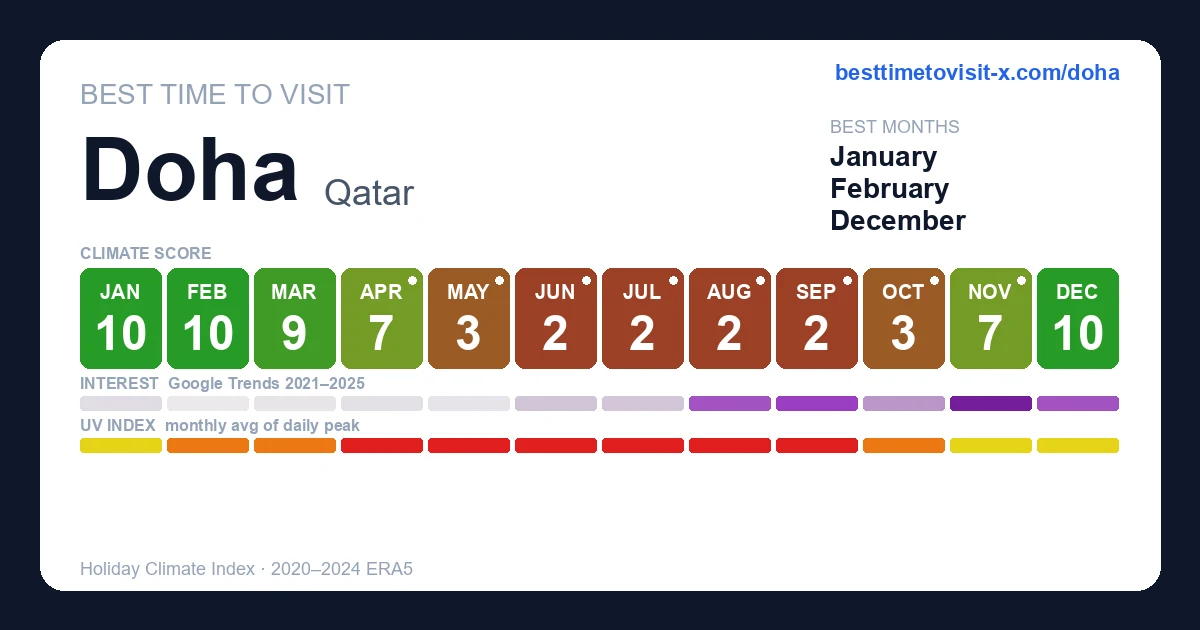
| Month | Temp °C | Feels °C | Rain days | Rain h | Rain h/day | Humidity | Wind km/h | Sun h | UV | Interest | Score |
|---|---|---|---|---|---|---|---|---|---|---|---|
| Jan | 15–22 | 20 | 4 | 34 | 8.5 | 53% | 24 | 212 | 5 | Quiet | 10 |
| Feb | 15–24 | 21 | 1 | 9 | 9.0 | 47% | 26 | 212 | 6 | Peak | 10 |
| Mar | 18–27 | 25 | 2 | 13 | 6.5 | 40% | 26 | 239 | 7 | Quiet | 9 |
| Apr | 22–32 | 30 | 1 | 12 | 12.0 | 34% | 25 | 229 | 9 | Quiet | 7 |
| May | 26–37 | 36 | 0 | 3 | — | 27% | 27 | 271 | 10 | Quiet | 3 |
| Jun | 29–41 | 41 | 0 | 0 | — | 25% | 27 | 278 | 10 | Quiet | 2 |
| Jul | 31–41 | 44 | 1 | 4 | 4.0 | 36% | 25 | 270 | 9 | Quiet | 2 |
| Aug | 31–41 | 44 | 0 | 0 | — | 38% | 23 | 264 | 9 | Quiet | 2 |
| Sep | 29–39 | 42 | 0 | 0 | — | 39% | 22 | 248 | 9 | Moderate | 2 |
| Oct | 26–35 | 37 | 1 | 5 | 5.0 | 41% | 22 | 254 | 7 | Quiet | 3 |
| Nov | 22–30 | 31 | 1 | 5 | 5.0 | 46% | 21 | 226 | 5 | Busy | 7 |
| Dec | 17–25 | 24 | 1 | 7 | 7.0 | 50% | 20 | 215 | 4 | Busy | 10 |
UV Index in Doha by Month
UV index in Doha peaks at 10 (very high) in June, dropping to 4 (moderate) in December. April, May, June, July, August, September reach very high or extreme levels — apply SPF 50+, wear a hat and protective clothing, and limit direct sun between 11:00 and 17:00.
Best months in detail
December
10/1017–25°C (feels 24°C) · 1 rain days (7h) · 215 sun hours · 50% humidity · Busy crowd · UV 4 (moderate)
January
10/1015–22°C (feels 20°C) · 4 rain days (34h) · 212 sun hours · 53% humidity · Quiet crowd · UV 5 (moderate)
February
10/1015–24°C (feels 21°C) · 1 rain days (9h) · 212 sun hours · 47% humidity · Peak crowd · UV 6 (high)
Every month
Show the other 9 months in detail
March
9/1018–27°C (feels 25°C) · 2 rain days (13h) · 239 sun hours · 40% humidity · Quiet crowd · UV 7 (high) · sunniest 1 in 10 days reach 9 (very high)
April
7/1022–32°C (feels 30°C) · 1 rain days (12h) · 229 sun hours · 34% humidity · Quiet crowd · UV 9 (very high) · sunniest 1 in 10 days reach 10 (very high)
May
3/1026–37°C (feels 36°C) · 0 rain days (3h) · 271 sun hours · 27% humidity · Quiet crowd · UV 10 (very high)
June
2/1029–41°C · 0 rain days (0h) · 278 sun hours · 25% humidity · Quiet crowd · UV 10 (very high)
July
2/1031–41°C (feels 44°C) · 1 rain days (4h) · 270 sun hours · 36% humidity · Quiet crowd · UV 9 (very high)
August
2/1031–41°C (feels 44°C) · 0 rain days (0h) · 264 sun hours · 38% humidity · Quiet crowd · UV 9 (very high)
September
2/1029–39°C (feels 42°C) · 0 rain days (0h) · 248 sun hours · 39% humidity · Moderate crowd · UV 9 (very high)
October
3/1026–35°C (feels 37°C) · 1 rain days (5h) · 254 sun hours · 41% humidity · Quiet crowd · UV 7 (high) · sunniest 1 in 10 days reach 8 (very high)
November
7/1022–30°C · 1 rain days (5h) · 226 sun hours · 46% humidity · Busy crowd · UV 5 (moderate) · sunniest 1 in 10 days reach 6 (high)
Qatar law halts outdoor work at 10:00 from June to mid-September
Doha's summer is not just hot, it is legislated. Ministerial Decision No. 17 of 2021, in force since 27 May 2021 and published in full on Al Meezan, the State of Qatar's legal portal, fixes working hours for anything done under the sun or in an open workplace that is not shaded and ventilated: between 1 June and 15 September each year, work may not be carried out from 10:00 to 15:30. Article 4 also requires employers to stop work at any hour where the wet-bulb globe temperature exceeds 32.1, and Article 7 lets the Minister close a non-compliant site in part or in whole.
The decision binds employers, not visitors, and nothing stops you walking the Corniche at noon in July. It matters as a measured judgement about those hours by the body that enforces it. Our own 2020-2024 record puts Doha's mean daily maximum at 41.4C in both June and July, with a mean daily minimum of 31.2C in July - the night gives almost nothing back. Measurable rain falls on no days at all in June, August and September.
So summer plans move indoors, and the indoor timetable has holes of its own. Qatar Museums closes the Museum of Islamic Art on Wednesdays, the National Museum of Qatar on Tuesdays and Mathaf on Mondays, and every venue opens late on Friday, at 13:30. During Ramadan the whole group switches to 09:00-14:00 and 20:00 to midnight, Saturday to Thursday, with Friday evenings only.
Sources: Al Meezan, Qatar Legal Portal - Ministerial Decision 17/2021, Article 2 (outdoor work hours) , Al Meezan - Ministerial Decision 17/2021, full text (WBGT 32.1 stop rule, closure power) , Qatar Museums - opening hours for all venues , Qatar Museums - visiting during Ramadan , Museum of Islamic Art - plan your visit , FIFA - World Cup Qatar 2022 at a glance (finals dates, 20 Nov - 18 Dec)
What is the best month to visit Doha?
December to February. Our 2020-2024 record gives mean daily maxima of 25.2C in December, 22.4C in January and 23.8C in February, with overnight lows around 15C to 17C. January is also the wettest month at 34.5mm, which in Doha means a few brief downpours rather than sustained rain.
How hot is Doha in summer, really?
Our 2020-2024 record puts the mean daily maximum at 41.4C in June and July and 41.0C in August. The unusual part is the night: the mean daily minimum is 31.2C in July and 31.4C in August, so there is no cool hour to retreat into. Humidity climbs back to 36-38 per cent in July and August.
Does Qatar's outdoor work ban apply to tourists?
No. Ministerial Decision 17/2021 regulates employers and workers, not visitors, and nobody will stop you being outside at 13:00 in July. Treat it as official guidance on those hours: the state has decided that 10:00 to 15:30, from 1 June to 15 September, is not safe for sustained outdoor exertion.
What are the Museum of Islamic Art's opening hours?
9am to 7pm Saturday to Tuesday, 9am to 9pm on Thursday, 1:30pm to 7pm on Friday, and closed all day Wednesday. MIA Park outside is open 24 hours. The Wednesday closure catches people out most often, because the National Museum of Qatar takes Tuesday instead and Mathaf takes Monday.
How does Ramadan change opening hours in Doha?
Qatar Museums switches every venue to 9am-2pm plus 8pm to midnight, Saturday to Thursday, and evenings only on Friday from 8pm. Cafes and restaurants inside shift to post-iftar service. Ramadan follows the lunar calendar and starts roughly eleven days earlier each year, so confirm the month before booking.
Does it ever rain in Doha?
Barely, and only in winter. Our 2020-2024 record shows 34.5mm across four days in January, then almost nothing: zero measurable rain days in June, August and September. Annual totals are so small that a single storm can supply most of the year's rainfall and briefly flood underpasses.
How many days do you need in Doha?
Two full days covers the Museum of Islamic Art, the National Museum of Qatar, Souq Waqif and the Corniche, with a half-day for the inland sea or the dunes at Khor Al Adaid. Plan around the closure days - MIA on Wednesday, the National Museum on Tuesday - or you will lose one of the two.
Should I choose Doha or Dubai?
They share a climate but not a character. Dubai is bigger, more commercial and has far more beach and theme-park capacity; Doha is compact, museum-led and cheaper to cross. For a stopover of two days Doha is the easier city; for a week with children Dubai has more to fill it.
Why was the 2022 World Cup played in November and December?
FIFA's own record shows the Qatar 2022 finals ran from 20 November to 18 December, outside the June-July slot every other men's World Cup has used. Whatever the formal reasoning, the calendar is a useful signal: the people staging a month of outdoor sport in Qatar did not choose the summer.
Are October and April good shoulder months in Doha?
Only just. Our 2020-2024 record gives October a mean daily maximum of 35.3C and April 32.0C, both still hot for walking. November at 30.4C is the first genuinely comfortable month, and March at 27.4C the last one in spring. The usable window is roughly mid-November to mid-March.
Frequently asked questions about visiting Doha
When is the best time to visit Doha?
December is the highest-scoring month (10/10 on the Holiday Climate Index). Typical conditions: 17–25°C (1 rainy day). The top three months by score are December, January, February.
What is the worst time to visit Doha?
September is the lowest-scoring month (2/10, capped by extreme heat). Typical conditions: 29–39°C (0 rainy days).
Is Doha too hot in summer?
8 months (April, May, June, July, August, September, October, November) trip the heat deal-breaker in our scoring: apparent temperature crosses the comfort cap, so even with clear skies and low rain the score is held down. Plan around it if heat tolerance is low.
When are crowds lowest in Doha?
Search-interest seasonality (Google Trends 2021-2025) is lowest in May and peaks in February. Interest tracks both in-trip visitors and lead-time planners, so treat it as a "destination is on people's minds" signal rather than literal arrivals.
Which months in Doha have good weather but fewer tourists?
January (climate 10/10, crowd index 8) and March (climate 9/10, crowd index 30) — shoulder months with above-average climate and below-median search-interest. Often the best value-for-weather trade.
What is the UV index in Doha by month?
UV peaks at 10 (very high) in June and is lowest in December at 4 (moderate). Monthly peak values: Jan 5, Feb 6, Mar 7, Apr 9, May 10, Jun 10, Jul 9, Aug 9, Sep 9, Oct 7, Nov 5, Dec 4. April, May, June, July, August, September reach very high or extreme levels — apply SPF 50+, wear a hat and protective clothing, and limit direct sun between 11:00 and 17:00.
What is the UV index in Doha in June?
June is the peak UV month in Doha, with a daily-peak UV index of 10 (very high). At this level, sunburn can occur in under 20 minutes on unprotected fair skin. Apply SPF 50+, wear protective clothing and a hat, and avoid direct midday sun (11:00–17:00).
How high can UV get in Doha on the sunniest days?
Most days look like the monthly average, but on the sunniest ~1 in 10 days UV climbs higher than the mean suggests. April is the worst case: typical days average UV 9 (very high), but the top 10% of days reach UV 10 (very high) — and even higher. Months where the sunniest days routinely exceed the typical reading: March, April, October, November. Plan sun protection for the worst case, not the average.
Is air quality in Doha bad for travelers?
PM2.5 (fine-particle pollution) exceeds the WHO sensitive-group guideline (15 µg/m³) in 12 months: January, February, March, April, May, June, July, August, September, October, November, December. The worst month is August with a typical-day mean of 55 µg/m³ (hazardous); on the worst 10% of days PM2.5 reaches 70 µg/m³ (hazardous) and higher. People with asthma, heart conditions, or sensitive children may want to avoid these months or limit outdoor activity. Source: CAMS via Open-Meteo.