Best time to visit Salalah
Re-score for me — drag the dial — every chart recolours live for your heat & sea limits 27°C · sea 29°C
Default 27 °C is the upper edge of the Holiday Climate Index "ideal comfort" band (Scott, Rutty, Amelung & Tang, 2016). Above this, most warm-tourism travellers report measurable discomfort.
Default 29 °C is the Beach Climate Index "bathtub" line (Morgan et al.) — where the sea stops being refreshing and starts feeling like a warm bath.
Greyed factors are scored normally — extreme heat overrides them, so a clear sky or low rain can't lift the period.
Greyed factors are scored normally — extreme heat overrides them, so a clear sky or low rain can't lift the period.
Greyed factors are scored normally — extreme heat overrides them, so a clear sky or low rain can't lift the period.
Greyed factors are scored normally — extreme heat overrides them, so a clear sky or low rain can't lift the period.
Greyed factors are scored normally — extreme heat overrides them, so a clear sky or low rain can't lift the period.
Greyed factors are scored normally — extreme heat overrides them, so a clear sky or low rain can't lift the period.
Greyed factors are scored normally — extreme heat overrides them, so a clear sky or low rain can't lift the period.
Greyed factors are scored normally — extreme heat overrides them, so a clear sky or low rain can't lift the period.
Greyed factors are scored normally — extreme heat overrides them, so a clear sky or low rain can't lift the period.
Greyed factors are scored normally — extreme heat overrides them, so a clear sky or low rain can't lift the period.
Greyed factors are scored normally — extreme heat overrides them, so a clear sky or low rain can't lift the period.
Greyed factors are scored normally — extreme heat overrides them, so a clear sky or low rain can't lift the period.
Greyed factors are scored normally — extreme heat overrides them, so a clear sky or low rain can't lift the period.
Greyed factors are scored normally — extreme heat overrides them, so a clear sky or low rain can't lift the period.
Greyed factors are scored normally — extreme heat overrides them, so a clear sky or low rain can't lift the period.
Greyed factors are scored normally — extreme heat overrides them, so a clear sky or low rain can't lift the period.
Greyed factors are scored normally — extreme heat overrides them, so a clear sky or low rain can't lift the period.
Greyed factors are scored normally — extreme heat overrides them, so a clear sky or low rain can't lift the period.
Greyed factors are scored normally — extreme heat overrides them, so a clear sky or low rain can't lift the period.
Greyed factors are scored normally — extreme heat overrides them, so a clear sky or low rain can't lift the period.
Greyed factors are scored normally — extreme heat overrides them, so a clear sky or low rain can't lift the period.
Greyed factors are scored normally — extreme heat overrides them, so a clear sky or low rain can't lift the period.
Greyed factors are scored normally — extreme heat overrides them, so a clear sky or low rain can't lift the period.
Greyed factors are scored normally — extreme heat overrides them, so a clear sky or low rain can't lift the period.
Greyed factors are scored normally — extreme heat overrides them, so a clear sky or low rain can't lift the period.
Greyed factors are scored normally — extreme heat overrides them, so a clear sky or low rain can't lift the period.
Greyed factors are scored normally — extreme heat overrides them, so a clear sky or low rain can't lift the period.
Greyed factors are scored normally — extreme heat overrides them, so a clear sky or low rain can't lift the period.
Greyed factors are scored normally — extreme heat overrides them, so a clear sky or low rain can't lift the period.
Greyed factors are scored normally — extreme heat overrides them, so a clear sky or low rain can't lift the period.
Greyed factors are scored normally — extreme heat overrides them, so a clear sky or low rain can't lift the period.
Greyed factors are scored normally — extreme heat overrides them, so a clear sky or low rain can't lift the period.
Greyed factors are scored normally — extreme heat overrides them, so a clear sky or low rain can't lift the period.
Greyed factors are scored normally — extreme heat overrides them, so a clear sky or low rain can't lift the period.
Greyed factors are scored normally — extreme heat overrides them, so a clear sky or low rain can't lift the period.
Greyed factors are scored normally — extreme heat overrides them, so a clear sky or low rain can't lift the period.
Greyed factors are scored normally — extreme heat overrides them, so a clear sky or low rain can't lift the period.
Greyed factors are scored normally — extreme heat overrides them, so a clear sky or low rain can't lift the period.
Greyed factors are scored normally — extreme heat overrides them, so a clear sky or low rain can't lift the period.
Greyed factors are scored normally — extreme heat overrides them, so a clear sky or low rain can't lift the period.
Greyed factors are scored normally — extreme heat overrides them, so a clear sky or low rain can't lift the period.
Greyed factors are scored normally — extreme heat overrides them, so a clear sky or low rain can't lift the period.
Greyed factors are scored normally — extreme heat overrides them, so a clear sky or low rain can't lift the period.
Greyed factors are scored normally — extreme heat overrides them, so a clear sky or low rain can't lift the period.
Greyed factors are scored normally — extreme heat overrides them, so a clear sky or low rain can't lift the period.
Greyed factors are scored normally — extreme heat overrides them, so a clear sky or low rain can't lift the period.
Greyed factors are scored normally — extreme heat overrides them, so a clear sky or low rain can't lift the period.
Greyed factors are scored normally — extreme heat overrides them, so a clear sky or low rain can't lift the period.
Greyed factors are scored normally — extreme heat overrides them, so a clear sky or low rain can't lift the period.
Greyed factors are scored normally — extreme heat overrides them, so a clear sky or low rain can't lift the period.
Greyed factors are scored normally — extreme heat overrides them, so a clear sky or low rain can't lift the period.
Greyed factors are scored normally — extreme heat overrides them, so a clear sky or low rain can't lift the period.
Greyed factors are scored normally — extreme heat overrides them, so a clear sky or low rain can't lift the period.
Greyed factors are scored normally — extreme heat overrides them, so a clear sky or low rain can't lift the period.
Greyed factors are scored normally — extreme heat overrides them, so a clear sky or low rain can't lift the period.
Greyed factors are scored normally — extreme heat overrides them, so a clear sky or low rain can't lift the period.
Greyed factors are scored normally — extreme heat overrides them, so a clear sky or low rain can't lift the period.
Greyed factors are scored normally — extreme heat overrides them, so a clear sky or low rain can't lift the period.
Greyed factors are scored normally — extreme heat overrides them, so a clear sky or low rain can't lift the period.
Greyed factors are scored normally — extreme heat overrides them, so a clear sky or low rain can't lift the period.
Greyed factors are scored normally — extreme heat overrides them, so a clear sky or low rain can't lift the period.
Greyed factors are scored normally — extreme heat overrides them, so a clear sky or low rain can't lift the period.
Greyed factors are scored normally — extreme heat overrides them, so a clear sky or low rain can't lift the period.
Greyed factors are scored normally — extreme heat overrides them, so a clear sky or low rain can't lift the period.
Greyed factors are scored normally — extreme heat overrides them, so a clear sky or low rain can't lift the period.
Greyed factors are scored normally — extreme heat overrides them, so a clear sky or low rain can't lift the period.
Greyed factors are scored normally — extreme heat overrides them, so a clear sky or low rain can't lift the period.
Greyed factors are scored normally — extreme heat overrides them, so a clear sky or low rain can't lift the period.
Greyed factors are scored normally — extreme heat overrides them, so a clear sky or low rain can't lift the period.
Greyed factors are scored normally — extreme heat overrides them, so a clear sky or low rain can't lift the period.
How is this scored? HCI / Steadman / CCI gate — full methodology and citations below.
Compare with another destination
Add as many as you like — stacked below the main strips above. Each row is just the recent-window score strip and (for beach destinations) sea-temperature strip.
Tours in Salalah
30 top-rated tours via Viator. Booking links earn this site a commission at no cost to you. Map locations are approximate (centred on Salalah).
- 1
 Private Salalah Mountain Safari
 - 2
 Private Guided Tour to West Beaches of Salalah
 - 3
 Empty Quarter Desert Sunset tour
 - 4
 Sunset desert safari tour in Salalah(private tour)
 - 5
 East Salalah mountain Safari - Full day tour
 - 6
 East and West Salalah – Full-Day Guided Combination Tour
 - 7
 Rub Al Khali Desert Safari: Sunset, Sandboarding & Black Camels
 - 8
 West Salalah, Al Mughsail Beach, White Beach, Frankincense Tree (Half day Tour)
 - 9
 East Salalah Mountain Safari, Wadi Darbat, Beach, Camels, Dunes
 - 10
 Explore West Salalah’s Stunning Natural Scenery - a Full-Day Tour
 - 11
 West Salalah Tour - Caribbean of Orient - Fazayah Beach with City
 - 12
 East & West Salalah Combination Tour - Darbat Waterfall, Mughsail
 - 13
 Ultimate Tour - Salalah city highlights
 - 14
 Sunset desert safari tour (private tour)
 - 15
 Magical Night Stay in Rub Al Khali Empty Quarter Desert Salalah
 - 16
 3-Day Tour Lush Greenery Khareef Waterfalls and Rivers in Salalah
 - 17
 Rub al Khali Sunset Safari: Private 4WD Tour
 - 18
 East Salalah Highlights: Half-Day Heritage & Scenic Countryside
 - 19
 5 Hours of Salalah City Best | Private Tour
 - 20
 East Salalah tour Full day (private tour)
 - 21
 Samhan Mountain Summit Safari: full day tour with Lunch & Vistas
 - 22
 Golden Dunes Over-Night Safari: Campfire, Sunrise & desert Life
 - 23
 East Salalah Private Tour by VisitSalalah
 - 24
 East and West Salalah Combination Private Full-day Tour
 - 25
 Private Luxury Airport Transfer From Or To Salalah Airport
 - 26
 Private Hiking in Salalah Mountains
 - 27
 West Salalah Tour by VisitSalalah
 - 28
 Desert Camping in Bedouin Tent with Dinner
 - 29
 Explore West Salalah & Swim ( Caribbean Orient ) Fazayeh Beach
 - 30
 West Salalah Beaches and Blowholes(private tour)
Last refreshed 2026-08-13.
Similar climatesTampa82% · Kingston76% · Key West76%
Other destinations with the most-alike year-round climate to Salalah (apparent temperature, rain hours, sunshine — matched within the same trip-profile). The ±N chip compares each match's typical score for the current month against Salalah's. Based on the 2020-2024 climatology, not this year's actual weather.
Month-by-month
| Month | Temp °C | Feels °C | Rain days | Rain h | Rain h/day | Humidity | Wind km/h | Sun h | UV | Interest | Score |
|---|---|---|---|---|---|---|---|---|---|---|---|
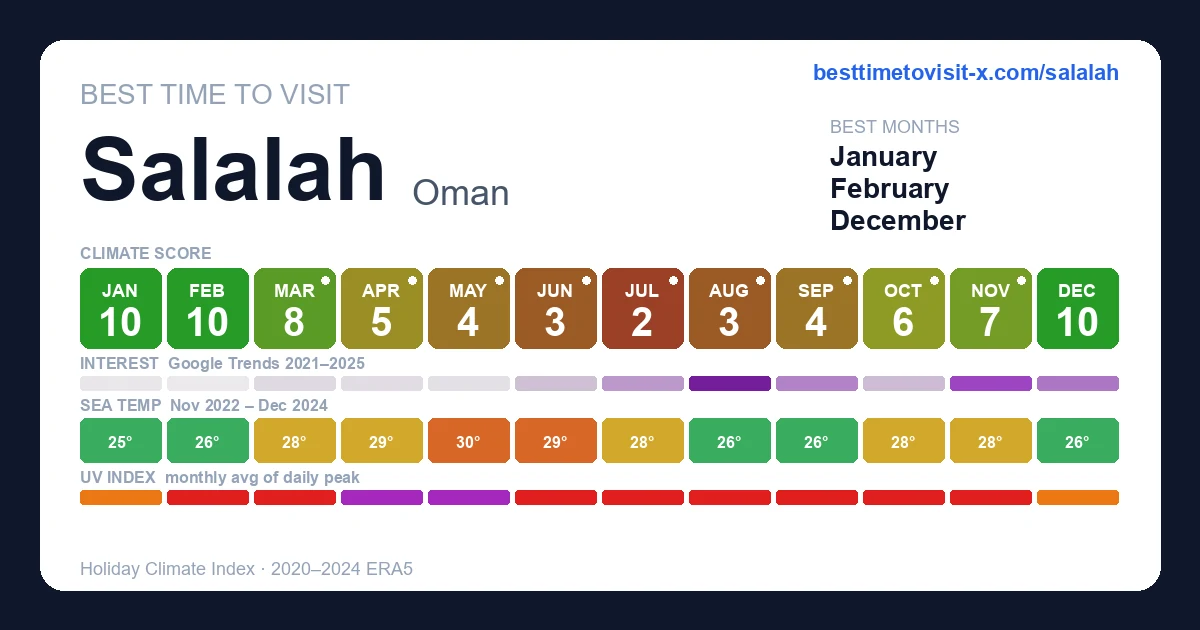
| Jan | 19–27 | 26 | 2 | 34 | 17.0 | 45% | 20 | 248 | 8 | Quiet | 10 |
| Feb | 20–28 | 27 | 0 | 9 | — | 46% | 18 | 233 | 10 | Quiet | 10 |
| Mar | 22–30 | 31 | 2 | 43 | 21.5 | 49% | 17 | 252 | 11 | Quiet | 8 |
| Apr | 25–31 | 34 | 3 | 47 | 15.7 | 59% | 18 | 257 | 12 | Quiet | 5 |
| May | 27–33 | 37 | 4 | 81 | 20.3 | 62% | 19 | 261 | 12 | Quiet | 4 |
| Jun | 26–31 | 36 | 10 | 145 | 14.5 | 73% | 17 | 216 | 10 | Moderate | 3 |
| Jul | 25–29 | 33 | 17 | 264 | 15.5 | 79% | 17 | 174 | 9 | Peak | 2 |
| Aug | 24–28 | 32 | 14 | 244 | 17.4 | 81% | 16 | 172 | 10 | Peak | 3 |
| Sep | 25–29 | 34 | 9 | 168 | 18.7 | 74% | 16 | 207 | 10 | Quiet | 4 |
| Oct | 24–30 | 33 | 4 | 55 | 13.8 | 60% | 16 | 254 | 10 | Quiet | 6 |
| Nov | 22–31 | 32 | 1 | 12 | 12.0 | 50% | 16 | 240 | 8 | Moderate | 7 |
| Dec | 20–29 | 28 | 1 | 9 | 9.0 | 40% | 20 | 250 | 7 | Moderate | 10 |
UV Index in Salalah by Month
UV index in Salalah peaks at 12 (extreme) in April, dropping to 7 (high) in December. February, March, April, May, June, July, August, September, October, November reach very high or extreme levels — apply SPF 50+, wear a hat and protective clothing, and limit direct sun between 11:00 and 17:00.
Best months in detail
January
10/1019–27°C (feels 26°C) · 2 rain days (34h) · 248 sun hours · 45% humidity · Quiet crowd · UV 8 (high) · sunniest 1 in 10 days reach 9 (very high)
February
10/1020–28°C · 0 rain days (9h) · 233 sun hours · 46% humidity · Quiet crowd · UV 10 (very high)
December
10/1020–29°C (feels 28°C) · 1 rain days (9h) · 250 sun hours · 40% humidity · Moderate crowd · UV 7 (high)
Every month
Show the other 9 months in detail
March
8/1022–30°C · 2 rain days (43h) · 252 sun hours · 49% humidity · Quiet crowd · UV 11 (very high) · sunniest 1 in 10 days reach 12 (extreme)
April
5/1025–31°C (feels 34°C) · 3 rain days (47h) · 257 sun hours · 59% humidity · Quiet crowd · UV 12 (extreme)
May
4/1027–33°C (feels 37°C) · 4 rain days (81h) · 261 sun hours · 62% humidity · Quiet crowd · UV 12 (extreme) · sunniest 1 in 10 days reach 13 (extreme)
June
3/1026–31°C (feels 36°C) · 10 rain days (145h) · 216 sun hours · 73% humidity · Moderate crowd · UV 10 (very high) · sunniest 1 in 10 days reach 12 (extreme)
July
2/1025–29°C (feels 33°C) · 17 rain days (264h) · 174 sun hours · 79% humidity · Peak crowd · UV 9 (very high) · sunniest 1 in 10 days reach 10 (very high)
August
3/1024–28°C (feels 32°C) · 14 rain days (244h) · 172 sun hours · 81% humidity · Peak crowd · UV 10 (very high) · sunniest 1 in 10 days reach 12 (extreme)
September
4/1025–29°C (feels 34°C) · 9 rain days (168h) · 207 sun hours · 74% humidity · Quiet crowd · UV 10 (very high) · sunniest 1 in 10 days reach 11 (extreme)
October
6/1024–30°C (feels 33°C) · 4 rain days (55h) · 254 sun hours · 60% humidity · Quiet crowd · UV 10 (very high)
November
7/1022–31°C (feels 32°C) · 1 rain days (12h) · 240 sun hours · 50% humidity · Moderate crowd · UV 8 (very high)
The only corner of Arabia that turns green in summer
Salalah runs on a climate almost nothing else in the Gulf shares. Between roughly 21 June and 21 September the Indian Ocean monsoon reaches the Dhofar coast as the khareef — not the torrential downpour of a South Asian monsoon, but weeks of low cloud, sea mist and persistent drizzle. Total rainfall is modest, on the order of 50 to 100 millimetres spread over dozens of damp days, with August typically the wettest.
The effect is out of all proportion to the numbers. The Dhofar mountains turn green, seasonal waterfalls run, and daytime temperatures sit far below the rest of the Arabian Peninsula at the same moment. While the Gulf bakes, Salalah is mild, grey and lush — which is precisely why it fills with regional visitors in July and August, the months a traveller would normally avoid anywhere else in Arabia.
That inverts the usual reading of a climate score. A low summer score here reflects cloud, humidity and drizzle, which is exactly the weather people travel for.
Sources: Dalil Oman — what is khareef , Oman Spirit — khareef season guide
Which month is best for Salalah?
It depends which Salalah you want. July and August are the heart of the khareef — greenest hills, running waterfalls, cool mist, and the busiest, priciest weeks of the year. For beach weather and clear skies, come between October and April, when the coast is warm and dry and visitor numbers collapse.
How many days are enough for Salalah?
Three to four. That covers the beaches and Al Baleed on the coastal plain, a day in the Dhofar mountains for the khareef greenery or the frankincense country, and a run east or west along the coast to the blowholes or the empty beaches. Add a day if you are visiting during the khareef, when low cloud can hide the hills until the afternoon clears.
Is the khareef actually rainy?
Not in the way the word monsoon suggests. It is mist, low cloud and steady drizzle rather than heavy downpours — total rainfall stays modest. What it does is keep temperatures down and turn the hills green, which is the whole attraction. May is the wettest month in the record at only about 39 mm, which shows how little actual rainfall the greenery needs.
What is the khareef and when does it happen?
The khareef is the monsoon that reaches Dhofar roughly from late June to early September, turning the desert around Salalah green with mist and drizzle. It is the reason Salalah's visitor peak is in August rather than winter — the opposite of the rest of the Gulf, where summer is avoided.
What is the hottest month in Salalah?
May, averaging about 33C, just before the khareef arrives and cools everything down. That is the key quirk here: unlike the rest of Arabia, Salalah's peak heat is in late spring, and its summer is comparatively mild because of the monsoon cloud cover.
Does it rain in Salalah?
Very little outside the khareef — February averages around 1 mm. During the monsoon it is less rain than persistent mist and drizzle, with May at about 39 mm the wettest month in the record. That fine moisture, not heavy rainfall, is what makes the Dhofar hills green.
How many days do you need in Salalah?
Three to four. One for the city, the souk and the frankincense sites; one for the coast west toward Mughsayl and the blowholes; one for the wadis and the Dhofar mountains, which are the whole point during the khareef. Add a day if you plan to reach the empty quarter.
What is Salalah known for?
The khareef — a monsoon that reaches the Dhofar coast from about late June to early September and turns the surrounding hills green, uniquely in Arabia. It is also the historic centre of the frankincense trade, and the Land of Frankincense sites, including Al Baleed and Wadi Dawkah, are UNESCO-listed.
What not to miss in Salalah?
Al Baleed Archaeological Park and its frankincense museum, the blowholes and cliffs at Mughsayl west of the city, the wadis and springs in the Dhofar mountains — spectacular during the khareef — and the banana and coconut plantations along the coastal plain, which are unexpected for Oman.
Is Salalah worth visiting?
Yes, and it is unlike anywhere else in the Gulf. During the khareef it is green, misty and around 10C cooler than the rest of Arabia, which is why regional visitors arrive in August rather than winter. Outside the monsoon it offers empty beaches, frankincense archaeology and warm clear water with very few tourists.
Frequently asked questions about visiting Salalah
When is the best time to visit Salalah?
January is the highest-scoring month (10/10 on the Holiday Climate Index). Typical conditions: 19–27°C (2 rainy days). The top three months by score are January, February, December.
What is the worst time to visit Salalah?
July is the lowest-scoring month (2/10, capped by extreme heat). Typical conditions: 25–29°C (17 rainy days).
Is Salalah too hot in summer?
9 months (March, April, May, June, July, August, September, October, November) trip the heat deal-breaker in our scoring: apparent temperature crosses the comfort cap, so even with clear skies and low rain the score is held down. Plan around it if heat tolerance is low.
When are crowds lowest in Salalah?
Search-interest seasonality (Google Trends 2021-2025) is lowest in May and peaks in August. Interest tracks both in-trip visitors and lead-time planners, so treat it as a "destination is on people's minds" signal rather than literal arrivals.
Which months in Salalah have good weather but fewer tourists?
January (climate 10/10, crowd index 12) and February (climate 10/10, crowd index 6) — shoulder months with above-average climate and below-median search-interest. Often the best value-for-weather trade.
What is the UV index in Salalah by month?
UV peaks at 12 (extreme) in April and is lowest in December at 7 (high). Monthly peak values: Jan 8, Feb 10, Mar 11, Apr 12, May 12, Jun 10, Jul 9, Aug 10, Sep 10, Oct 10, Nov 8, Dec 7. February, March, April, May, June, July, August, September, October, November reach very high or extreme levels — apply SPF 50+, wear a hat and protective clothing, and limit direct sun between 11:00 and 17:00.
What is the UV index in Salalah in April?
April is the peak UV month in Salalah, with a daily-peak UV index of 12 (extreme). At this level, sunburn can occur in under 20 minutes on unprotected fair skin. Apply SPF 50+, wear protective clothing and a hat, and avoid direct midday sun (11:00–17:00).
How high can UV get in Salalah on the sunniest days?
Most days look like the monthly average, but on the sunniest ~1 in 10 days UV climbs higher than the mean suggests. May is the worst case: typical days average UV 12 (extreme), but the top 10% of days reach UV 13 (extreme) — and even higher. Months where the sunniest days routinely exceed the typical reading: January, March, May, June, July, August, September. Plan sun protection for the worst case, not the average.
Is air quality in Salalah bad for travelers?
PM2.5 (fine-particle pollution) exceeds the WHO sensitive-group guideline (15 µg/m³) in 12 months: January, February, March, April, May, June, July, August, September, October, November, December. The worst month is December with a typical-day mean of 31 µg/m³ (unhealthy); on the worst 10% of days PM2.5 reaches 58 µg/m³ (hazardous) and higher. People with asthma, heart conditions, or sensitive children may want to avoid these months or limit outdoor activity. Source: CAMS via Open-Meteo.