Best time to visit Death Valley
Re-score for me — drag the dial — every chart on the page recolours live for your heat limit 27°C
Default 27 °C is the upper edge of the Holiday Climate Index "ideal comfort" band (Scott, Rutty, Amelung & Tang, 2016). Above this, most warm-tourism travellers report measurable discomfort.
Greyed factors are scored normally — extreme heat overrides them, so a clear sky or low rain can't lift the period.
Greyed factors are scored normally — extreme heat overrides them, so a clear sky or low rain can't lift the period.
Greyed factors are scored normally — extreme heat overrides them, so a clear sky or low rain can't lift the period.
Greyed factors are scored normally — extreme heat overrides them, so a clear sky or low rain can't lift the period.
Greyed factors are scored normally — extreme heat overrides them, so a clear sky or low rain can't lift the period.
Greyed factors are scored normally — extreme heat overrides them, so a clear sky or low rain can't lift the period.
Greyed factors are scored normally — extreme heat overrides them, so a clear sky or low rain can't lift the period.
Greyed factors are scored normally — extreme heat overrides them, so a clear sky or low rain can't lift the period.
Greyed factors are scored normally — extreme heat overrides them, so a clear sky or low rain can't lift the period.
Greyed factors are scored normally — extreme heat overrides them, so a clear sky or low rain can't lift the period.
Greyed factors are scored normally — extreme heat overrides them, so a clear sky or low rain can't lift the period.
Greyed factors are scored normally — extreme heat overrides them, so a clear sky or low rain can't lift the period.
Greyed factors are scored normally — extreme heat overrides them, so a clear sky or low rain can't lift the period.
Greyed factors are scored normally — extreme heat overrides them, so a clear sky or low rain can't lift the period.
Greyed factors are scored normally — extreme heat overrides them, so a clear sky or low rain can't lift the period.
Greyed factors are scored normally — extreme heat overrides them, so a clear sky or low rain can't lift the period.
Greyed factors are scored normally — extreme heat overrides them, so a clear sky or low rain can't lift the period.
Greyed factors are scored normally — extreme heat overrides them, so a clear sky or low rain can't lift the period.
Greyed factors are scored normally — extreme heat overrides them, so a clear sky or low rain can't lift the period.
Greyed factors are scored normally — extreme heat overrides them, so a clear sky or low rain can't lift the period.
Greyed factors are scored normally — extreme heat overrides them, so a clear sky or low rain can't lift the period.
Greyed factors are scored normally — extreme heat overrides them, so a clear sky or low rain can't lift the period.
Greyed factors are scored normally — extreme heat overrides them, so a clear sky or low rain can't lift the period.
Greyed factors are scored normally — extreme heat overrides them, so a clear sky or low rain can't lift the period.
Greyed factors are scored normally — extreme heat overrides them, so a clear sky or low rain can't lift the period.
Greyed factors are scored normally — extreme heat overrides them, so a clear sky or low rain can't lift the period.
Greyed factors are scored normally — extreme heat overrides them, so a clear sky or low rain can't lift the period.
Greyed factors are scored normally — extreme heat overrides them, so a clear sky or low rain can't lift the period.
Greyed factors are scored normally — extreme heat overrides them, so a clear sky or low rain can't lift the period.
Greyed factors are scored normally — extreme heat overrides them, so a clear sky or low rain can't lift the period.
Greyed factors are scored normally — extreme heat overrides them, so a clear sky or low rain can't lift the period.
Greyed factors are scored normally — extreme heat overrides them, so a clear sky or low rain can't lift the period.
Greyed factors are scored normally — extreme heat overrides them, so a clear sky or low rain can't lift the period.
Greyed factors are scored normally — extreme heat overrides them, so a clear sky or low rain can't lift the period.
Greyed factors are scored normally — extreme heat overrides them, so a clear sky or low rain can't lift the period.
Greyed factors are scored normally — extreme heat overrides them, so a clear sky or low rain can't lift the period.
Greyed factors are scored normally — extreme heat overrides them, so a clear sky or low rain can't lift the period.
Greyed factors are scored normally — extreme heat overrides them, so a clear sky or low rain can't lift the period.
Greyed factors are scored normally — extreme heat overrides them, so a clear sky or low rain can't lift the period.
Greyed factors are scored normally — extreme heat overrides them, so a clear sky or low rain can't lift the period.
Greyed factors are scored normally — extreme heat overrides them, so a clear sky or low rain can't lift the period.
How is this scored? HCI / Steadman / CCI gate — full methodology and citations below.
Compare with another destination
Add as many as you like — stacked below the main strips above. Each row is just the recent-window score strip and (for beach destinations) sea-temperature strip.
Tours in Death Valley
6 top-rated tours via Viator. Booking links earn this site a commission at no cost to you. Map locations are approximate (centred on Death Valley).
- 1
 California Adventure Bundle: 13 Self-Guided Audio Tours
 - 2
 Death Valley National Park Self-Guided Audio Driving Tour
 - 3
 Annual Pass National Parks with Audioguide
 - 4
 US West National Parks Driving and Walking Audio Tour Bundle
 - 5
 Private Death Valley National Park Tour
 - 6
 South California Self Guided Driving and Walking Bundle Tour
Last refreshed 2026-08-13.
Similar climatesPalm Springs98% · Phoenix94% · Pyramids of Giza93%
Other destinations with the most-alike year-round climate to Death Valley (apparent temperature, rain hours, sunshine — matched within the same trip-profile). The ±N chip compares each match's typical score for the current month against Death Valley's. Based on the 2020-2024 climatology, not this year's actual weather.
Month-by-month
| Month | Temp °C | Feels °C | Rain days | Rain h | Rain h/day | Humidity | Wind km/h | Sun h | UV | Interest | Score |
|---|---|---|---|---|---|---|---|---|---|---|---|
| Jan | 11–19 | 16 | 3 | 24 | 8.0 | 30% | 10 | 207 | 3 | Busy | 8 |
| Feb | 12–21 | 18 | 3 | 33 | 11.0 | 23% | 12 | 201 | 4 | Peak | 8 |
| Mar | 14–23 | 20 | 3 | 27 | 9.0 | 22% | 14 | 253 | 6 | Peak | 9 |
| Apr | 20–30 | 26 | 1 | 8 | 8.0 | 14% | 14 | 274 | 8 | Moderate | 8 |
| May | 25–35 | 31 | 0 | 2 | — | 11% | 15 | 311 | 9 | Quiet | 6 |
| Jun | 30–40 | 37 | 0 | 1 | — | 11% | 15 | 308 | 10 | Quiet | 3 |
| Jul | 35–44 | 42 | 0 | 1 | — | 11% | 15 | 317 | 11 | Quiet | 2 |
| Aug | 32–42 | 40 | 1 | 9 | 9.0 | 14% | 13 | 296 | 10 | Quiet | 2 |
| Sep | 29–38 | 36 | 0 | 4 | — | 14% | 11 | 262 | 8 | Quiet | 3 |
| Oct | 22–32 | 29 | 0 | 1 | — | 15% | 10 | 248 | 6 | Quiet | 8 |
| Nov | 14–23 | 19 | 1 | 7 | 7.0 | 19% | 10 | 214 | 3 | Moderate | 8 |
| Dec | 11–19 | 16 | 2 | 19 | 9.5 | 29% | 10 | 194 | 2 | Peak | 8 |
UV Index in Death Valley by Month
UV index in Death Valley peaks at 11 (very high) in July, dropping to 2 (low) in December. May, June, July, August reach very high or extreme levels — apply SPF 50+, wear a hat and protective clothing, and limit direct sun between 11:00 and 17:00.
Best months in detail
March
9/1014–23°C (feels 20°C) · 3 rain days (27h) · 253 sun hours · 22% humidity · Peak crowd · UV 6 (moderate) · sunniest 1 in 10 days reach 7 (high)
November
8/1014–23°C (feels 19°C) · 1 rain days (7h) · 214 sun hours · 19% humidity · Moderate crowd · UV 3 (moderate)
January
8/1011–19°C (feels 16°C) · 3 rain days (24h) · 207 sun hours · 30% humidity · Busy crowd · UV 3 (low) · sunniest 1 in 10 days reach 3 (moderate)
Every month
Show the other 9 months in detail
February
8/1012–21°C (feels 18°C) · 3 rain days (33h) · 201 sun hours · 23% humidity · Peak crowd · UV 4 (moderate)
April
8/1020–30°C (feels 26°C) · 1 rain days (8h) · 274 sun hours · 14% humidity · Moderate crowd · UV 8 (high) · sunniest 1 in 10 days reach 9 (very high)
May
6/1025–35°C (feels 31°C) · 0 rain days (2h) · 311 sun hours · 11% humidity · Quiet crowd · UV 9 (very high)
June
3/1030–40°C (feels 37°C) · 0 rain days (1h) · 308 sun hours · 11% humidity · Quiet crowd · UV 10 (very high) · sunniest 1 in 10 days reach 11 (extreme)
July
2/1035–44°C (feels 42°C) · 0 rain days (1h) · 317 sun hours · 11% humidity · Quiet crowd · UV 11 (very high) · sunniest 1 in 10 days reach 12 (extreme)
August
2/1032–42°C (feels 40°C) · 1 rain days (9h) · 296 sun hours · 14% humidity · Quiet crowd · UV 10 (very high)
September
3/1029–38°C (feels 36°C) · 0 rain days (4h) · 262 sun hours · 14% humidity · Quiet crowd · UV 8 (high) · sunniest 1 in 10 days reach 9 (very high)
October
8/1022–32°C (feels 29°C) · 0 rain days (1h) · 248 sun hours · 15% humidity · Quiet crowd · UV 6 (moderate) · sunniest 1 in 10 days reach 7 (high)
December
8/1011–19°C (feels 16°C) · 2 rain days (19h) · 194 sun hours · 29% humidity · Peak crowd · UV 2 (low)
It holds the hottest air temperature ever recorded on Earth
Death Valley is not merely hot in the way other desert parks are hot. On 10 July 1913 a reading of 134F — about 56.7C — was taken at Furnace Creek, and it remains the highest air temperature ever recorded anywhere on Earth.
That is not a historical curiosity. The National Park Service recorded the hottest meteorological summer in the park's history with an average 24-hour temperature of 104.5F (40.3C) — an average that includes the nights — with nine consecutive days reaching 125F (51.7C) or higher. Rangers responded to multiple life-threatening heat incidents, including a fatality, and one visitor suffered second-degree burns to the feet after losing footwear on the dunes. The park's own advice for summer is to limit time outside air conditioning to a few minutes at a time.
This is the rare destination where the summer figures are a warning rather than a trade-off.
Sources: NPS — Record heat at Death Valley , NPS — Death Valley weather and climate
When to avoid Death Valley?
June to September. The park has recorded an entire summer averaging 104.5F across 24 hours, including nine consecutive days at or above 125F. Heat here causes deaths and serious burns most years, and the National Park Service advises limiting time outside air conditioning to minutes.
How many days do you need at Death Valley?
Two days. One covers Badwater Basin, Artists Palette, Golden Canyon and Zabriskie Point; a second reaches Ubehebe Crater, Mesquite Flat Dunes and Dantes View. The park is vast and distances between sights are long, so allow far more driving time than the map suggests.
Which is better, Joshua Tree or Death Valley?
Death Valley is the more extreme and more spectacular landscape — salt flats, dunes and badlands below sea level — but it is a driving park with long distances. Joshua Tree is smaller, closer to Los Angeles, better for rock scrambling and walking, and less dangerous in shoulder seasons. Both are winter destinations.
What's the best month to visit Death Valley?
March. Daytime temperatures are comfortable for walking, the light on the badlands is at its best, and a wet winter can bring a wildflower bloom — though a strong bloom is not an annual event. November through February are also excellent and quieter; December lows average around 8C, mild for a winter trip.
When not to go to Death Valley?
June through September. July averages about 44C by day, and the park has recorded an entire summer averaging 104.5F across 24 hours including the nights, with nine consecutive days at or above 125F. This is not a discomfort question — heat kills visitors here most years, and rangers respond to multiple life-threatening incidents each summer.
Which is hotter, Phoenix or Death Valley?
Death Valley, decisively. It holds the highest air temperature ever recorded on Earth — 134F, about 56.7C, at Furnace Creek on 10 July 1913. Phoenix is severe but Death Valley sits below sea level in a basin that traps and re-radiates heat, so it regularly runs several degrees hotter on the same day.
Why do you have to turn off AC in Death Valley?
On long climbs in extreme heat, running air conditioning adds engine load and can push a cooling system into overheating — so the advice is to switch it off and run the heater on the steepest grades to shed heat. Carry extra water for the radiator as well as for yourself, and do not rely on phone signal for a breakdown.
What is the driest month in Death Valley?
June, at around 2 mm, though the whole year is arid — February is the wettest at just 24 mm. The rare rain matters out of proportion to its volume: a downpour on baked ground runs straight off and can close roads with flash flooding and debris, and a wet winter is what triggers a spring wildflower bloom.
How many people died in Death Valley every year?
Deaths are rare relative to visitor numbers but heat is a recurring cause, and the park recorded a heat-related fatality during its hottest summer on record. Serious injury is more common than death — one visitor suffered second-degree burns to the feet after losing footwear on the dunes. The park advises limiting time outside air conditioning to minutes in summer.
What not to miss in Death Valley?
Badwater Basin, the lowest point in North America at 86 m below sea level, and the salt polygons on its floor; Zabriskie Point at sunrise for the badlands; Mesquite Flat Dunes; and Dantes View, which looks down on the whole basin from over 1,600 m. Artists Palette is best in late afternoon when the mineral colours read strongest.
Is it worth going to Death Valley?
It is the hottest, driest and lowest place in North America, and holds the highest air temperature ever recorded on earth — 134F at Furnace Creek in July 1913. That extremity is the attraction, and in winter it is genuinely pleasant to explore. Between June and September it is a place to drive through with brief stops, not to hike in.
What is the main attraction of Death Valley National Park?
Badwater Basin, the salt flat 86 m below sea level, is the single most visited spot, and the contrast with Telescope Peak more than 3,000 m directly above it is the park in one view. But Death Valley's real character is the variety across enormous distances — dunes, badlands, craters and canyons — which is why it needs two days and a lot of driving.
Frequently asked questions about visiting Death Valley
When is the best time to visit Death Valley?
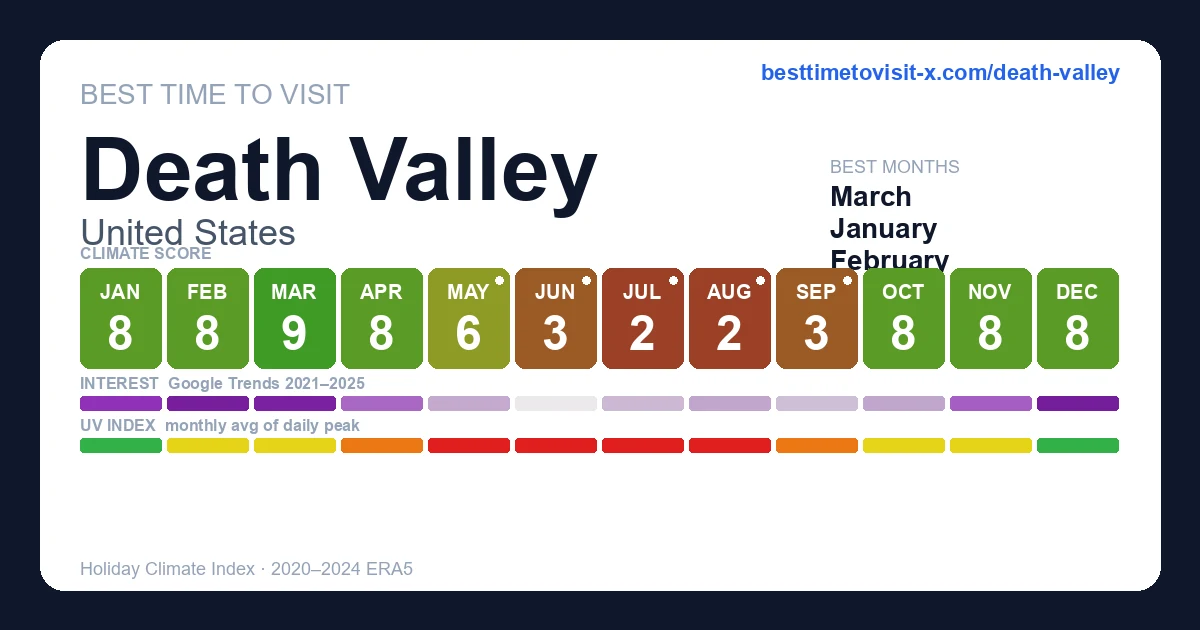
March is the highest-scoring month (9/10 on the Holiday Climate Index). Typical conditions: 14–23°C (3 rainy days). The top three months by score are March, November, January.
What is the worst time to visit Death Valley?
August is the lowest-scoring month (2/10, capped by extreme heat). Typical conditions: 32–42°C (1 rainy day).
Is Death Valley too hot in summer?
5 months (May, June, July, August, September) trip the heat deal-breaker in our scoring: apparent temperature crosses the comfort cap, so even with clear skies and low rain the score is held down. Plan around it if heat tolerance is low.
When are crowds lowest in Death Valley?
Search-interest seasonality (Google Trends 2021-2025) is lowest in June and peaks in December. Interest tracks both in-trip visitors and lead-time planners, so treat it as a "destination is on people's minds" signal rather than literal arrivals.
Which months in Death Valley have good weather but fewer tourists?
October (climate 8/10, crowd index 34) — shoulder months with above-average climate and below-median search-interest. Often the best value-for-weather trade.
What is the UV index in Death Valley by month?
UV peaks at 11 (very high) in July and is lowest in December at 2 (low). Monthly peak values: Jan 3, Feb 4, Mar 6, Apr 8, May 9, Jun 10, Jul 11, Aug 10, Sep 8, Oct 6, Nov 3, Dec 2. May, June, July, August reach very high or extreme levels — apply SPF 50+, wear a hat and protective clothing, and limit direct sun between 11:00 and 17:00.
What is the UV index in Death Valley in July?
July is the peak UV month in Death Valley, with a daily-peak UV index of 11 (very high). At this level, sunburn can occur in under 20 minutes on unprotected fair skin. Apply SPF 50+, wear protective clothing and a hat, and avoid direct midday sun (11:00–17:00).
How high can UV get in Death Valley on the sunniest days?
Most days look like the monthly average, but on the sunniest ~1 in 10 days UV climbs higher than the mean suggests. July is the worst case: typical days average UV 11 (very high), but the top 10% of days reach UV 12 (extreme) — and even higher. Months where the sunniest days routinely exceed the typical reading: January, March, April, June, July, September, October. Plan sun protection for the worst case, not the average.