Best time to visit Phoenix
Re-score for me — drag the dial — every chart on the page recolours live for your heat limit 27°C
Default 27 °C is the upper edge of the Holiday Climate Index "ideal comfort" band (Scott, Rutty, Amelung & Tang, 2016). Above this, most warm-tourism travellers report measurable discomfort.
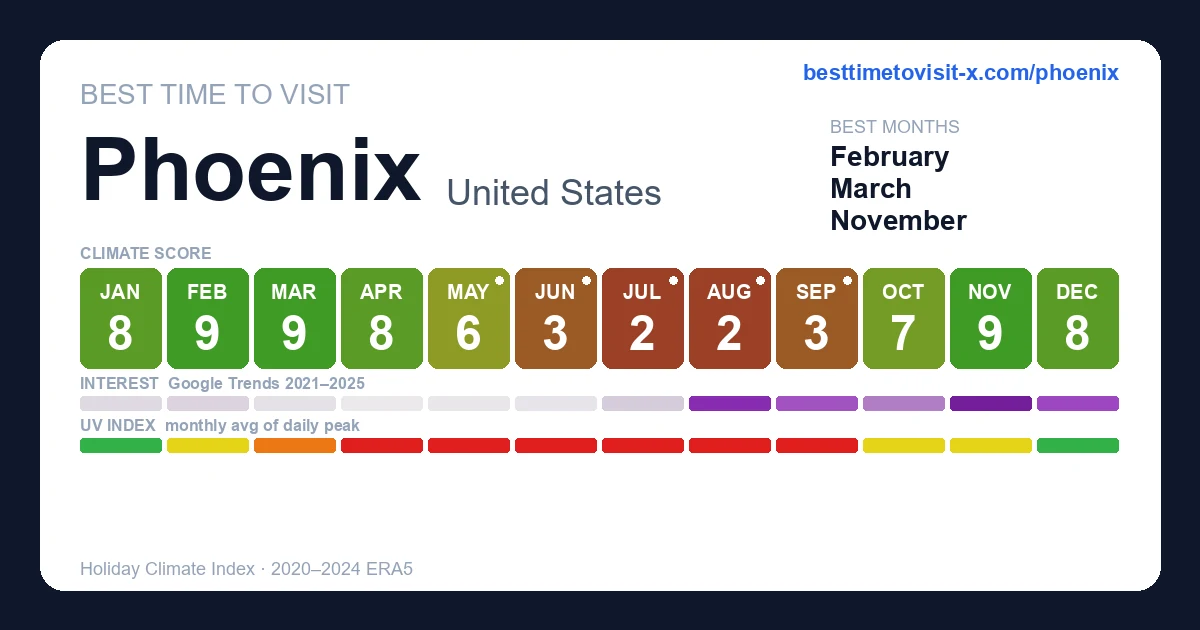
Greyed factors are scored normally — extreme heat overrides them, so a clear sky or low rain can't lift the period.
Greyed factors are scored normally — extreme heat overrides them, so a clear sky or low rain can't lift the period.
Greyed factors are scored normally — extreme heat overrides them, so a clear sky or low rain can't lift the period.
Greyed factors are scored normally — extreme heat overrides them, so a clear sky or low rain can't lift the period.
Greyed factors are scored normally — extreme heat overrides them, so a clear sky or low rain can't lift the period.
Greyed factors are scored normally — extreme heat overrides them, so a clear sky or low rain can't lift the period.
Greyed factors are scored normally — extreme heat overrides them, so a clear sky or low rain can't lift the period.
Greyed factors are scored normally — extreme heat overrides them, so a clear sky or low rain can't lift the period.
Greyed factors are scored normally — extreme heat overrides them, so a clear sky or low rain can't lift the period.
Greyed factors are scored normally — extreme heat overrides them, so a clear sky or low rain can't lift the period.
Greyed factors are scored normally — extreme heat overrides them, so a clear sky or low rain can't lift the period.
Greyed factors are scored normally — extreme heat overrides them, so a clear sky or low rain can't lift the period.
Greyed factors are scored normally — extreme heat overrides them, so a clear sky or low rain can't lift the period.
Greyed factors are scored normally — extreme heat overrides them, so a clear sky or low rain can't lift the period.
Greyed factors are scored normally — extreme heat overrides them, so a clear sky or low rain can't lift the period.
Greyed factors are scored normally — extreme heat overrides them, so a clear sky or low rain can't lift the period.
Greyed factors are scored normally — extreme heat overrides them, so a clear sky or low rain can't lift the period.
Greyed factors are scored normally — extreme heat overrides them, so a clear sky or low rain can't lift the period.
Greyed factors are scored normally — extreme heat overrides them, so a clear sky or low rain can't lift the period.
Greyed factors are scored normally — extreme heat overrides them, so a clear sky or low rain can't lift the period.
Greyed factors are scored normally — extreme heat overrides them, so a clear sky or low rain can't lift the period.
Greyed factors are scored normally — extreme heat overrides them, so a clear sky or low rain can't lift the period.
Greyed factors are scored normally — extreme heat overrides them, so a clear sky or low rain can't lift the period.
Greyed factors are scored normally — extreme heat overrides them, so a clear sky or low rain can't lift the period.
Greyed factors are scored normally — extreme heat overrides them, so a clear sky or low rain can't lift the period.
Greyed factors are scored normally — extreme heat overrides them, so a clear sky or low rain can't lift the period.
Greyed factors are scored normally — extreme heat overrides them, so a clear sky or low rain can't lift the period.
Greyed factors are scored normally — extreme heat overrides them, so a clear sky or low rain can't lift the period.
Greyed factors are scored normally — extreme heat overrides them, so a clear sky or low rain can't lift the period.
Greyed factors are scored normally — extreme heat overrides them, so a clear sky or low rain can't lift the period.
Greyed factors are scored normally — extreme heat overrides them, so a clear sky or low rain can't lift the period.
Greyed factors are scored normally — extreme heat overrides them, so a clear sky or low rain can't lift the period.
Greyed factors are scored normally — extreme heat overrides them, so a clear sky or low rain can't lift the period.
Greyed factors are scored normally — extreme heat overrides them, so a clear sky or low rain can't lift the period.
Greyed factors are scored normally — extreme heat overrides them, so a clear sky or low rain can't lift the period.
Greyed factors are scored normally — extreme heat overrides them, so a clear sky or low rain can't lift the period.
Greyed factors are scored normally — extreme heat overrides them, so a clear sky or low rain can't lift the period.
Greyed factors are scored normally — extreme heat overrides them, so a clear sky or low rain can't lift the period.
Greyed factors are scored normally — extreme heat overrides them, so a clear sky or low rain can't lift the period.
Greyed factors are scored normally — extreme heat overrides them, so a clear sky or low rain can't lift the period.
How is this scored? HCI / Steadman / CCI gate — full methodology and citations below.
Compare with another destination
Add as many as you like — stacked below the main strips above. Each row is just the recent-window score strip and (for beach destinations) sea-temperature strip.
Tours in Phoenix
25 top-rated tours via Viator. Booking links earn this site a commission at no cost to you. Map locations are approximate (centred on Phoenix).
- 1
 Phoenix area Hot Air Balloon Ride on the Largest Balloon in USA
 - 2
 Guided Arizona Desert Tour by UTV - Centipede Tour
 - 3
 Kayaking the Salt River Foxtail Trip
 - 4
 Ancient Ruins Tour - Guided Arizona Desert Tour by UTV
 - 5
 Arizona Desert Guided E-Bike Adventure
 - 6
 Self-Guided Centipede Desert UTV Rental
 - 7
 Stunning Sunset or Sunrise Guided Hiking Adventure in Phoenix
 - 8
 Amazing 2-Hour Guided Hiking Adventure in Phoenix, Arizona
 - 9
 Party Bike Private Party Up To 14 People in Downtown Phoenix
 - 10
 Guided Arizona Desert Tour by ATV - Centipede Tour
 - 11
 Phoenix Morning Hot Air Balloon Ride with Bubbly + Breakfast
 - 12
 Grand Canyon with Sedona and Oak Creek Canyon Van Tour
 - 13
 Small Group or Private Sedona and Native American Ruins Day Tour
 - 14
 Self-Guided Centipede Desert ATV Rental
 - 15
 3-Hour ATV and Shooting Combo
 - 163-Hour UTV and Shooting Combo
- 17
 ATV Training Session
 - 18
 Epic Camelback Mountain Guided Hiking Adventure in Phoenix, Arizona
 - 19
 The Shoot House
 - 20
 Spectacular Sunrise Guided Hike in Phoenix, Arizona
 - 21
 Phoenix Hot Air Balloon Ride at Sunrise
 - 22
 Small-Group or Private Grand Canyon with Sedona Tour from Phoenix
 - 23
 Camelback's Hidden Gems - Hike & Yoga with a View
 - 24
 Easy Desert Hike & Yoga with Stunning Views
 - 25
 Single Kayak Neon Night Paddle
Last refreshed 2026-05-30.
Similar climatesPalm Springs94% · Death Valley94% · Pyramids of Giza92%
Other destinations with the most-alike year-round climate to Phoenix (apparent temperature, rain hours, sunshine — matched within the same trip-profile). The ±N chip compares each match's typical score for the current month against Phoenix's. Based on the 2020-2024 climatology, not this year's actual weather.
Month-by-month
| Month | Temp °C | Feels °C | Rain days | Rain h | Rain h/day | Humidity | Wind km/h | Sun h | UV | Interest | Score |
|---|---|---|---|---|---|---|---|---|---|---|---|
| Jan | 5–18 | 15 | 4 | 45 | 11.3 | 40% | 15 | 197 | 3 | Quiet | 8 |
| Feb | 7–21 | 17 | 3 | 29 | 9.7 | 30% | 18 | 208 | 5 | Peak | 9 |
| Mar | 10–23 | 20 | 4 | 52 | 13.0 | 29% | 19 | 240 | 6 | Busy | 9 |
| Apr | 15–31 | 26 | 0 | 6 | — | 14% | 20 | 282 | 8 | Moderate | 8 |
| May | 20–35 | 31 | 0 | 1 | — | 11% | 21 | 301 | 9 | Quiet | 6 |
| Jun | 26–40 | 37 | 1 | 5 | 5.0 | 12% | 22 | 293 | 10 | Quiet | 3 |
| Jul | 30–42 | 42 | 4 | 32 | 8.0 | 24% | 22 | 281 | 10 | Moderate | 2 |
| Aug | 28–40 | 41 | 5 | 34 | 6.8 | 28% | 20 | 280 | 10 | Moderate | 2 |
| Sep | 25–38 | 37 | 2 | 20 | 10.0 | 22% | 19 | 257 | 8 | Quiet | 3 |
| Oct | 18–32 | 30 | 1 | 7 | 7.0 | 19% | 17 | 246 | 6 | Quiet | 7 |
| Nov | 10–25 | 21 | 1 | 9 | 9.0 | 22% | 15 | 212 | 4 | Quiet | 9 |
| Dec | 7–20 | 17 | 4 | 39 | 9.8 | 35% | 13 | 193 | 3 | Quiet | 8 |
UV Index in Phoenix by Month
UV index in Phoenix peaks at 10 (very high) in July, dropping to 3 (low) in December. April, May, June, July, August, September reach very high or extreme levels — apply SPF 50+, wear a hat and protective clothing, and limit direct sun between 11:00 and 17:00.
Best months in detail
March
9/1010–23°C (feels 20°C) · 4 rain days (52h) · 240 sun hours · 29% humidity · Busy crowd · UV 6 (high) · sunniest 1 in 10 days reach 8 (high)
November
9/1010–25°C (feels 21°C) · 1 rain days (9h) · 212 sun hours · 22% humidity · Quiet crowd · UV 4 (moderate)
February
9/107–21°C (feels 17°C) · 3 rain days (29h) · 208 sun hours · 30% humidity · Peak crowd · UV 5 (moderate)
Every month
Show the other 9 months in detail
January
8/105–18°C (feels 15°C) · 4 rain days (45h) · 197 sun hours · 40% humidity · Quiet crowd · UV 3 (low) · sunniest 1 in 10 days reach 4 (moderate)
April
8/1015–31°C (feels 26°C) · 0 rain days (6h) · 282 sun hours · 14% humidity · Moderate crowd · UV 8 (very high)
May
6/1020–35°C (feels 31°C) · 0 rain days (1h) · 301 sun hours · 11% humidity · Quiet crowd · UV 9 (very high)
June
3/1026–40°C (feels 37°C) · 1 rain days (5h) · 293 sun hours · 12% humidity · Quiet crowd · UV 10 (very high) · sunniest 1 in 10 days reach 11 (extreme)
July
2/1030–42°C · 4 rain days (32h) · 281 sun hours · 24% humidity · Moderate crowd · UV 10 (very high) · sunniest 1 in 10 days reach 11 (extreme)
August
2/1028–40°C · 5 rain days (34h) · 280 sun hours · 28% humidity · Moderate crowd · UV 10 (very high)
September
3/1025–38°C (feels 37°C) · 2 rain days (20h) · 257 sun hours · 22% humidity · Quiet crowd · UV 8 (very high)
October
7/1018–32°C (feels 30°C) · 1 rain days (7h) · 246 sun hours · 19% humidity · Quiet crowd · UV 6 (moderate) · sunniest 1 in 10 days reach 7 (high)
December
8/107–20°C (feels 17°C) · 4 rain days (39h) · 193 sun hours · 35% humidity · Quiet crowd · UV 3 (low) · sunniest 1 in 10 days reach 3 (moderate)
A weather-service warning shuts Camelback from 8am to 5pm
Phoenix closes its most famous trails by rule, not by advice. Under the Trail Heat Safety Program the Parks and Recreation Board set up in 2021, Camelback Mountain's Echo Canyon and Cholla trails, the Piestewa Peak summit trail, and four routes at South Mountain are restricted from 8 am to 5 pm whenever the National Weather Service issues an Extreme Heat Warning. The hours have tightened twice: 11 am to 5 pm in the 2021 pilot, 9 am from 2023, 8 am after the board's vote of 25 October 2024. The South Mountain list was fixed on 27 March 2025.
The trigger is the part travel pages get wrong. It is not a temperature. NWS Phoenix issues the warning on HeatRisk category, at Major or Extreme with high confidence, and states plainly that no single constant temperature drives the alert, because 40C in May stresses an unacclimatised body more than 40C in July. The product was renamed on 4 March 2025, from Excessive Heat Warning to Extreme Heat Warning, so older guidance uses a term that no longer exists.
The scale is not marginal. Phoenix logged 45 closure days between 1 May and 13 October 2024, in a year with 121 days at or above 41C and 69 above 43C. Rescues from the closed trails fell from 57 in 2021 to 35 in 2024. Maricopa County recorded 430 heat-related deaths in 2025 after a record 645 in 2023. Our own figures show why night brings no relief: the July mean minimum is 28.2C.
Sources: City of Phoenix - Trail Heat Safety Program, restricted trails and hours , National Weather Service Phoenix - heat policy and HeatRisk criteria , National Weather Service - heat watch and warning products renamed, March 2025 , Maricopa County Department of Public Health - 2025 Heat-Related Deaths Report
Which Phoenix trails close in extreme heat?
Echo Canyon and Cholla on Camelback Mountain, the Piestewa Peak summit trail and its associated trails, and at South Mountain the Holbert, Mormon and Hau'pal Loop trails plus access to the National Trail from Pima Canyon Trailhead. Restrictions run 8 am to 5 pm. More than 100 miles of South Mountain trail stay open.
What triggers a closure?
An Extreme Heat Warning from the National Weather Service, nothing else. NWS Phoenix issues one when HeatRisk reaches Major or Extreme with about 80 per cent confidence, and says there is no single constant temperature behind the decision. The product was called an Excessive Heat Warning until 4 March 2025.
How many days a year are the trails actually shut?
Phoenix counted 45 closure days between 1 May and 13 October 2024. That year had 121 days reaching 41C or more and 69 days above 43C. Rescues from the restricted trails have fallen since the programme began, from 57 in 2021 to 47, then 30, then 35 in 2024; citywide more than 200 hikers a year are still rescued.
Can I climb Camelback early in the morning instead?
Yes. The restriction only covers 8 am to 5 pm, and Camelback is open sunrise to sunset, so a start at first light is legal even on a warning day. Parking at both Camelback trailheads is limited and fills fast. At Piestewa Peak the trailhead car park opens at 5 am, staying open until 9 pm from 1 June to 30 September.
When is the best time of year to come?
November through March. March averages 24.9C by day, November 23.9C, and both sit below the threshold where warnings and closures become routine. April at 29.3C and October at 31.0C are the outer edges. Only two months of the year average inside 18 to 27C, which is unusually few for a city this popular in winter.
Why is February the busiest month?
Our crowd index puts February at 100 and September at 0, an inversion of the usual summer pattern. It coincides with Cactus League spring training, which fields 15 major-league clubs across 10 ballparks all within an hour's drive of each other in the metro area; the 2026 season opened on 20 February.
Is the summer heat genuinely dangerous or just unpleasant?
Maricopa County confirmed 430 heat-related deaths in 2025, down from a record 645 in 2023 and 608 in 2024. Of the 2025 total, 313 occurred outdoors, including 38 in desert areas and 17 in parks. The county also found 47 per cent of deaths fell on days rated only moderate heat risk, meaning no warning and no trail closure.
Do the nights cool off?
Barely. July's mean overnight minimum is 28.2C and August's 27.8C, so the city does not reset between days. That is precisely what the weather service's top HeatRisk level describes: long-duration heat with little or no relief overnight. December and January nights average 4.9C, a 23C annual range in the minima alone.
Can I bring a dog on the trails?
Not when it is hot. Phoenix prohibits dogs on all city hiking trails whenever the temperature is 38C or above, which covers most days from May to September. Dogs are barred from the Piestewa Peak summit trail year-round regardless of temperature. Unshaded rock reaches burn temperatures long before the air does.
How much rain should I expect?
About 249mm a year, arriving in two separate seasons. February is the wettest month at 37.9mm, from Pacific systems; then July and August bring 18.7mm and 28.3mm as monsoon thunderstorms, with dust and flash flooding rather than steady rain. May and June are effectively dry, at 4.1mm and 1.9mm.
Frequently asked questions about visiting Phoenix
When is the best time to visit Phoenix?
March is the highest-scoring month (9/10 on the Holiday Climate Index). Typical conditions: 10–23°C (4 rainy days). The top three months by score are March, November, February.
What is the worst time to visit Phoenix?
August is the lowest-scoring month (2/10, capped by extreme heat). Typical conditions: 28–40°C (5 rainy days).
Is Phoenix too hot in summer?
5 months (May, June, July, August, September) trip the heat deal-breaker in our scoring: apparent temperature crosses the comfort cap, so even with clear skies and low rain the score is held down. Plan around it if heat tolerance is low.
When are crowds lowest in Phoenix?
Search-interest seasonality (Google Trends 2021-2025) is lowest in September and peaks in February. Interest tracks both in-trip visitors and lead-time planners, so treat it as a "destination is on people's minds" signal rather than literal arrivals.
Which months in Phoenix have good weather but fewer tourists?
November (climate 9/10, crowd index 22) and January (climate 8/10, crowd index 24) — shoulder months with above-average climate and below-median search-interest. Often the best value-for-weather trade.
What is the UV index in Phoenix by month?
UV peaks at 10 (very high) in July and is lowest in December at 3 (low). Monthly peak values: Jan 3, Feb 5, Mar 6, Apr 8, May 9, Jun 10, Jul 10, Aug 10, Sep 8, Oct 6, Nov 4, Dec 3. April, May, June, July, August, September reach very high or extreme levels — apply SPF 50+, wear a hat and protective clothing, and limit direct sun between 11:00 and 17:00.
What is the UV index in Phoenix in July?
July is the peak UV month in Phoenix, with a daily-peak UV index of 10 (very high). At this level, sunburn can occur in under 20 minutes on unprotected fair skin. Apply SPF 50+, wear protective clothing and a hat, and avoid direct midday sun (11:00–17:00).
How high can UV get in Phoenix on the sunniest days?
Most days look like the monthly average, but on the sunniest ~1 in 10 days UV climbs higher than the mean suggests. June is the worst case: typical days average UV 10 (very high), but the top 10% of days reach UV 11 (extreme) — and even higher. Months where the sunniest days routinely exceed the typical reading: January, March, June, July, October, December. Plan sun protection for the worst case, not the average.
Is air quality in Phoenix bad for travelers?
PM2.5 (fine-particle pollution) exceeds the WHO sensitive-group guideline (15 µg/m³) in 5 months: January, February, March, November, December. The worst month is December with a typical-day mean of 18 µg/m³ (unhealthy for sensitive); on the worst 10% of days PM2.5 reaches 27 µg/m³ (unhealthy) and higher. People with asthma, heart conditions, or sensitive children may want to avoid these months or limit outdoor activity. Source: CAMS via Open-Meteo.