Best time to visit Joshua Tree
Re-score for me — drag the dial — every chart on the page recolours live for your heat limit 27°C
Default 27 °C is the upper edge of the Holiday Climate Index "ideal comfort" band (Scott, Rutty, Amelung & Tang, 2016). Above this, most warm-tourism travellers report measurable discomfort.
Greyed factors are scored normally — extreme heat overrides them, so a clear sky or low rain can't lift the period.
Greyed factors are scored normally — extreme heat overrides them, so a clear sky or low rain can't lift the period.
Greyed factors are scored normally — extreme heat overrides them, so a clear sky or low rain can't lift the period.
Greyed factors are scored normally — extreme heat overrides them, so a clear sky or low rain can't lift the period.
Greyed factors are scored normally — extreme heat overrides them, so a clear sky or low rain can't lift the period.
Greyed factors are scored normally — extreme heat overrides them, so a clear sky or low rain can't lift the period.
Greyed factors are scored normally — extreme heat overrides them, so a clear sky or low rain can't lift the period.
Greyed factors are scored normally — extreme heat overrides them, so a clear sky or low rain can't lift the period.
Greyed factors are scored normally — extreme heat overrides them, so a clear sky or low rain can't lift the period.
Greyed factors are scored normally — extreme heat overrides them, so a clear sky or low rain can't lift the period.
Greyed factors are scored normally — extreme heat overrides them, so a clear sky or low rain can't lift the period.
Greyed factors are scored normally — extreme heat overrides them, so a clear sky or low rain can't lift the period.
Greyed factors are scored normally — extreme heat overrides them, so a clear sky or low rain can't lift the period.
Greyed factors are scored normally — extreme heat overrides them, so a clear sky or low rain can't lift the period.
Greyed factors are scored normally — extreme heat overrides them, so a clear sky or low rain can't lift the period.
Greyed factors are scored normally — extreme heat overrides them, so a clear sky or low rain can't lift the period.
Greyed factors are scored normally — extreme heat overrides them, so a clear sky or low rain can't lift the period.
Greyed factors are scored normally — extreme heat overrides them, so a clear sky or low rain can't lift the period.
Greyed factors are scored normally — extreme heat overrides them, so a clear sky or low rain can't lift the period.
Greyed factors are scored normally — extreme heat overrides them, so a clear sky or low rain can't lift the period.
Greyed factors are scored normally — extreme heat overrides them, so a clear sky or low rain can't lift the period.
Greyed factors are scored normally — extreme heat overrides them, so a clear sky or low rain can't lift the period.
Greyed factors are scored normally — extreme heat overrides them, so a clear sky or low rain can't lift the period.
Greyed factors are scored normally — extreme heat overrides them, so a clear sky or low rain can't lift the period.
Greyed factors are scored normally — extreme heat overrides them, so a clear sky or low rain can't lift the period.
Greyed factors are scored normally — extreme heat overrides them, so a clear sky or low rain can't lift the period.
Greyed factors are scored normally — extreme heat overrides them, so a clear sky or low rain can't lift the period.
Greyed factors are scored normally — extreme heat overrides them, so a clear sky or low rain can't lift the period.
How is this scored? HCI / Steadman / CCI gate — full methodology and citations below.
Compare with another destination
Add as many as you like — stacked below the main strips above. Each row is just the recent-window score strip and (for beach destinations) sea-temperature strip.
Tours in Joshua Tree
21 top-rated tours via Viator. Booking links earn this site a commission at no cost to you. Map locations are approximate (centred on Joshua Tree).
- 1
 Joshua Tree National Park Offroad Tour
 - 2
 Joshua Tree National Park Paved Road Tour
 - 3
 Joshua Tree National Park Scenic Tour
 - 4
 Joshua Tree Open Air Hummer Adventure
 - 5
 Beginner Group Rock Climbing in Joshua Tree National Park
 - 6
 Family Rock Climbing Trips in Joshua Tree National Park (4 Hours)
 - 7
 Palm Springs and Joshua Tree Self-Guided Driving Audio Tours
 - 8
 Joshua Tree National Park Small Group Day Tour from Los Angeles
 - 9
 Rappelling Adventure in Joshua Tree National Park (4 Hours)
 - 10
 Guided Electric Motorbike Tour inside Joshua Tree National Park
 - 11
 Self-Guided Driving Audio Tour in Joshua Tree National Park
 - 12
 Desert Nature Walk, Cacao Ceremony and Soundbath in Joshua Tree
 - 13
 Family Rock Climbing Trips in Joshua Tree National Park (6 Hours)
 - 14
 Palm Springs - Private Photoshoot with a Top Local Photographer
 - 15
 Joshua Tree's Hidden Valley Self-Guided Walking Tour
 - 16
 Rappelling Adventure in Joshua Tree National Park (6 Hours)
 - 17
 Guided Tour of Joshua Tree National Park with Local Expert
 - 18
 California Adventure Bundle: 13 Self-Guided Audio Tours
 - 19
 Joshua Tree National Park Private Adventure from Los Angeles
 - 20
 Journey into Joshua Tree On-Demand Audio Tour and Locals Guide
 - 21
 Private 1 Day Tour to Joshua Tree National Park
Last refreshed 2026-08-13.
Similar climatesLas Vegas96% · Wadi Rum95% · Palm Springs91%
Other destinations with the most-alike year-round climate to Joshua Tree (apparent temperature, rain hours, sunshine — matched within the same trip-profile). The ±N chip compares each match's typical score for the current month against Joshua Tree's. Based on the 2020-2024 climatology, not this year's actual weather.
Month-by-month
| Month | Temp °C | Feels °C | Rain days | Rain h | Rain h/day | Humidity | Wind km/h | Sun h | UV | Interest | Score |
|---|---|---|---|---|---|---|---|---|---|---|---|
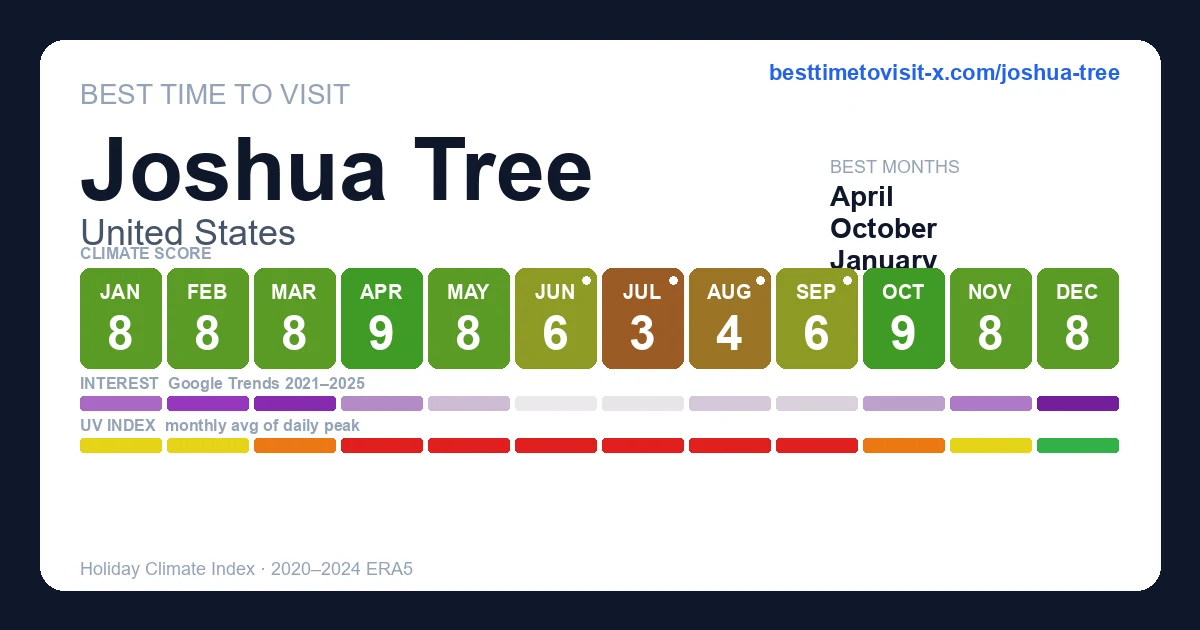
| Jan | 6–15 | 11 | 3 | 26 | 8.7 | 34% | 18 | 210 | 3 | Moderate | 8 |
| Feb | 7–16 | 12 | 2 | 16 | 8.0 | 27% | 19 | 208 | 4 | Busy | 8 |
| Mar | 8–18 | 14 | 4 | 39 | 9.8 | 31% | 20 | 253 | 6 | Peak | 8 |
| Apr | 13–25 | 21 | 1 | 15 | 15.0 | 19% | 19 | 278 | 8 | Moderate | 9 |
| May | 18–29 | 25 | 0 | 2 | — | 15% | 19 | 309 | 9 | Quiet | 8 |
| Jun | 23–34 | 31 | 1 | 4 | 4.0 | 15% | 18 | 309 | 11 | Quiet | 6 |
| Jul | 27–38 | 36 | 1 | 8 | 8.0 | 19% | 18 | 314 | 11 | Quiet | 3 |
| Aug | 25–36 | 35 | 4 | 22 | 5.5 | 24% | 17 | 294 | 10 | Quiet | 4 |
| Sep | 22–33 | 31 | 2 | 14 | 7.0 | 21% | 16 | 261 | 8 | Quiet | 6 |
| Oct | 16–27 | 24 | 1 | 5 | 5.0 | 20% | 16 | 250 | 6 | Quiet | 9 |
| Nov | 10–20 | 15 | 1 | 5 | 5.0 | 22% | 16 | 221 | 4 | Moderate | 8 |
| Dec | 7–16 | 12 | 1 | 16 | 16.0 | 30% | 15 | 198 | 3 | Peak | 8 |
UV Index in Joshua Tree by Month
UV index in Joshua Tree peaks at 11 (very high) in July, dropping to 3 (low) in December. April, May, June, July, August, September reach very high or extreme levels — apply SPF 50+, wear a hat and protective clothing, and limit direct sun between 11:00 and 17:00.
Best months in detail
October
9/1016–27°C (feels 24°C) · 1 rain days (5h) · 250 sun hours · 20% humidity · Quiet crowd · UV 6 (high)
April
9/1013–25°C (feels 21°C) · 1 rain days (15h) · 278 sun hours · 19% humidity · Moderate crowd · UV 8 (very high)
May
8/1018–29°C (feels 25°C) · 0 rain days (2h) · 309 sun hours · 15% humidity · Quiet crowd · UV 9 (very high)
Every month
Show the other 9 months in detail
January
8/106–15°C (feels 11°C) · 3 rain days (26h) · 210 sun hours · 34% humidity · Moderate crowd · UV 3 (moderate)
February
8/107–16°C (feels 12°C) · 2 rain days (16h) · 208 sun hours · 27% humidity · Busy crowd · UV 4 (moderate) · sunniest 1 in 10 days reach 6 (high)
March
8/108–18°C (feels 14°C) · 4 rain days (39h) · 253 sun hours · 31% humidity · Peak crowd · UV 6 (high) · sunniest 1 in 10 days reach 8 (very high)
June
6/1023–34°C (feels 31°C) · 1 rain days (4h) · 309 sun hours · 15% humidity · Quiet crowd · UV 11 (very high) · sunniest 1 in 10 days reach 12 (extreme)
July
3/1027–38°C (feels 36°C) · 1 rain days (8h) · 314 sun hours · 19% humidity · Quiet crowd · UV 11 (very high) · sunniest 1 in 10 days reach 12 (extreme)
August
4/1025–36°C (feels 35°C) · 4 rain days (22h) · 294 sun hours · 24% humidity · Quiet crowd · UV 10 (very high) · sunniest 1 in 10 days reach 11 (extreme)
September
6/1022–33°C (feels 31°C) · 2 rain days (14h) · 261 sun hours · 21% humidity · Quiet crowd · UV 8 (very high)
November
8/1010–20°C (feels 15°C) · 1 rain days (5h) · 221 sun hours · 22% humidity · Moderate crowd · UV 4 (moderate)
December
8/107–16°C (feels 12°C) · 1 rain days (16h) · 198 sun hours · 30% humidity · Peak crowd · UV 3 (low) · sunniest 1 in 10 days reach 3 (moderate)
There is no water inside the park, and no shade to wait in
Joshua Tree looks approachable — it is close to Palm Springs, the roads are good and the walks are short. The catch is that the park's interior has essentially no services. The National Park Service states there is no water or shade inside the park, and the centre of the park has no potable water at all; fill stations exist only at Black Rock and Cottonwood, on the edges.
Temperatures reach 120F, about 49C, and the park warns that hiking in extreme heat risks heat stroke, hyponatremia and death. Its own guidance is not to hike between 10am and 5pm in the hot months — which is most of the daylight.
So the useful question is not whether the weather is bearable, but whether you can carry enough water for the hours you intend to be out in it.
Sources: NPS — Joshua Tree goods and services , NPS — Visiting Joshua Tree in summer
What is the best month to visit Joshua Tree National Park?
March and April, or October and November. Spring adds wildflowers and comfortable rock-scrambling temperatures; autumn gives the same warmth with fewer visitors. Winter days are pleasant but nights drop below freezing, which matters if you are camping.
When not to visit Joshua Tree?
June through September, when temperatures reach around 49C and the National Park Service advises against hiking between 10am and 5pm — which is most of the daylight. With no potable water in the centre of the park and no shade anywhere in it, summer turns a straightforward walk into a genuine risk. July alone averages about 37C.
How many days do I need at Joshua Tree?
One full day covers the main park road, Hidden Valley, Barker Dam, Keys View and Cholla Cactus Garden. A second day is worth it for climbing or scrambling, or to catch both sunrise and the night sky — this is an International Dark Sky Park. Fill your water containers before entering — there is no potable water in the centre of the park and no shade at all.
Which is better, Joshua Tree or Death Valley?
Joshua Tree is smaller, easier to reach from Los Angeles, and better for short walks and rock scrambling. Death Valley is a far more extreme landscape of salt flats and dunes, but demands long drives and is genuinely dangerous in summer. Joshua Tree suits a weekend; Death Valley needs a dedicated trip.
What's the best month to visit Joshua Tree?
March or April for wildflowers and comfortable rock-scrambling temperatures, or October and November for the same warmth with fewer people. July averages about 37C, which rules out midday walking. Winter days are pleasant but nights drop to around 6C and below, which matters if you are camping.
Is Joshua Tree too hot in summer?
Yes for hiking. Temperatures reach 120F, about 49C, and the park warns that hiking in extreme heat risks heat stroke, hyponatremia and death — its own guidance is not to hike between 10am and 5pm. Combined with no water and no shade inside the park, summer turns a short walk into a genuine hazard.
What is the coldest month in Joshua Tree?
December, with lows averaging around 6C and frost common at night — the park sits between roughly 900 m and 1,700 m, so it is high desert rather than low. Winter days are often perfect for walking and climbing. Campers regularly underestimate the overnight drop and arrive with summer sleeping bags.
Should I spend more time in Death Valley or Joshua Tree?
Joshua Tree if you want to be out of the car — it is compact, with short trails and world-class rock scrambling, and is easier to reach from Los Angeles. Death Valley is the more extreme landscape but demands long drives between widely separated sights. For a weekend, Joshua Tree; for a dedicated trip, Death Valley.
How many days in Joshua Tree is enough?
One full day covers the park road, Hidden Valley, Barker Dam, Keys View and the Cholla Cactus Garden. A second day is worth it for climbing or scrambling, or to catch both sunrise and the night sky — this is an International Dark Sky Park, and the stargazing is among the best within reach of a major city.
What not to miss in Joshua Tree National Park?
Hidden Valley for the classic rock-enclosed loop, Barker Dam for the petroglyphs and a chance of water, Keys View at sunset for the panorama over the Coachella Valley and the San Andreas Fault, and the Cholla Cactus Garden in low light. Stay after dark — this is an International Dark Sky Park within reach of Los Angeles.
Is Palm Springs or Joshua Tree better?
They complement rather than compete. Palm Springs is a resort town with hotels, restaurants and mid-century architecture; Joshua Tree is a park with no services inside it — no food, no fuel, no water in the centre. Most visitors stay in Palm Springs or the town of Joshua Tree and drive in, which is the sensible arrangement.
Can I just drive through Joshua Tree National Park?
Yes, and the road between the west and north entrances takes in most of the headline sights, with short walks from car parks. But the park is at its best on foot among the rock formations, and the walks are genuinely short. If you drive through between June and September, treat it as scenic driving only — the park advises against hiking from 10am to 5pm.
Frequently asked questions about visiting Joshua Tree
When is the best time to visit Joshua Tree?
October is the highest-scoring month (9/10 on the Holiday Climate Index). Typical conditions: 16–27°C (1 rainy day). The top three months by score are October, April, May.
What is the worst time to visit Joshua Tree?
July is the lowest-scoring month (3/10, capped by extreme heat). Typical conditions: 27–38°C (1 rainy day).
Is Joshua Tree too hot in summer?
4 months (June, July, August, September) trip the heat deal-breaker in our scoring: apparent temperature crosses the comfort cap, so even with clear skies and low rain the score is held down. Plan around it if heat tolerance is low.
When are crowds lowest in Joshua Tree?
Search-interest seasonality (Google Trends 2021-2025) is lowest in June and peaks in December. Interest tracks both in-trip visitors and lead-time planners, so treat it as a "destination is on people's minds" signal rather than literal arrivals.
Which months in Joshua Tree have good weather but fewer tourists?
April (climate 9/10, crowd index 46) and October (climate 9/10, crowd index 37) — shoulder months with above-average climate and below-median search-interest. Often the best value-for-weather trade.
What is the UV index in Joshua Tree by month?
UV peaks at 11 (very high) in July and is lowest in December at 3 (low). Monthly peak values: Jan 3, Feb 4, Mar 6, Apr 8, May 9, Jun 11, Jul 11, Aug 10, Sep 8, Oct 6, Nov 4, Dec 3. April, May, June, July, August, September reach very high or extreme levels — apply SPF 50+, wear a hat and protective clothing, and limit direct sun between 11:00 and 17:00.
What is the UV index in Joshua Tree in July?
July is the peak UV month in Joshua Tree, with a daily-peak UV index of 11 (very high). At this level, sunburn can occur in under 20 minutes on unprotected fair skin. Apply SPF 50+, wear protective clothing and a hat, and avoid direct midday sun (11:00–17:00).
How high can UV get in Joshua Tree on the sunniest days?
Most days look like the monthly average, but on the sunniest ~1 in 10 days UV climbs higher than the mean suggests. July is the worst case: typical days average UV 11 (very high), but the top 10% of days reach UV 12 (extreme) — and even higher. Months where the sunniest days routinely exceed the typical reading: February, March, June, July, August, December. Plan sun protection for the worst case, not the average.