Best time to visit Lecce
Re-score for me — drag the dial — every chart on the page recolours live for your heat limit 27°C
Default 27 °C is the upper edge of the Holiday Climate Index "ideal comfort" band (Scott, Rutty, Amelung & Tang, 2016). Above this, most warm-tourism travellers report measurable discomfort.
Greyed factors are scored normally — extreme heat overrides them, so a clear sky or low rain can't lift the period.
Greyed factors are scored normally — extreme heat overrides them, so a clear sky or low rain can't lift the period.
Greyed factors are scored normally — extreme heat overrides them, so a clear sky or low rain can't lift the period.
Greyed factors are scored normally — extreme heat overrides them, so a clear sky or low rain can't lift the period.
Greyed factors are scored normally — extreme heat overrides them, so a clear sky or low rain can't lift the period.
Greyed factors are scored normally — extreme heat overrides them, so a clear sky or low rain can't lift the period.
Greyed factors are scored normally — extreme heat overrides them, so a clear sky or low rain can't lift the period.
Greyed factors are scored normally — extreme heat overrides them, so a clear sky or low rain can't lift the period.
Greyed factors are scored normally — extreme heat overrides them, so a clear sky or low rain can't lift the period.
Greyed factors are scored normally — extreme heat overrides them, so a clear sky or low rain can't lift the period.
Greyed factors are scored normally — extreme heat overrides them, so a clear sky or low rain can't lift the period.
Greyed factors are scored normally — extreme heat overrides them, so a clear sky or low rain can't lift the period.
Greyed factors are scored normally — extreme heat overrides them, so a clear sky or low rain can't lift the period.
Greyed factors are scored normally — extreme heat overrides them, so a clear sky or low rain can't lift the period.
Greyed factors are scored normally — extreme heat overrides them, so a clear sky or low rain can't lift the period.
Greyed factors are scored normally — extreme heat overrides them, so a clear sky or low rain can't lift the period.
Greyed factors are scored normally — extreme heat overrides them, so a clear sky or low rain can't lift the period.
Greyed factors are scored normally — extreme heat overrides them, so a clear sky or low rain can't lift the period.
Greyed factors are scored normally — extreme heat overrides them, so a clear sky or low rain can't lift the period.
Greyed factors are scored normally — extreme heat overrides them, so a clear sky or low rain can't lift the period.
How is this scored? HCI / Steadman / CCI gate — full methodology and citations below.
Compare with another destination
Add as many as you like — stacked below the main strips above. Each row is just the recent-window score strip and (for beach destinations) sea-temperature strip.
Tours in Lecce
7 top-rated tours via Viator. Booking links earn this site a commission at no cost to you. Map locations are approximate (centred on Lecce).
- 1
 Cooking Class in an Italian Family Home : Pasta & Wine near Lecce
 - 2
 Boat tour to the caves
 - 3
 3 hours - Boat Tour to the Caves of Santa Maria di Leuca
 - 4
 3-Hour Guided Boat Tour to the Caves in Santa Maria di Leuca
 - 5
 LECCE & GALLIPOLI from Bari or customers accomodation
 - 6
 Private walking tour in Lecce
 - 7
 Sunset on a Sailing Boat in Gallipoli
Last refreshed 2026-06-14.
Similar climatesBari97% · Matera96% · Rome95%
Other destinations with the most-alike year-round climate to Lecce (apparent temperature, rain hours, sunshine — matched within the same trip-profile). The ±N chip compares each match's typical score for the current month against Lecce's. Based on the 2020-2024 climatology, not this year's actual weather.
Month-by-month
| Month | Temp °C | Feels °C | Rain days | Rain h | Rain h/day | Humidity | Wind km/h | Sun h | UV | Interest | Score |
|---|---|---|---|---|---|---|---|---|---|---|---|
| Jan | 7–14 | 11 | 8 | 80 | 10.0 | 67% | 21 | 176 | 1 | Moderate | 7 |
| Feb | 7–15 | 12 | 6 | 66 | 11.0 | 64% | 20 | 187 | 2 | Quiet | 7 |
| Mar | 8–16 | 13 | 9 | 102 | 11.3 | 60% | 20 | 224 | 3 | Quiet | 7 |
| Apr | 10–19 | 17 | 9 | 104 | 11.6 | 56% | 19 | 233 | 5 | Moderate | 8 |
| May | 15–24 | 23 | 8 | 71 | 8.9 | 52% | 19 | 278 | 6 | Quiet | 9 |
| Jun | 20–30 | 30 | 5 | 52 | 10.4 | 47% | 18 | 296 | 8 | Quiet | 8 |
| Jul | 22–33 | 33 | 3 | 19 | 6.3 | 42% | 18 | 321 | 9 | Quiet | 5 |
| Aug | 23–32 | 34 | 5 | 36 | 7.2 | 47% | 18 | 298 | 7 | Peak | 5 |
| Sep | 20–28 | 28 | 8 | 58 | 7.3 | 52% | 18 | 241 | 6 | Busy | 9 |
| Oct | 15–23 | 23 | 8 | 78 | 9.8 | 64% | 17 | 218 | 4 | Moderate | 9 |
| Nov | 12–19 | 18 | 11 | 106 | 9.6 | 69% | 19 | 160 | 2 | Quiet | 7 |
| Dec | 8–15 | 13 | 8 | 88 | 11.0 | 73% | 19 | 159 | 1 | Moderate | 7 |
UV Index in Lecce by Month
UV index in Lecce peaks at 9 (very high) in July, dropping to 1 (low) in January. July reach very high or extreme levels — apply SPF 50+, wear a hat and protective clothing, and limit direct sun between 11:00 and 17:00.
Best months in detail
May
9/1015–24°C (feels 23°C) · 8 rain days (71h) · 278 sun hours · 52% humidity · Quiet crowd · UV 6 (high)
September
9/1020–28°C · 8 rain days (58h) · 241 sun hours · 52% humidity · Busy crowd · UV 6 (moderate) · sunniest 1 in 10 days reach 7 (high)
October
9/1015–23°C · 8 rain days (78h) · 218 sun hours · 64% humidity · Moderate crowd · UV 4 (moderate)
Every month
Show the other 9 months in detail
January
7/107–14°C (feels 11°C) · 8 rain days (80h) · 176 sun hours · 67% humidity · Moderate crowd · UV 1 (low)
February
7/107–15°C (feels 12°C) · 6 rain days (66h) · 187 sun hours · 64% humidity · Quiet crowd · UV 2 (low) · sunniest 1 in 10 days reach 3 (moderate)
March
7/108–16°C (feels 13°C) · 9 rain days (102h) · 224 sun hours · 60% humidity · Quiet crowd · UV 3 (moderate) · sunniest 1 in 10 days reach 5 (moderate)
April
8/1010–19°C (feels 17°C) · 9 rain days (104h) · 233 sun hours · 56% humidity · Moderate crowd · UV 5 (moderate) · sunniest 1 in 10 days reach 7 (high)
June
8/1020–30°C · 5 rain days (52h) · 296 sun hours · 47% humidity · Quiet crowd · UV 8 (high) · sunniest 1 in 10 days reach 9 (very high)
July
5/1022–33°C · 3 rain days (19h) · 321 sun hours · 42% humidity · Quiet crowd · UV 9 (very high)
August
5/1023–32°C (feels 34°C) · 5 rain days (36h) · 298 sun hours · 47% humidity · Peak crowd · UV 7 (high) · sunniest 1 in 10 days reach 9 (very high)
November
7/1012–19°C (feels 18°C) · 11 rain days (106h) · 160 sun hours · 69% humidity · Quiet crowd · UV 2 (low)
December
7/108–15°C (feels 13°C) · 8 rain days (88h) · 159 sun hours · 73% humidity · Moderate crowd · UV 1 (low)
The busiest week of the year commemorates a plague that never arrived
In 1656 an epidemic swept the Kingdom of Naples and spared Lecce. The city credited Sant'Oronzo, deposed Sant'Irene as principal patron after centuries, and set about thanking him properly.
The thanks took the form of a column in the main square, begun in 1666 and finished in 1686 after a pause for lack of money. It was assembled from the fallen drums of one of the two Roman columns that marked the end of the Via Appia at Brindisi — so the statue presiding over Lecce stands on a piece of another city's Roman terminus. The original wooden figure burned in 1737 when a festival rocket set it alight during the August celebrations.
The feast that vow created still runs 23 to 27 August, and it now sits alongside the region's other August fixture: the Notte della Taranta concert at Melpignano, 25 km away, reported at around 160,000 people in 2025.
Sources: Fondazione La Notte della Taranta — official festival site , Diocesi di Lecce — Sant'Irene, compatrona, and the 1656 patron change
When is the Sant'Oronzo festival in Lecce?
23 to 27 August, and the dates have been stable across recent years. The solemn procession with the statues takes place on the evening of the 24th, ending in Piazza Duomo, with the Pontifical mass on the 25th. A street fair runs alongside it through the centre from the 23rd.
What is the Notte della Taranta?
A festival of pizzica, the Salento tarantella tradition, founded in 1998 with around 5,000 attendees. Its closing Concertone at Melpignano, about 25 km from Lecce, has grown enormously — 2025 was reported at roughly 160,000 people. The 2026 edition falls on 22 August, days before Lecce's own feast.
What is Lecce famous for?
Baroque architecture carved from pietra leccese, a soft local limestone that can be cut and turned like wood when freshly quarried and hardens on exposure to air. That workability is why the city's facades carry such dense friezes, rosettes and capitals — the stone permitted detail that harder limestone would not.
What is the best month to visit Lecce?
May, June or late September. All three avoid the August peak, when the Sant'Oronzo feast and the Taranta concert fill the whole province and accommodation tightens for weeks. Spring gives the best light on the Baroque stone, and the Salento coast is swimmable from June.
How many days do you need in Lecce?
Two for the city — the Piazza del Duomo, the basilica of Santa Croce, the Roman amphitheatre under Piazza Sant'Oronzo and the workshops in the old town. A third day for Otranto or Gallipoli on the coast, both under an hour away, or for the smaller Baroque towns of the Salento interior.
Why is the Sant'Oronzo column made of Roman stone?
It was built from the fallen drums of one of the two Roman columns that marked the terminus of the Via Appia at Brindisi. Construction began in 1666 and finished in 1686. The column stands about 29 m with a statue of roughly 4 m on top — a bronze replica replaced the earlier figure in 2024.
Is Lecce worth visiting?
Yes — it has the most concentrated Baroque townscape in southern Italy, and because the stone is soft the carving is exceptional rather than merely abundant. It is also a real university city rather than a museum piece, so it has a working food and bar scene the smaller Salento towns lack.
What is pietra leccese?
A marly calcarenite roughly six million years old, quarried around Lecce and the nearby towns in open pits as deep as 50 metres. Freshly cut it is soft enough to shape by hand or on a lathe; exposure to air hardens it and turns it a honey-amber colour. The whole local Baroque idiom depends on that property.
What is the wettest month in Lecce?
Autumn carries the rain here, with summer effectively dry — the Salento pattern is a rainless July and August and a wet late autumn. That dryness is part of why the August festival season works outdoors, and why the Baroque stone has weathered as well as it has.
Is Lecce good for a day trip?
It deserves an overnight. The city is compact and you could walk the main sights in a day, but the Baroque facades change completely with the light, and the evening passeggiata is when the centre comes alive. Day-trippers from the coast see it at its flattest, in the middle of the afternoon.
Frequently asked questions about visiting Lecce
When is the best time to visit Lecce?
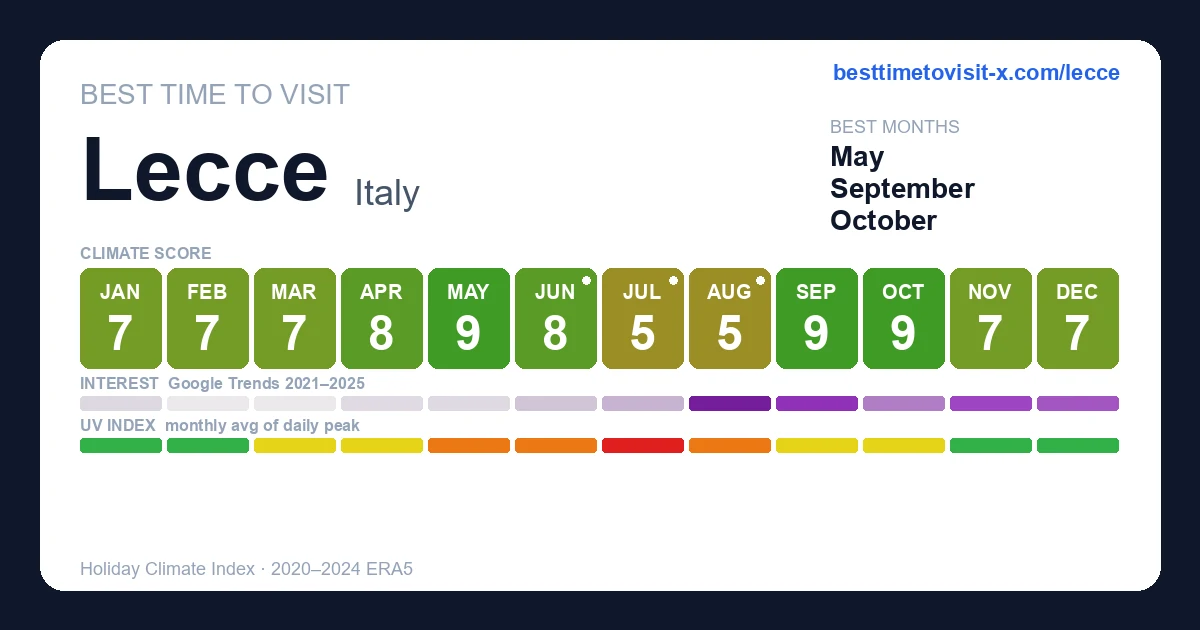
May is the highest-scoring month (9/10 on the Holiday Climate Index). Typical conditions: 15–24°C (8 rainy days). The top three months by score are May, September, October.
What is the worst time to visit Lecce?
August is the lowest-scoring month (5/10, capped by extreme heat). Typical conditions: 23–32°C (5 rainy days).
Is Lecce too hot in summer?
3 months (June, July, August) trip the heat deal-breaker in our scoring: apparent temperature crosses the comfort cap, so even with clear skies and low rain the score is held down. Plan around it if heat tolerance is low.
When are crowds lowest in Lecce?
Search-interest seasonality (Google Trends 2021-2025) is lowest in June and peaks in August. Interest tracks both in-trip visitors and lead-time planners, so treat it as a "destination is on people's minds" signal rather than literal arrivals.
Which months in Lecce have good weather but fewer tourists?
May (climate 9/10, crowd index 31) and October (climate 9/10, crowd index 45) — shoulder months with above-average climate and below-median search-interest. Often the best value-for-weather trade.
What is the UV index in Lecce by month?
UV peaks at 9 (very high) in July and is lowest in January at 1 (low). Monthly peak values: Jan 1, Feb 2, Mar 3, Apr 5, May 6, Jun 8, Jul 9, Aug 7, Sep 6, Oct 4, Nov 2, Dec 1. July reach very high or extreme levels — apply SPF 50+, wear a hat and protective clothing, and limit direct sun between 11:00 and 17:00.
What is the UV index in Lecce in July?
July is the peak UV month in Lecce, with a daily-peak UV index of 9 (very high). At this level, sunburn can occur in under 20 minutes on unprotected fair skin. Apply SPF 50+, wear protective clothing and a hat, and avoid direct midday sun (11:00–17:00).
How high can UV get in Lecce on the sunniest days?
Most days look like the monthly average, but on the sunniest ~1 in 10 days UV climbs higher than the mean suggests. June is the worst case: typical days average UV 8 (high), but the top 10% of days reach UV 9 (very high) — and even higher. Months where the sunniest days routinely exceed the typical reading: February, March, April, June, August, September. Plan sun protection for the worst case, not the average.
Is air quality in Lecce bad for travelers?
PM2.5 (fine-particle pollution) exceeds the WHO sensitive-group guideline (15 µg/m³) in 6 months: January, February, March, August, October, December. The worst month is February with a typical-day mean of 13 µg/m³ (moderate); on the worst 10% of days PM2.5 reaches 23 µg/m³ (unhealthy for sensitive) and higher. People with asthma, heart conditions, or sensitive children may want to avoid these months or limit outdoor activity. Source: CAMS via Open-Meteo.