Best time to visit Kyoto
Re-score for me — drag the dial — every chart on the page recolours live for your heat limit 27°C
Default 27 °C is the upper edge of the Holiday Climate Index "ideal comfort" band (Scott, Rutty, Amelung & Tang, 2016). Above this, most warm-tourism travellers report measurable discomfort.
Greyed factors are scored normally — extreme heat overrides them, so a clear sky or low rain can't lift the period.
Greyed factors are scored normally — extreme heat overrides them, so a clear sky or low rain can't lift the period.
Greyed factors are scored normally — extreme heat overrides them, so a clear sky or low rain can't lift the period.
Greyed factors are scored normally — extreme heat overrides them, so a clear sky or low rain can't lift the period.
Greyed factors are scored normally — extreme heat overrides them, so a clear sky or low rain can't lift the period.
Greyed factors are scored normally — extreme heat overrides them, so a clear sky or low rain can't lift the period.
Greyed factors are scored normally — extreme heat overrides them, so a clear sky or low rain can't lift the period.
Greyed factors are scored normally — extreme heat overrides them, so a clear sky or low rain can't lift the period.
Greyed factors are scored normally — extreme heat overrides them, so a clear sky or low rain can't lift the period.
Greyed factors are scored normally — extreme heat overrides them, so a clear sky or low rain can't lift the period.
Greyed factors are scored normally — extreme heat overrides them, so a clear sky or low rain can't lift the period.
Greyed factors are scored normally — extreme heat overrides them, so a clear sky or low rain can't lift the period.
Greyed factors are scored normally — extreme heat overrides them, so a clear sky or low rain can't lift the period.
Greyed factors are scored normally — extreme heat overrides them, so a clear sky or low rain can't lift the period.
Greyed factors are scored normally — extreme heat overrides them, so a clear sky or low rain can't lift the period.
Greyed factors are scored normally — extreme heat overrides them, so a clear sky or low rain can't lift the period.
Greyed factors are scored normally — extreme heat overrides them, so a clear sky or low rain can't lift the period.
Greyed factors are scored normally — extreme heat overrides them, so a clear sky or low rain can't lift the period.
Greyed factors are scored normally — extreme heat overrides them, so a clear sky or low rain can't lift the period.
Greyed factors are scored normally — extreme heat overrides them, so a clear sky or low rain can't lift the period.
Greyed factors are scored normally — extreme heat overrides them, so a clear sky or low rain can't lift the period.
How is this scored? HCI / Steadman / CCI gate — full methodology and citations below.
Compare with another destination
Add as many as you like — stacked below the main strips above. Each row is just the recent-window score strip and (for beach destinations) sea-temperature strip.
Tours in Kyoto
30 top-rated tours via Viator. Booking links earn this site a commission at no cost to you. Map locations are approximate (centred on Kyoto).
- 1
 Ultimate Kyoto Arashiyama Tour: Bamboo, Monkeys & Hidden Gardens
 - 2
 Nara: Half-Day Private Tour of 4 Must-See Spots & Deer Park
 - 3
 10 Must-see Spots in Kyoto One Day Private Tour
 - 4
 Kyoto 6hr Private Tour with Government-Licensed Guide
 - 5
 Private Kyoto Tour with a Local, Highlights & Hidden Gems, Personalised
 - 6
 Kyoto 4hr Private Tour with Government-Licensed Guide
 - 7
 Arashiyama Bamboo Forest & Hidden Gems Bike Tour (Early Bird)
 - 8
 PERFECT KYOTO 1-Day Bus Tour
 - 9
 Kimono Tea Ceremony Experience at Kyoto Oritzuruya, Nishiki
 - 10
 Private Kyoto Tour by Car with Optional Nara or Osaka Add-Ons
 - 11
 Kyoto : Chopsticks Making Workshop in Gion with Engraving Option
 - 12
 Kyoto Traditional Kintsugi Workshop in Gion Gold Repair Art
 - 13
 Kyoto Kintsugi Making Traditional Workshop
 - 14
 Osaka and Nara Day Tour with Private Transportation
 - 15
 Kyoto Private Customizable Day Trip With English chauffeur
 - 16
 No.1 Ramen Experience in Kyoto – 5.0 rated, 2,100+ reviews
 - 17
 Kyoto Gion Geisha District Walking Tour - The Stories of Geisha
 - 18
 Nara Early Morning Tour (Kyoto or Osaka Departure Available)
 - 19
 1 Hour Geisha Show in Kyoto
 - 20
 Kyoto: Gion Hidden Gems & Geisha Culture Tour
 - 21
 Kyoto Early Morning Tour with English-Speaking Guide
 - 22
 Kyoto: Gion Food Tour 13 Dishes at 4 Eateries
 - 23
 Hidden Kyoto E-Biking tour
 - 24
 Sushi Making in Kyoto! Same-day bookings welcome!
 - 25
 Kyoto Samurai Experience
 - 26
 Kyoto: Arashiyama Bamboo Forest, Monkeys, Matcha & Temple Tour
 - 27
 Kyoto Night Foodie Tour in Gion (9+ dishes + 6 Sake tastings)
 - 28
 World Heritage Kyoto & Nara Uji Authentic Matcha Experience
 - 29
 Kyoto Gion Cultural Walk & Geisha Show with Dining Options
 - 30
 Kimono Tea Ceremony Experience at Kyoto Orizuruya Gion
Last refreshed 2026-05-25.
Similar climatesNara98% · Osaka96% · Kobe96%
Other destinations with the most-alike year-round climate to Kyoto (apparent temperature, rain hours, sunshine — matched within the same trip-profile). The ±N chip compares each match's typical score for the current month against Kyoto's. Based on the 2020-2024 climatology, not this year's actual weather.
Month-by-month
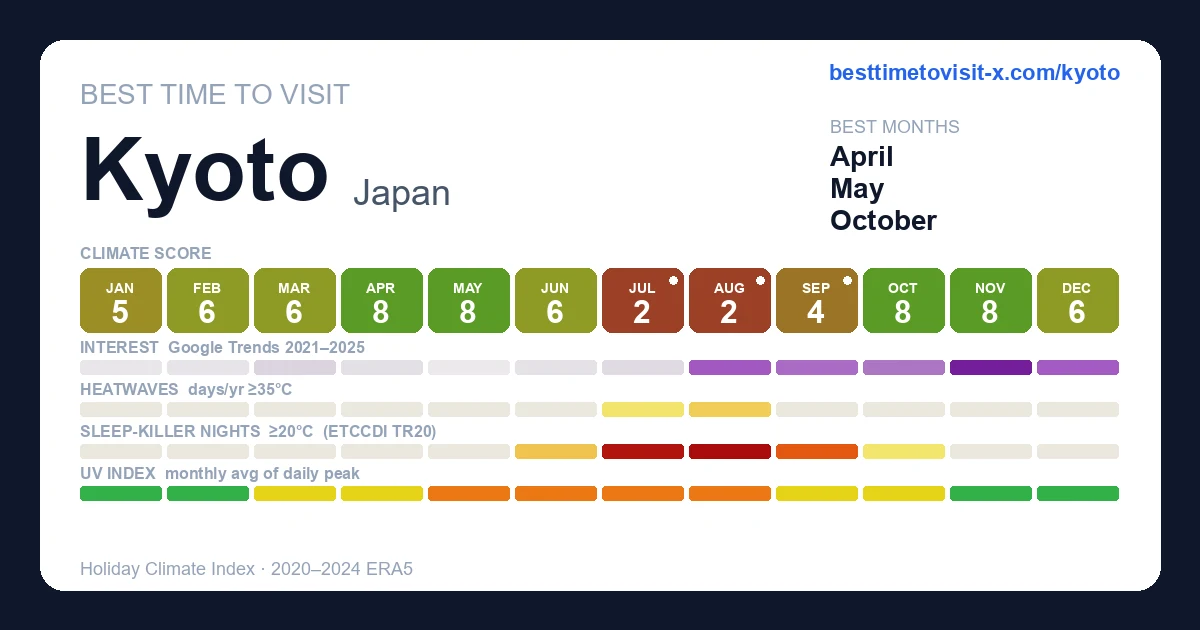
| Month | Temp °C | Feels °C | Rain days | Rain h | Rain h/day | Humidity | Wind km/h | Sun h | UV | Interest | Score |
|---|---|---|---|---|---|---|---|---|---|---|---|
| Jan | -1–9 | 5 | 9 | 106 | 11.8 | 63% | 16 | 164 | 2 | Quiet | 5 |
| Feb | 0–10 | 6 | 8 | 97 | 12.1 | 60% | 17 | 152 | 3 | Quiet | 6 |
| Mar | 4–14 | 11 | 11 | 138 | 12.5 | 58% | 16 | 186 | 4 | Busy | 6 |
| Apr | 8–19 | 17 | 10 | 134 | 13.4 | 56% | 17 | 189 | 5 | Moderate | 8 |
| May | 13–23 | 23 | 13 | 148 | 11.4 | 58% | 15 | 205 | 6 | Quiet | 8 |
| Jun | 18–27 | 28 | 13 | 179 | 13.8 | 63% | 14 | 190 | 6 | Quiet | 6 |
| Jul | 23–30 | 34 | 18 | 245 | 13.6 | 68% | 14 | 207 | 8 | Quiet | 2 |
| Aug | 24–32 | 37 | 14 | 163 | 11.6 | 62% | 14 | 237 | 7 | Busy | 2 |
| Sep | 21–29 | 32 | 15 | 159 | 10.6 | 65% | 13 | 202 | 6 | Busy | 4 |
| Oct | 13–22 | 22 | 9 | 111 | 12.3 | 62% | 13 | 190 | 4 | Busy | 8 |
| Nov | 7–17 | 15 | 7 | 75 | 10.7 | 63% | 13 | 177 | 3 | Peak | 8 |
| Dec | 1–11 | 7 | 6 | 79 | 13.2 | 62% | 15 | 182 | 2 | Moderate | 6 |
UV Index in Kyoto by Month
UV index in Kyoto peaks at 8 (high) in July, dropping to 2 (low) in December. May, June, July, August have high UV — SPF 30+ and sunglasses recommended.
Best months in detail
October
8/1013–22°C · 9 rain days (111h) · 190 sun hours · 62% humidity · Busy crowd · UV 4 (moderate) · sunniest 1 in 10 days reach 6 (moderate)
May
8/1013–23°C · 13 rain days (148h) · 205 sun hours · 58% humidity · Quiet crowd · UV 6 (high) · sunniest 1 in 10 days reach 8 (very high)
November
8/107–17°C (feels 15°C) · 7 rain days (75h) · 177 sun hours · 63% humidity · Peak crowd · UV 3 (low) · sunniest 1 in 10 days reach 4 (moderate)
Every month
Show the other 9 months in detail
January
5/10-1–9°C (feels 5°C) · 9 rain days (106h) · 164 sun hours · 63% humidity · Quiet crowd · UV 2 (low)
February
6/100–10°C (feels 6°C) · 8 rain days (97h) · 152 sun hours · 60% humidity · Quiet crowd · UV 3 (low) · sunniest 1 in 10 days reach 4 (moderate)
March
6/104–14°C (feels 11°C) · 11 rain days (138h) · 186 sun hours · 58% humidity · Busy crowd · UV 4 (moderate) · sunniest 1 in 10 days reach 6 (moderate)
April
8/108–19°C (feels 17°C) · 10 rain days (134h) · 189 sun hours · 56% humidity · Moderate crowd · UV 5 (moderate) · sunniest 1 in 10 days reach 8 (high)
June
6/1018–27°C (feels 28°C) · 13 rain days (179h) · 190 sun hours · 63% humidity · Quiet crowd · UV 6 (high) · sunniest 1 in 10 days reach 9 (very high)
July
2/1023–30°C (feels 34°C) · 18 rain days (245h) · 207 sun hours · 68% humidity · Quiet crowd · UV 8 (high) · sunniest 1 in 10 days reach 10 (very high)
August
2/1024–32°C (feels 37°C) · 14 rain days (163h) · 237 sun hours · 62% humidity · Busy crowd · UV 7 (high) · sunniest 1 in 10 days reach 9 (very high)
September
4/1021–29°C (feels 32°C) · 15 rain days (159h) · 202 sun hours · 65% humidity · Busy crowd · UV 6 (moderate) · sunniest 1 in 10 days reach 8 (high)
December
6/101–11°C (feels 7°C) · 6 rain days (79h) · 182 sun hours · 62% humidity · Moderate crowd · UV 2 (low)
Comparisons people search for
Pairs validated by Google Autocomplete demand — only pairs people actually compare.
Kyoto has 1,200 years of bloom dates — and they have moved
Kyoto keeps what is widely considered the longest continuous record of any natural phenomenon on Earth. The date its cherry trees reached full bloom has been written down since the ninth century, assembled from court diaries and temple chronicles, giving an unbroken series stretching back more than a millennium.
For roughly a thousand years, from about 812 to 1800, the average peak sat stable. Then it began moving earlier, and since 1850 it has advanced by close to two weeks; a 2022 study attributed the shift primarily to human-caused warming, worth around 11 days. The record now holds its earliest entry in twelve centuries — 25 March, in 2023 — against a latest of 4 May, set in 1323.
The practical consequence is that inherited advice is out of date. "Go to Kyoto in April for the blossom" was sound for most of the record's length and is now a gamble: in a warm year the petals are down before April begins.
Sources: Our World in Data — Japan's cherry trees are blossoming earlier , Kyoto City Tourism Association — accommodation tax change, March 2026
What is the best month to go to Kyoto?
Late March to early April for cherry blossom, or November for autumn colour — and our crowd data shows November as the single busiest month of the year here, ahead of the spring peak. For weather without the crush, May and early June are excellent. Avoid August, which averages about 31C with high humidity in a basin that traps heat.
When can I see cherry blossoms in Kyoto?
Typically the last week of March into the first week of April, but the date moves by up to two weeks between years and full bloom lasts only about a week. The Japanese forecasts published from January onward are the practical guide. The historical record ranges from 25 March at the earliest to 4 May at the latest.
Is April too late for cherry blossoms in Kyoto?
Increasingly, yes — mid-April is now often too late. The peak bloom date has advanced by close to two weeks since 1850, and 2023 set the earliest date in the twelve-hundred-year record at 25 March. Early April can still work in a cool year, but planning around mid-April is now a poor bet.
When is the autumn colour in Kyoto?
Mid to late November, and it is the busiest period of the year — our crowd index peaks in November rather than in spring. The maples at Tofuku-ji, Eikan-do and Arashiyama are the draws, and temples run evening illuminations. Book accommodation months ahead; November fills earlier than blossom season.
When should you not visit Kyoto?
July and August. July is the wettest month at around 240 mm, overlapping the rainy season, and August averages about 31C with heavy humidity — Kyoto sits in a basin ringed by hills that trap heat, making it noticeably worse than coastal Japanese cities. Late June through August is uncomfortable for temple-walking.
Does Kyoto charge an accommodation tax?
Yes, and it rose sharply on 1 March 2026 to a five-tier structure charged per person per night: 200 yen under 6,000 yen, 400 yen to 19,999, 1,000 yen to 49,999, 4,000 yen to 99,999, and 10,000 yen at 100,000 yen or above. The top tier is ten times the old maximum, so budget for it on a luxury stay.
Can tourists walk in Gion?
On the main streets yes, but since April 2024 the private alleys of Gion are closed to tourists, with signage in Japanese and English and a fine of 10,000 yen. Hanamikoji Street itself is public and remains open. The restriction followed repeated harassment of geiko and maiko by visitors chasing photographs.
Is 3 days in Kyoto too long?
No — three days is close to the minimum. Kyoto has seventeen UNESCO-listed sites spread across the city, and moving between them eats time. Three days covers eastern Kyoto and Arashiyama at a reasonable pace; four or five lets you add Fushimi Inari at dawn and a day trip without rushing.
Is it better to visit Osaka or Kyoto first?
Most itineraries base in Kyoto and day-trip to Osaka, which is about 15 minutes away by rapid train. Kyoto has the temples and gardens; Osaka has the food and nightlife. If you are arriving at Kansai airport, Osaka is marginally closer, but Kyoto rewards the longer stay and makes the better base.
What is Kyoto best known for?
Being Japan's imperial capital for over a thousand years, and for what survived because of it — some 1,600 Buddhist temples and 400 Shinto shrines, seventeen of them collectively UNESCO-listed. Kinkaku-ji's gold pavilion, the vermilion torii of Fushimi Inari and the Arashiyama bamboo grove are the most recognised.
What should you not miss in Kyoto?
Fushimi Inari at dawn, before the coaches arrive and while the torii tunnels are empty; Kinkaku-ji; the Philosopher's Path in blossom season; and Arashiyama's bamboo grove early. Less obvious but worth it: Tofuku-ji for autumn maples, and Nishiki Market for food. Nara is a 45-minute day trip.
How do you avoid crowds in Kyoto?
Go early — most major sites open around 08:00 or earlier and coach groups arrive mid-morning, so the first two hours are transformative. Avoid November and the blossom week if you can, since those are the two demand peaks. Northern and western Kyoto stay far quieter than the eastern temple corridor at any time of year.
Frequently asked questions about visiting Kyoto
When is the best time to visit Kyoto?
October is the highest-scoring month (8/10 on the Holiday Climate Index). Typical conditions: 13–22°C (9 rainy days). The top three months by score are October, May, November.
What is the worst time to visit Kyoto?
August is the lowest-scoring month (2/10, capped by extreme heat). Typical conditions: 24–32°C (14 rainy days).
Is Kyoto too hot in summer?
3 months (July, August, September) trip the heat deal-breaker in our scoring: apparent temperature crosses the comfort cap, so even with clear skies and low rain the score is held down. Plan around it if heat tolerance is low.
When are crowds lowest in Kyoto?
Search-interest seasonality (Google Trends 2021-2025) is lowest in January and peaks in November. Interest tracks both in-trip visitors and lead-time planners, so treat it as a "destination is on people's minds" signal rather than literal arrivals.
Which months in Kyoto have good weather but fewer tourists?
May (climate 8/10, crowd index 38) and February (climate 6/10, crowd index 18) — shoulder months with above-average climate and below-median search-interest. Often the best value-for-weather trade.
What is the UV index in Kyoto by month?
UV peaks at 8 (high) in July and is lowest in December at 2 (low). Monthly peak values: Jan 2, Feb 3, Mar 4, Apr 5, May 6, Jun 6, Jul 8, Aug 7, Sep 6, Oct 4, Nov 3, Dec 2.
What is the UV index in Kyoto in July?
July is the peak UV month in Kyoto, with a daily-peak UV index of 8 (high). Apply SPF 30+, wear sunglasses, and seek shade during midday hours.
How high can UV get in Kyoto on the sunniest days?
Most days look like the monthly average, but on the sunniest ~1 in 10 days UV climbs higher than the mean suggests. July is the worst case: typical days average UV 8 (high), but the top 10% of days reach UV 10 (very high) — and even higher. Months where the sunniest days routinely exceed the typical reading: February, March, April, May, June, July, August, September, October, November. Plan sun protection for the worst case, not the average.
Is air quality in Kyoto bad for travelers?
PM2.5 (fine-particle pollution) exceeds the WHO sensitive-group guideline (15 µg/m³) in 11 months: January, February, March, April, May, June, July, August, September, November, December. The worst month is June with a typical-day mean of 17 µg/m³ (unhealthy for sensitive); on the worst 10% of days PM2.5 reaches 29 µg/m³ (unhealthy) and higher. People with asthma, heart conditions, or sensitive children may want to avoid these months or limit outdoor activity. Source: CAMS via Open-Meteo.