Best time to visit Galápagos Islands
Re-score for me — drag the dial — every chart on the page recolours live for your heat limit 27°C
Default 27 °C is the upper edge of the Holiday Climate Index "ideal comfort" band (Scott, Rutty, Amelung & Tang, 2016). Above this, most warm-tourism travellers report measurable discomfort.
Greyed factors are scored normally — extreme heat overrides them, so a clear sky or low rain can't lift the period.
Greyed factors are scored normally — extreme heat overrides them, so a clear sky or low rain can't lift the period.
Greyed factors are scored normally — extreme heat overrides them, so a clear sky or low rain can't lift the period.
Greyed factors are scored normally — extreme heat overrides them, so a clear sky or low rain can't lift the period.
Greyed factors are scored normally — extreme heat overrides them, so a clear sky or low rain can't lift the period.
Greyed factors are scored normally — extreme heat overrides them, so a clear sky or low rain can't lift the period.
Greyed factors are scored normally — extreme heat overrides them, so a clear sky or low rain can't lift the period.
Greyed factors are scored normally — extreme heat overrides them, so a clear sky or low rain can't lift the period.
Greyed factors are scored normally — extreme heat overrides them, so a clear sky or low rain can't lift the period.
Greyed factors are scored normally — extreme heat overrides them, so a clear sky or low rain can't lift the period.
Greyed factors are scored normally — extreme heat overrides them, so a clear sky or low rain can't lift the period.
Greyed factors are scored normally — extreme heat overrides them, so a clear sky or low rain can't lift the period.
Greyed factors are scored normally — extreme heat overrides them, so a clear sky or low rain can't lift the period.
Greyed factors are scored normally — extreme heat overrides them, so a clear sky or low rain can't lift the period.
Greyed factors are scored normally — extreme heat overrides them, so a clear sky or low rain can't lift the period.
Greyed factors are scored normally — extreme heat overrides them, so a clear sky or low rain can't lift the period.
Greyed factors are scored normally — extreme heat overrides them, so a clear sky or low rain can't lift the period.
Greyed factors are scored normally — extreme heat overrides them, so a clear sky or low rain can't lift the period.
Greyed factors are scored normally — extreme heat overrides them, so a clear sky or low rain can't lift the period.
Greyed factors are scored normally — extreme heat overrides them, so a clear sky or low rain can't lift the period.
Greyed factors are scored normally — extreme heat overrides them, so a clear sky or low rain can't lift the period.
Greyed factors are scored normally — extreme heat overrides them, so a clear sky or low rain can't lift the period.
Greyed factors are scored normally — extreme heat overrides them, so a clear sky or low rain can't lift the period.
Greyed factors are scored normally — extreme heat overrides them, so a clear sky or low rain can't lift the period.
Greyed factors are scored normally — extreme heat overrides them, so a clear sky or low rain can't lift the period.
Greyed factors are scored normally — extreme heat overrides them, so a clear sky or low rain can't lift the period.
Greyed factors are scored normally — extreme heat overrides them, so a clear sky or low rain can't lift the period.
Greyed factors are scored normally — extreme heat overrides them, so a clear sky or low rain can't lift the period.
Greyed factors are scored normally — extreme heat overrides them, so a clear sky or low rain can't lift the period.
Greyed factors are scored normally — extreme heat overrides them, so a clear sky or low rain can't lift the period.
Greyed factors are scored normally — extreme heat overrides them, so a clear sky or low rain can't lift the period.
Greyed factors are scored normally — extreme heat overrides them, so a clear sky or low rain can't lift the period.
How is this scored? HCI / Steadman / CCI gate — full methodology and citations below.
Compare with another destination
Add as many as you like — stacked below the main strips above. Each row is just the recent-window score strip and (for beach destinations) sea-temperature strip.
Tours in Galápagos Islands
17 top-rated tours via Viator. Booking links earn this site a commission at no cost to you.
- 1
 Transfer Airport-hotel in Galapagos Santa Cruz with visit to Giant Tortoises
 - 2
 Giant Turtle Watching and Lava Tunnels Tour
 - 3
 BiciTour Giant Turtles and Lava Tunnel in Galapagos
 - 4
 Full Day Tour Pinzon Island + La Fe/Las Palmas - Snorkeling & Fishing
 - 5
 Snorkeling in Cabo Rosa Tunnels Isabela Island
 - 6
 Half Day Bay Tour in Santa Cruz Island
 - 7
 Santa Fe Island & Playa Escondida Snorkeling Day Trip
 - 8
 Meet a 150-Year-Old Giant Tortoise in the Galapagos Highlands
 - 9
 Galapagos Intensive 5 days, land base (3Islands) Excludes galapagos flight
 - 10
 Hiking Tour to Sierra Negra Volcano
 - 11
 Day Trip to Bartolome Island from Puerto Ayora
 - 12
 Snorkeling and Fauna Observation at Las Tintoreras Islet
 - 13
 Day Trip to Isabela Island and Tintoreras in Galápagos
 - 14
 7-day Galapagos Island Hopping Adventure Expedition
 - 15
 Visit to the Interior of the Triplets Volcano Crater
 - 16
 Private Shuttler Baltra Airport to Any Hotel in Santa Cruz
 - 17
 Private Gastronomy Walking Tour
Last refreshed 2026-08-01.
Similar climatesMonteverde79% · Singapore75% · Boquete71%
Other destinations with the most-alike year-round climate to Galápagos Islands (apparent temperature, rain hours, sunshine — matched within the same trip-profile). The ±N chip compares each match's typical score for the current month against Galápagos Islands's. Based on the 2020-2024 climatology, not this year's actual weather.
Month-by-month
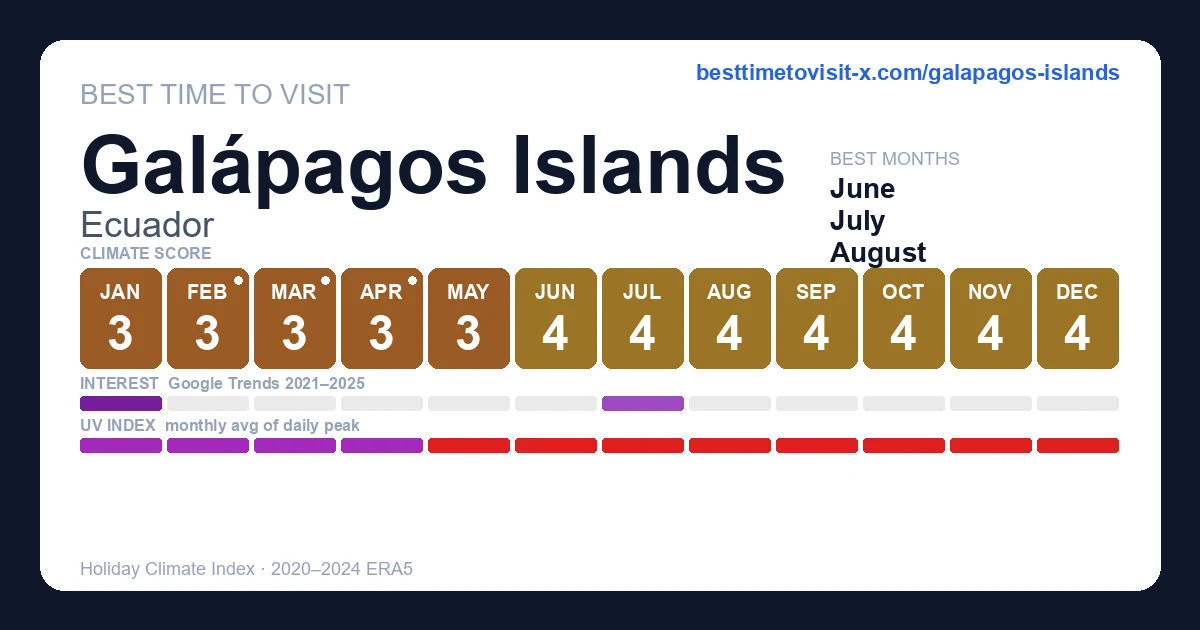
| Month | Temp °C | Feels °C | Rain days | Rain h | Rain h/day | Humidity | Wind km/h | Sun h | UV | Interest | Score |
|---|---|---|---|---|---|---|---|---|---|---|---|
| Jan | 23–26 | 28 | 23 | 381 | 16.6 | 80% | 17 | 264 | 11 | Moderate | 3 |
| Feb | 24–27 | 31 | 21 | 316 | 15.0 | 76% | 16 | 238 | 12 | Moderate | 3 |
| Mar | 24–28 | 32 | 18 | 239 | 13.3 | 74% | 15 | 267 | 12 | Busy | 3 |
| Apr | 24–27 | 31 | 22 | 289 | 13.1 | 78% | 16 | 257 | 12 | Peak | 3 |
| May | 23–26 | 28 | 24 | 363 | 15.1 | 79% | 18 | 263 | 11 | Moderate | 3 |
| Jun | 22–24 | 26 | 24 | 373 | 15.5 | 81% | 20 | 245 | 10 | Quiet | 4 |
| Jul | 21–23 | 25 | 27 | 412 | 15.3 | 83% | 20 | 227 | 9 | Quiet | 4 |
| Aug | 20–23 | 23 | 20 | 323 | 16.1 | 80% | 21 | 229 | 10 | Quiet | 4 |
| Sep | 20–22 | 23 | 22 | 378 | 17.2 | 82% | 20 | 197 | 10 | Quiet | 4 |
| Oct | 20–22 | 24 | 26 | 415 | 16.0 | 83% | 20 | 215 | 10 | Moderate | 4 |
| Nov | 20–23 | 24 | 19 | 301 | 15.8 | 77% | 19 | 236 | 11 | Moderate | 4 |
| Dec | 21–24 | 26 | 24 | 385 | 16.0 | 80% | 18 | 253 | 10 | Quiet | 4 |
UV Index in Galápagos Islands by Month
UV index in Galápagos Islands peaks at 12 (extreme) in March, dropping to 9 (very high) in July. January, February, March, April, May, June, July, August, September, October, November, December reach very high or extreme levels — apply SPF 50+, wear a hat and protective clothing, and limit direct sun between 11:00 and 17:00.
Best months in detail
November
4/1020–23°C · 19 rain days (301h) · 236 sun hours · 77% humidity · Moderate crowd · UV 11 (very high) · sunniest 1 in 10 days reach 12 (extreme)
August
4/1020–23°C · 20 rain days (323h) · 229 sun hours · 80% humidity · Quiet crowd · UV 10 (very high) · sunniest 1 in 10 days reach 12 (extreme)
June
4/1022–24°C (feels 26°C) · 24 rain days (373h) · 245 sun hours · 81% humidity · Quiet crowd · UV 10 (very high)
Every month
Show the other 9 months in detail
January
3/1023–26°C (feels 28°C) · 23 rain days (381h) · 264 sun hours · 80% humidity · Moderate crowd · UV 11 (extreme) · sunniest 1 in 10 days reach 13 (extreme)
February
3/1024–27°C (feels 31°C) · 21 rain days (316h) · 238 sun hours · 76% humidity · Moderate crowd · UV 12 (extreme) · sunniest 1 in 10 days reach 14 (extreme)
March
3/1024–28°C (feels 32°C) · 18 rain days (239h) · 267 sun hours · 74% humidity · Busy crowd · UV 12 (extreme) · sunniest 1 in 10 days reach 14 (extreme)
April
3/1024–27°C (feels 31°C) · 22 rain days (289h) · 257 sun hours · 78% humidity · Peak crowd · UV 12 (extreme) · sunniest 1 in 10 days reach 13 (extreme)
May
3/1023–26°C (feels 28°C) · 24 rain days (363h) · 263 sun hours · 79% humidity · Moderate crowd · UV 11 (very high) · sunniest 1 in 10 days reach 12 (extreme)
July
4/1021–23°C (feels 25°C) · 27 rain days (412h) · 227 sun hours · 83% humidity · Quiet crowd · UV 9 (very high) · sunniest 1 in 10 days reach 11 (very high)
September
4/1020–22°C · 22 rain days (378h) · 197 sun hours · 82% humidity · Quiet crowd · UV 10 (very high) · sunniest 1 in 10 days reach 12 (extreme)
October
4/1020–22°C (feels 24°C) · 26 rain days (415h) · 215 sun hours · 83% humidity · Moderate crowd · UV 10 (very high) · sunniest 1 in 10 days reach 12 (extreme)
December
4/1021–24°C (feels 26°C) · 24 rain days (385h) · 253 sun hours · 80% humidity · Quiet crowd · UV 10 (very high) · sunniest 1 in 10 days reach 12 (extreme)
You do not choose your itinerary — the park assigns it
The Galapagos are not a place you improvise. Ninety-seven per cent of the land area is national park, there are 176 designated visitor sites each with its own carrying capacity, and under the special tourism regulation the national park directorate assigns fixed annual itineraries to every operator. A visitor may not access a site that is not legally authorised to their vessel, and most sites cannot be walked at all without a licensed guide.
So the month you book changes which rotation is legally purchasable, not merely the weather. The hardest example is the waved albatross: virtually the entire world breeding population nests on a single island, Espanola, arriving from March, laying from mid-April to late June and fledging around December. In January and February the colony is empty, and no amount of money buys it.
The park's own arrivals data also inverts the usual advice. The foreign-visitor peak is March and April; the annual trough is September — which still sits inside albatross season and at the height of whale sharks at Darwin.
Sources: Galapagos National Park Directorate — arrival information, entry fees and transit card , Reglamento Especial de Turismo en Areas Naturales Protegidas — fixed itineraries and permit caps
How much does it cost to enter the Galapagos?
Park entry is $200 for a foreign adult and $100 for a foreign child under 12, doubled from the previous rate with effect from 1 August 2024 under a resolution of the Galapagos regional government. It is paid in cash on arrival at Baltra or San Cristobal. A separate $20 transit control card must be bought on the mainland before check-in.
What is the transit control card?
A mandatory $20 card issued by the Galapagos regional government, purchased at Quito or Guayaquil airport before you check in for the flight. The rule that catches people is the allowance: 60 days maximum per year counted cumulatively across all visits, not 60 days per trip. A return ticket is required.
Do you need a guide in the Galapagos?
For most visitor sites, yes — they cannot be entered without a park-licensed naturalist guide, and the park assigns fixed annual itineraries to operators, so a vessel may only visit sites authorised to it. A few sites near the inhabited towns can be walked independently, but the majority of the archipelago cannot.
When is the best time to visit the Galapagos?
September is the strongest single answer: it is the annual low for visitor arrivals, the waved albatross are still on Espanola, and it falls inside the July-to-December whale shark season at Darwin. The trade-off is cooler, rougher water. The foreign-visitor peak is actually March and April, not the northern summer.
When can you see the waved albatross?
Roughly April to December on Espanola, where virtually the entire world breeding population nests — around 9,600 pairs. Birds begin returning in March, eggs are laid from mid-April to late June, and chicks fledge around December. The colony is effectively empty in January and February, so those months rule it out entirely.
What are the Galapagos seasons?
A warm, wetter season running roughly December to May, with water around 25C, warmer air and calmer seas; and a cool, drier garua season for the rest of the year, with water nearer 22C, misty drizzle and rougher crossings. Authoritative sources differ by about a month at the edges, so treat November and December as a shoulder.
When can you see whale sharks in the Galapagos?
July to December at Darwin and Wolf in the far north, with none recorded between January and April. These are advanced dive sites reached by liveaboard rather than day trips, so they require a specific kind of booking — another case where the month determines what is legally and practically purchasable.
Is the Galapagos getting more crowded?
Yes. The islands received 290,404 visitors in 2025, up 4%, and the first half of 2026 was up a further 9%. Notably the doubling of the entry fee in August 2024 did not suppress demand — arrivals grew afterwards. Only about a fifth of visitors are on cruises; most stay on the inhabited islands.
How many days do you need in the Galapagos?
Eight is the common minimum for a cruise itinerary, since the park's fixed rotations are built around week-long cycles and the outer islands need sailing time. Land-based trips can work in five or six days but reach fewer sites. Add two days on the mainland for the flight connections at either end.
Can you visit the Galapagos independently?
Partly. You can fly in, stay on an inhabited island and take day tours, which is how most visitors now travel. What you cannot do is roam — 97% of the land is national park, there are 176 designated visitor sites each with a carrying capacity, and access is through licensed guides and authorised operators.
Frequently asked questions about visiting Galápagos Islands
When is the best time to visit Galápagos Islands?
November is the highest-scoring month (4/10 on the Holiday Climate Index). Typical conditions: 20–23°C (19 rainy days). The top three months by score are November, August, June.
What is the worst time to visit Galápagos Islands?
February is the lowest-scoring month (3/10, capped by extreme heat). Typical conditions: 24–27°C (21 rainy days).
Is Galápagos Islands too hot in summer?
3 months (February, March, April) trip the heat deal-breaker in our scoring: apparent temperature crosses the comfort cap, so even with clear skies and low rain the score is held down. Plan around it if heat tolerance is low.
When are crowds lowest in Galápagos Islands?
Search-interest seasonality (Google Trends 2021-2025) is lowest in July and peaks in April. Interest tracks both in-trip visitors and lead-time planners, so treat it as a "destination is on people's minds" signal rather than literal arrivals.
What is the UV index in Galápagos Islands by month?
UV peaks at 12 (extreme) in March and is lowest in July at 9 (very high). Monthly peak values: Jan 11, Feb 12, Mar 12, Apr 12, May 11, Jun 10, Jul 9, Aug 10, Sep 10, Oct 10, Nov 11, Dec 10. January, February, March, April, May, June, July, August, September, October, November, December reach very high or extreme levels — apply SPF 50+, wear a hat and protective clothing, and limit direct sun between 11:00 and 17:00.
What is the UV index in Galápagos Islands in March?
March is the peak UV month in Galápagos Islands, with a daily-peak UV index of 12 (extreme). At this level, sunburn can occur in under 20 minutes on unprotected fair skin. Apply SPF 50+, wear protective clothing and a hat, and avoid direct midday sun (11:00–17:00).
How high can UV get in Galápagos Islands on the sunniest days?
Most days look like the monthly average, but on the sunniest ~1 in 10 days UV climbs higher than the mean suggests. March is the worst case: typical days average UV 12 (extreme), but the top 10% of days reach UV 14 (extreme) — and even higher. Months where the sunniest days routinely exceed the typical reading: January, February, March, April, May, July, August, September, October, November, December. Plan sun protection for the worst case, not the average.