Best time to visit Fuengirola
Re-score for me — drag the dial — every chart recolours live for your heat & sea limits 27°C · sea 29°C
Default 27 °C is the upper edge of the Holiday Climate Index "ideal comfort" band (Scott, Rutty, Amelung & Tang, 2016). Above this, most warm-tourism travellers report measurable discomfort.
Default 29 °C is the Beach Climate Index "bathtub" line (Morgan et al.) — where the sea stops being refreshing and starts feeling like a warm bath.
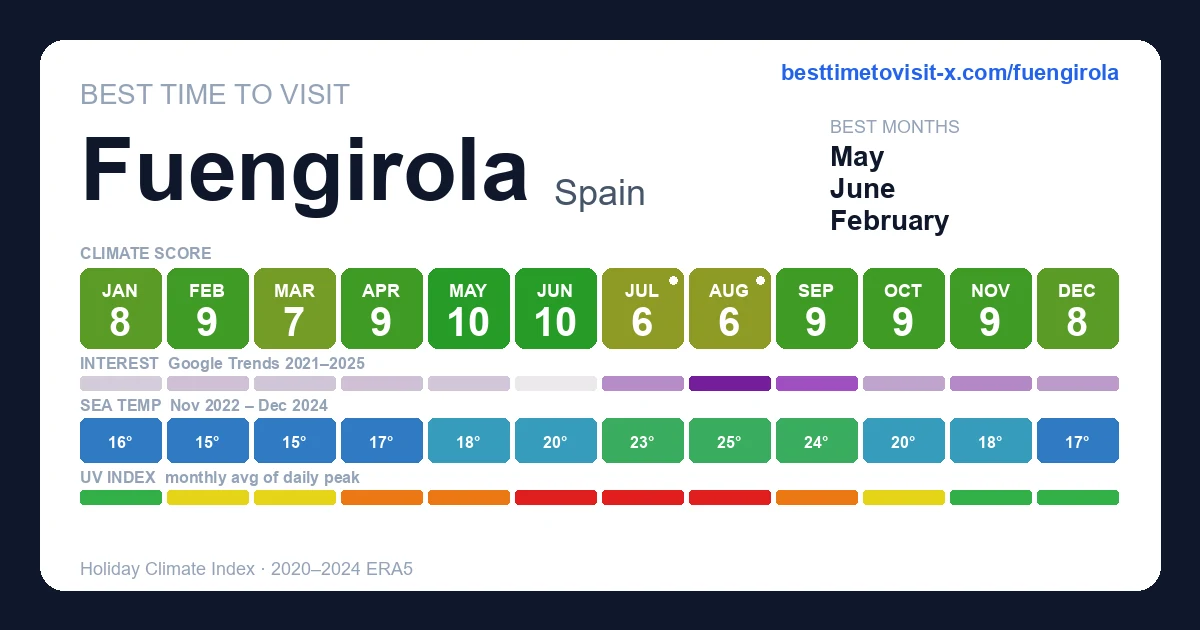
Greyed factors are scored normally — extreme heat overrides them, so a clear sky or low rain can't lift the period.
Greyed factors are scored normally — extreme heat overrides them, so a clear sky or low rain can't lift the period.
Greyed factors are scored normally — extreme heat overrides them, so a clear sky or low rain can't lift the period.
Greyed factors are scored normally — extreme heat overrides them, so a clear sky or low rain can't lift the period.
Greyed factors are scored normally — extreme heat overrides them, so a clear sky or low rain can't lift the period.
Greyed factors are scored normally — extreme heat overrides them, so a clear sky or low rain can't lift the period.
Greyed factors are scored normally — extreme heat overrides them, so a clear sky or low rain can't lift the period.
Greyed factors are scored normally — extreme heat overrides them, so a clear sky or low rain can't lift the period.
Greyed factors are scored normally — extreme heat overrides them, so a clear sky or low rain can't lift the period.
Greyed factors are scored normally — extreme heat overrides them, so a clear sky or low rain can't lift the period.
Greyed factors are scored normally — extreme heat overrides them, so a clear sky or low rain can't lift the period.
Greyed factors are scored normally — extreme heat overrides them, so a clear sky or low rain can't lift the period.
Greyed factors are scored normally — extreme heat overrides them, so a clear sky or low rain can't lift the period.
Greyed factors are scored normally — extreme heat overrides them, so a clear sky or low rain can't lift the period.
Greyed factors are scored normally — extreme heat overrides them, so a clear sky or low rain can't lift the period.
Greyed factors are scored normally — extreme heat overrides them, so a clear sky or low rain can't lift the period.
How is this scored? HCI / Steadman / CCI gate — full methodology and citations below.
Compare with another destination
Add as many as you like — stacked below the main strips above. Each row is just the recent-window score strip and (for beach destinations) sea-temperature strip.
Similar climatesMarbella98% · Malaga97% · Torremolinos97%
Other destinations with the most-alike year-round climate to Fuengirola (apparent temperature, rain hours, sunshine — matched within the same trip-profile). The ±N chip compares each match's typical score for the current month against Fuengirola's. Based on the 2020-2024 climatology, not this year's actual weather.
Month-by-month
| Month | Temp °C | Feels °C | Rain days | Rain h | Rain h/day | Humidity | Wind km/h | Sun h | UV | Interest | Score |
|---|---|---|---|---|---|---|---|---|---|---|---|
| Jan | 9–17 | 15 | 7 | 93 | 13.3 | 68% | 15 | 187 | 2 | Quiet | 8 |
| Feb | 10–18 | 17 | 5 | 55 | 11.0 | 67% | 16 | 199 | 3 | Quiet | 9 |
| Mar | 11–19 | 18 | 11 | 133 | 12.1 | 64% | 17 | 218 | 5 | Quiet | 7 |
| Apr | 13–21 | 20 | 8 | 80 | 10.0 | 62% | 16 | 249 | 7 | Moderate | 9 |
| May | 16–24 | 24 | 4 | 41 | 10.3 | 55% | 14 | 289 | 8 | Quiet | 10 |
| Jun | 19–28 | 28 | 2 | 20 | 10.0 | 50% | 15 | 297 | 9 | Moderate | 10 |
| Jul | 22–31 | 34 | 1 | 8 | 8.0 | 50% | 13 | 305 | 9 | Peak | 6 |
| Aug | 23–32 | 34 | 1 | 15 | 15.0 | 51% | 13 | 293 | 8 | Peak | 6 |
| Sep | 20–28 | 29 | 4 | 49 | 12.3 | 56% | 15 | 252 | 7 | Moderate | 9 |
| Oct | 16–24 | 25 | 6 | 63 | 10.5 | 61% | 14 | 218 | 4 | Quiet | 9 |
| Nov | 12–21 | 20 | 5 | 66 | 13.2 | 64% | 15 | 200 | 3 | Quiet | 9 |
| Dec | 10–18 | 17 | 7 | 78 | 11.1 | 68% | 15 | 188 | 2 | Quiet | 8 |
UV Index in Fuengirola by Month
UV index in Fuengirola peaks at 9 (very high) in July, dropping to 2 (low) in December. June, July, August reach very high or extreme levels — apply SPF 50+, wear a hat and protective clothing, and limit direct sun between 11:00 and 17:00.
Best months in detail
May
10/1016–24°C · 4 rain days (41h) · 289 sun hours · 55% humidity · Quiet crowd · UV 8 (high) · sunniest 1 in 10 days reach 9 (very high)
June
10/1019–28°C · 2 rain days (20h) · 297 sun hours · 50% humidity · Moderate crowd · UV 9 (very high)
October
9/1016–24°C · 6 rain days (63h) · 218 sun hours · 61% humidity · Quiet crowd · UV 4 (moderate) · sunniest 1 in 10 days reach 6 (moderate)
Every month
Show the other 9 months in detail
January
8/109–17°C (feels 15°C) · 7 rain days (93h) · 187 sun hours · 68% humidity · Quiet crowd · UV 2 (low)
February
9/1010–18°C (feels 17°C) · 5 rain days (55h) · 199 sun hours · 67% humidity · Quiet crowd · UV 3 (moderate)
March
7/1011–19°C (feels 18°C) · 11 rain days (133h) · 218 sun hours · 64% humidity · Quiet crowd · UV 5 (moderate) · sunniest 1 in 10 days reach 7 (high)
April
9/1013–21°C · 8 rain days (80h) · 249 sun hours · 62% humidity · Moderate crowd · UV 7 (high) · sunniest 1 in 10 days reach 8 (very high)
July
6/1022–31°C (feels 34°C) · 1 rain days (8h) · 305 sun hours · 50% humidity · Peak crowd · UV 9 (very high)
August
6/1023–32°C (feels 34°C) · 1 rain days (15h) · 293 sun hours · 51% humidity · Peak crowd · UV 8 (very high)
September
9/1020–28°C (feels 29°C) · 4 rain days (49h) · 252 sun hours · 56% humidity · Moderate crowd · UV 7 (high)
November
9/1012–21°C · 5 rain days (66h) · 200 sun hours · 64% humidity · Quiet crowd · UV 3 (low) · sunniest 1 in 10 days reach 4 (moderate)
December
8/1010–18°C (feels 17°C) · 7 rain days (78h) · 188 sun hours · 68% humidity · Quiet crowd · UV 2 (low)
Winter is not the off-season here — it is the Finnish season
Most Spanish coastal resorts empty out after October. Fuengirola does the opposite, and the reason is demographic rather than meteorological.
The town hall describes Fuengirola as home to the principal Finnish community anywhere outside Finland, and the Finnish state funds a full Finnish-curriculum school here, founded in 1991 with around 300 pupils — the first Finnish school abroad to open its own upper-secondary lukio. A foreign country's school calendar, not the beach season, therefore governs when a large slice of the population is present, and the Nordic arrival window runs October to March.
The effect is measurable. Hotel occupancy ran 63.6% from January to March 2026, with Finland among the top source markets. Restaurants and services stay staffed through the months when neighbouring resorts shutter.
Sources: AEMET — Malaga Aeropuerto climate normals , Ayuntamiento de Fuengirola — Q1 2026 tourism figures
Is Fuengirola worth visiting in winter?
Unusually, yes. Unlike most Costa del Sol resorts it keeps a real winter economy, driven by a large resident Nordic population — hotel occupancy ran 63.6% from January to March 2026. Restaurants and services stay open. Expect mild days around the mid-teens rather than beach weather, and short daylight in December.
Which is better, Marbella or Fuengirola?
Marbella is glossier and more expensive, with the Puerto Banus scene and a smarter old town. Fuengirola is cheaper, denser and more everyday, with a long promenade and a genuinely international resident population. Fuengirola suits families and longer winter stays; Marbella suits a shorter, more upmarket trip.
What is the wettest month in Fuengirola?
November, at around 66mm, with July effectively rainless at about 1mm. The pattern is strongly Mediterranean: rain concentrates from November to March and the summer is dry. Even the wet months are mild, with January lows around 9C, which is why the winter season functions at all.
How many sunshine hours does the Costa del Sol get?
Malaga airport records about 2,905 hours a year in the official Spanish meteorological normals. The seasonal spread is wide: December gives around 160 hours, roughly five a day, while July reaches about 347. That December figure is the honest number behind the region's year-round marketing.
Is Fuengirola run down?
It is a dense, working resort town rather than a boutique one, and its 1970s development shows in places. What it also has is a long promenade, a genuinely mixed international population — over 37% of residents are foreign nationals across 140-plus nationalities — and prices well below Marbella. Expectations set by glossier neighbours can mislead.
What day is the big market in Fuengirola?
The main weekly open-air market runs on Tuesday mornings at the Recinto Ferial, and it is one of the largest on the Costa del Sol. There is a smaller Saturday market at the same site. Arrive early — both fill quickly, and parking near the fairground becomes difficult after mid-morning.
Is there a tourist tax in Fuengirola?
No. Andalucia does not levy a regional tourist tax and none is planned, unlike Catalonia or the Balearics. Note that Malaga city approved a moratorium on new tourist-let licences in July 2026, but that applies to the city of Malaga rather than to Fuengirola.
What is the best month to visit Fuengirola?
May, June, September or October for beach weather without August's peak near 29C and the domestic holiday crowd. January to March is the distinctive alternative: mild, quiet by beach standards but fully open, and the months when the Nordic community makes the town function normally.
How many days do you need in Fuengirola?
Three to four as a beach base, or a week if you are using it to reach the wider region. Malaga is about 30 minutes by the Cercanias train, Granada and Seville are day trips by road, and Ronda is a spectacular one. The town itself needs a day.
Is Fuengirola good for families?
Yes — the beach shelves gently, the promenade runs about 8 km and is flat and continuous, and Bioparc Fuengirola sits in the centre of town. The resident international population means schools, clinics and services are geared to long-stay families rather than only to short holidays.
Frequently asked questions about visiting Fuengirola
When is the best time to visit Fuengirola?
May is the highest-scoring month (10/10 on the Holiday Climate Index). Typical conditions: 16–24°C (4 rainy days). The top three months by score are May, June, October.
What is the worst time to visit Fuengirola?
August is the lowest-scoring month (6/10, capped by extreme heat). Typical conditions: 23–32°C (1 rainy day).
Is Fuengirola too hot in summer?
2 months (July, August) trip the heat deal-breaker in our scoring: apparent temperature crosses the comfort cap, so even with clear skies and low rain the score is held down. Plan around it if heat tolerance is low.
When are crowds lowest in Fuengirola?
Search-interest seasonality (Google Trends 2021-2025) is lowest in December and peaks in July. Interest tracks both in-trip visitors and lead-time planners, so treat it as a "destination is on people's minds" signal rather than literal arrivals.
Which months in Fuengirola have good weather but fewer tourists?
May (climate 10/10, crowd index 39) and February (climate 9/10, crowd index 14) — shoulder months with above-average climate and below-median search-interest. Often the best value-for-weather trade.
What is the UV index in Fuengirola by month?
UV peaks at 9 (very high) in July and is lowest in December at 2 (low). Monthly peak values: Jan 2, Feb 3, Mar 5, Apr 7, May 8, Jun 9, Jul 9, Aug 8, Sep 7, Oct 4, Nov 3, Dec 2. June, July, August reach very high or extreme levels — apply SPF 50+, wear a hat and protective clothing, and limit direct sun between 11:00 and 17:00.
What is the UV index in Fuengirola in July?
July is the peak UV month in Fuengirola, with a daily-peak UV index of 9 (very high). At this level, sunburn can occur in under 20 minutes on unprotected fair skin. Apply SPF 50+, wear protective clothing and a hat, and avoid direct midday sun (11:00–17:00).
How high can UV get in Fuengirola on the sunniest days?
Most days look like the monthly average, but on the sunniest ~1 in 10 days UV climbs higher than the mean suggests. May is the worst case: typical days average UV 8 (high), but the top 10% of days reach UV 9 (very high) — and even higher. Months where the sunniest days routinely exceed the typical reading: March, April, May, October, November. Plan sun protection for the worst case, not the average.
Is air quality in Fuengirola bad for travelers?
PM2.5 (fine-particle pollution) exceeds the WHO sensitive-group guideline (15 µg/m³) in 2 months: July, August. The worst month is August with a typical-day mean of 12 µg/m³ (moderate); on the worst 10% of days PM2.5 reaches 17 µg/m³ (unhealthy for sensitive) and higher. People with asthma, heart conditions, or sensitive children may want to avoid these months or limit outdoor activity. Source: CAMS via Open-Meteo.