Best time to visit Seville
Re-score for me — drag the dial — every chart on the page recolours live for your heat limit 27°C
Default 27 °C is the upper edge of the Holiday Climate Index "ideal comfort" band (Scott, Rutty, Amelung & Tang, 2016). Above this, most warm-tourism travellers report measurable discomfort.
Greyed factors are scored normally — extreme heat overrides them, so a clear sky or low rain can't lift the period.
Greyed factors are scored normally — extreme heat overrides them, so a clear sky or low rain can't lift the period.
Greyed factors are scored normally — extreme heat overrides them, so a clear sky or low rain can't lift the period.
Greyed factors are scored normally — extreme heat overrides them, so a clear sky or low rain can't lift the period.
Greyed factors are scored normally — extreme heat overrides them, so a clear sky or low rain can't lift the period.
Greyed factors are scored normally — extreme heat overrides them, so a clear sky or low rain can't lift the period.
Greyed factors are scored normally — extreme heat overrides them, so a clear sky or low rain can't lift the period.
Greyed factors are scored normally — extreme heat overrides them, so a clear sky or low rain can't lift the period.
Greyed factors are scored normally — extreme heat overrides them, so a clear sky or low rain can't lift the period.
Greyed factors are scored normally — extreme heat overrides them, so a clear sky or low rain can't lift the period.
Greyed factors are scored normally — extreme heat overrides them, so a clear sky or low rain can't lift the period.
Greyed factors are scored normally — extreme heat overrides them, so a clear sky or low rain can't lift the period.
Greyed factors are scored normally — extreme heat overrides them, so a clear sky or low rain can't lift the period.
Greyed factors are scored normally — extreme heat overrides them, so a clear sky or low rain can't lift the period.
Greyed factors are scored normally — extreme heat overrides them, so a clear sky or low rain can't lift the period.
Greyed factors are scored normally — extreme heat overrides them, so a clear sky or low rain can't lift the period.
Greyed factors are scored normally — extreme heat overrides them, so a clear sky or low rain can't lift the period.
Greyed factors are scored normally — extreme heat overrides them, so a clear sky or low rain can't lift the period.
Greyed factors are scored normally — extreme heat overrides them, so a clear sky or low rain can't lift the period.
Greyed factors are scored normally — extreme heat overrides them, so a clear sky or low rain can't lift the period.
Greyed factors are scored normally — extreme heat overrides them, so a clear sky or low rain can't lift the period.
Greyed factors are scored normally — extreme heat overrides them, so a clear sky or low rain can't lift the period.
Greyed factors are scored normally — extreme heat overrides them, so a clear sky or low rain can't lift the period.
Greyed factors are scored normally — extreme heat overrides them, so a clear sky or low rain can't lift the period.
Greyed factors are scored normally — extreme heat overrides them, so a clear sky or low rain can't lift the period.
Greyed factors are scored normally — extreme heat overrides them, so a clear sky or low rain can't lift the period.
Greyed factors are scored normally — extreme heat overrides them, so a clear sky or low rain can't lift the period.
Greyed factors are scored normally — extreme heat overrides them, so a clear sky or low rain can't lift the period.
Greyed factors are scored normally — extreme heat overrides them, so a clear sky or low rain can't lift the period.
Greyed factors are scored normally — extreme heat overrides them, so a clear sky or low rain can't lift the period.
Greyed factors are scored normally — extreme heat overrides them, so a clear sky or low rain can't lift the period.
Greyed factors are scored normally — extreme heat overrides them, so a clear sky or low rain can't lift the period.
How is this scored? HCI / Steadman / CCI gate — full methodology and citations below.
Compare with another destination
Add as many as you like — stacked below the main strips above. Each row is just the recent-window score strip and (for beach destinations) sea-temperature strip.
Tours in Seville
30 top-rated tours via Viator. Booking links earn this site a commission at no cost to you.
- 1
 Flamenco Dance Class in Seville with optional Flamenco Costume
 - 2
 Flamenco Show at Casa de la Memoria Admission Ticket
 - 3
 Seville: Small-Group City Highlights Walking Tour
 - 4
 Seville: Small Group Rooftop Paella Class with Sangria Pairing
 - 5
 Seville: Puro Flamenco Show - Museo del Baile Flamenco
 - 6
 Day trip to Zahara, Setenil and Ronda from Seville
 - 7
 Cordoba & Carmona with Mezquita, Synagoge & Patios from Seville
 - 8
 Best of Seville Bike Tour: Top Sights & Hidden Gems
 - 9
 Small-Group Alcazar of Seville Guided Tour with entry ticket
 - 10
 Granada Day Trip: Alhambra & Nazaries Palaces from Seville
 - 11
 Baraka Triana. Flamenco show with drink
 - 12
 Cordoba City Tour with Mosque-Cathedral from Seville
 - 13
 Kayak Tour or Seville Rental
 - 14
 Tour Welcome to Seville in Eco Tuk Tuk Private with Local Guide
 - 15
 Gibraltar Day Trip from Seville + Rock Tour
 - 16
 Authentic Flamenco Show with Tapas & Wine Guided Tour
 - 17
 Private White Villages & Ronda Day Tour from Seville
 - 18
 Alcazar, Cathedral and Giralda Guided Tour with Priority Tickets
 - 19
 Ronda Private Tour from Seville
 - 20
 Ticket for Casa de la Guitarra Flamenco Show
 - 21
 Sevilla Food Tour: Tapas, Wine, History & Traditions
 - 22
 The Seville Tapas Crawl Tour by Food Lover Tour
 - 23
 Alcazar of Seville Tour with Skip the Line Ticket
 - 24
 Ultimate Seville Tapas, Wine & History Small Group Tour
 - 25
 Seville: Paella & Tapas Cooking Class + Triana Market Tour
 - 26
 Seville Ultimate Food Tour
 - 27
 Alcazar of Seville Private Tour
 - 28
 Kayak Rental
 - 29
 Make Seville unforgettable: Private Photoshoot at Plaza de España
 - 30
 Alcazar of Seville: Exclusive Early Access Tour
Last refreshed 2026-08-13.
Similar climatesCórdoba97% · Granada91% · Nicosia91%
Other destinations with the most-alike year-round climate to Seville (apparent temperature, rain hours, sunshine — matched within the same trip-profile). The ±N chip compares each match's typical score for the current month against Seville's. Based on the 2020-2024 climatology, not this year's actual weather.
Month-by-month
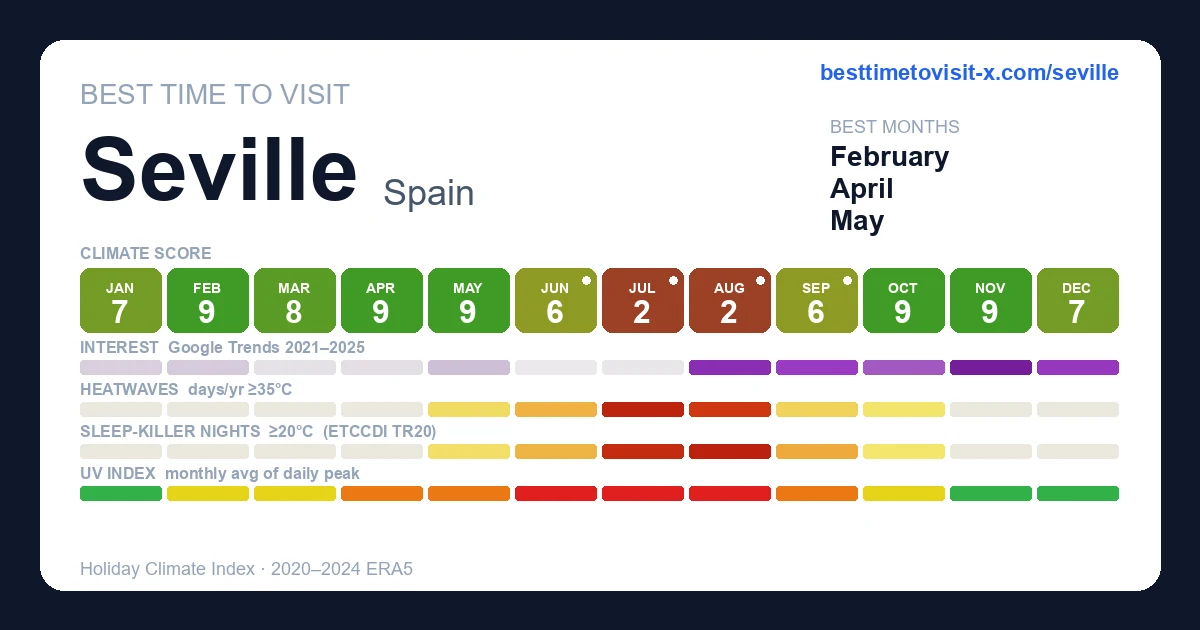
| Month | Temp °C | Feels °C | Rain days | Rain h | Rain h/day | Humidity | Wind km/h | Sun h | UV | Interest | Score |
|---|---|---|---|---|---|---|---|---|---|---|---|
| Jan | 7–16 | 15 | 5 | 70 | 14.0 | 71% | 14 | 175 | 2 | Quiet | 7 |
| Feb | 9–20 | 19 | 4 | 47 | 11.8 | 63% | 15 | 191 | 3 | Moderate | 9 |
| Mar | 10–21 | 20 | 9 | 114 | 12.7 | 58% | 17 | 208 | 5 | Moderate | 8 |
| Apr | 13–24 | 23 | 6 | 81 | 13.5 | 51% | 17 | 247 | 6 | Busy | 9 |
| May | 16–29 | 28 | 4 | 37 | 9.3 | 39% | 18 | 285 | 7 | Peak | 9 |
| Jun | 19–32 | 32 | 2 | 26 | 13.0 | 37% | 19 | 298 | 8 | Quiet | 6 |
| Jul | 22–38 | 39 | 0 | 0 | — | 29% | 18 | 309 | 9 | Quiet | 2 |
| Aug | 22–37 | 38 | 1 | 4 | 4.0 | 34% | 17 | 297 | 9 | Moderate | 2 |
| Sep | 19–31 | 32 | 4 | 48 | 12.0 | 46% | 17 | 247 | 6 | Busy | 6 |
| Oct | 16–27 | 27 | 8 | 89 | 11.1 | 54% | 16 | 206 | 4 | Busy | 9 |
| Nov | 11–21 | 20 | 6 | 69 | 11.5 | 67% | 14 | 184 | 3 | Quiet | 9 |
| Dec | 8–17 | 16 | 7 | 87 | 12.4 | 74% | 14 | 169 | 2 | Quiet | 7 |
UV Index in Seville by Month
UV index in Seville peaks at 9 (very high) in July, dropping to 2 (low) in December. June, July, August reach very high or extreme levels — apply SPF 50+, wear a hat and protective clothing, and limit direct sun between 11:00 and 17:00.
Best months in detail
April
9/1013–24°C (feels 23°C) · 6 rain days (81h) · 247 sun hours · 51% humidity · Busy crowd · UV 6 (high) · sunniest 1 in 10 days reach 8 (very high)
May
9/1016–29°C · 4 rain days (37h) · 285 sun hours · 39% humidity · Peak crowd · UV 7 (high) · sunniest 1 in 10 days reach 9 (very high)
October
9/1016–27°C · 8 rain days (89h) · 206 sun hours · 54% humidity · Busy crowd · UV 4 (moderate) · sunniest 1 in 10 days reach 6 (moderate)
Every month
Show the other 9 months in detail
January
7/107–16°C (feels 15°C) · 5 rain days (70h) · 175 sun hours · 71% humidity · Quiet crowd · UV 2 (low)
February
9/109–20°C (feels 19°C) · 4 rain days (47h) · 191 sun hours · 63% humidity · Moderate crowd · UV 3 (moderate)
March
8/1010–21°C (feels 20°C) · 9 rain days (114h) · 208 sun hours · 58% humidity · Moderate crowd · UV 5 (moderate) · sunniest 1 in 10 days reach 7 (high)
June
6/1019–32°C · 2 rain days (26h) · 298 sun hours · 37% humidity · Quiet crowd · UV 8 (very high)
July
2/1022–38°C · 0 rain days (0h) · 309 sun hours · 29% humidity · Quiet crowd · UV 9 (very high)
August
2/1022–37°C (feels 38°C) · 1 rain days (4h) · 297 sun hours · 34% humidity · Moderate crowd · UV 9 (very high)
September
6/1019–31°C · 4 rain days (48h) · 247 sun hours · 46% humidity · Busy crowd · UV 6 (high)
November
9/1011–21°C · 6 rain days (69h) · 184 sun hours · 67% humidity · Quiet crowd · UV 3 (low) · sunniest 1 in 10 days reach 4 (moderate)
December
7/108–17°C (feels 16°C) · 7 rain days (87h) · 169 sun hours · 74% humidity · Quiet crowd · UV 2 (low)
The first city in the world to name its heatwaves
Seville is the hottest major city in Spain. August averages sit around 35C and regularly exceed 40C, and the city holds an official maximum of 47C. In 2022 it became the first city anywhere to name and categorise heatwaves, starting with Heatwave Zoe — a deliberate move to make an abstract risk concrete enough that people change behaviour.
The city has been adapting to this for centuries and it shows in the fabric: narrow Islamic-era streets that shade themselves, internal courtyards, awnings strung across whole thoroughfares, street sprinklers, and a daily rhythm that empties the streets in the early afternoon and refills them after dark.
It is a place where a monthly average genuinely understates the experience. A 36C mean includes days well past 40, on stone that holds the heat into the night.
Sources: Monocle — how Seville manages its summer heat , Wikipedia — list of extreme temperatures in Spain
Is Seville too hot to visit in summer?
It is genuinely extreme — August averages around 35C with regular days above 40C. It is visitable if you follow the local rhythm: early mornings, a long indoor afternoon, and evenings from about 20:00. If you have any choice, come in spring or autumn instead.
What is the best month to visit Seville?
April, May, October and November. All are warm without being punishing — July averages about 35C and regularly exceeds 40C. April carries both Semana Santa and the Feria de Abril, which are spectacular but fill the city completely, so book accommodation months ahead or choose May instead for the same weather without the premium.
How many days do you need in Seville?
Three. One for the Cathedral and the Alcázar, which deserves a slow visit and an advance ticket; one for Santa Cruz and Triana across the river; one for the Plaza de España, the Metropol Parasol and a flamenco evening. A fourth allows Córdoba, about 45 minutes away by high-speed train and easily done as a day trip.
What is the hottest month in Seville?
July, averaging about 35C and regularly exceeding 40C — Seville is among the hottest cities in Europe. The heat is dry, and the city adapts with awnings over the streets and a late daily rhythm, but midday sightseeing in July and August is genuinely punishing.
When should you avoid Seville?
July and August, when the heat peaks near 35C and many locals leave. It is also worth knowing that Semana Santa and the Feria de Abril, while spectacular, fill the city completely — book far ahead or avoid those weeks if crowds and prices are a concern.
What is the rainiest month in Seville?
December, at around 76 mm, with July effectively dry at about 2 mm. Rain concentrates in the winter half of the year and arrives in short spells. Winter days are mild with January lows around 6C, making it a comfortable and very quiet time to see the Alcázar and cathedral.
What is Seville best known for?
Flamenco, which developed in Andalusia and is performed here nightly, and three UNESCO-listed monuments side by side: the cathedral, the largest Gothic church in the world; the Real Alcázar, a Moorish palace still in royal use; and the General Archive of the Indies. Semana Santa and the Feria de Abril are the two great festivals.
What not to miss in Seville?
The Real Alcázar, which deserves a slow visit and an advance ticket, and climbing the Giralda for the view. Then the Plaza de España, Triana across the river for ceramics and flamenco bars, and the Metropol Parasol walkway at dusk. Book an intimate flamenco tablao rather than a large dinner show.
Is Seville worth visiting?
Yes — it has the strongest concentration of Moorish and Gothic architecture in Spain, plus a genuine flamenco culture rather than a staged one. The single constraint is heat: July averages about 35C and regularly exceeds 40C, so summer visits mean early mornings and late evenings with the afternoon written off.
Is Seville walkable?
Yes — the historic centre is compact and largely pedestrianised, and the main sights sit within twenty minutes of each other on foot. The complication is summer heat, when July averages about 35C: the city is designed around it, with awnings strung over narrow streets and a late daily rhythm, but midday walking is punishing.
Frequently asked questions about visiting Seville
When is the best time to visit Seville?
April is the highest-scoring month (9/10 on the Holiday Climate Index). Typical conditions: 13–24°C (6 rainy days). The top three months by score are April, May, October.
What is the worst time to visit Seville?
July is the lowest-scoring month (2/10, capped by extreme heat). Typical conditions: 22–38°C (0 rainy days).
Is Seville too hot in summer?
4 months (June, July, August, September) trip the heat deal-breaker in our scoring: apparent temperature crosses the comfort cap, so even with clear skies and low rain the score is held down. Plan around it if heat tolerance is low.
When are crowds lowest in Seville?
Search-interest seasonality (Google Trends 2021-2025) is lowest in June and peaks in May. Interest tracks both in-trip visitors and lead-time planners, so treat it as a "destination is on people's minds" signal rather than literal arrivals.
Which months in Seville have good weather but fewer tourists?
November (climate 9/10, crowd index 14) and March (climate 8/10, crowd index 46) — shoulder months with above-average climate and below-median search-interest. Often the best value-for-weather trade.
What is the UV index in Seville by month?
UV peaks at 9 (very high) in July and is lowest in December at 2 (low). Monthly peak values: Jan 2, Feb 3, Mar 5, Apr 6, May 7, Jun 8, Jul 9, Aug 9, Sep 6, Oct 4, Nov 3, Dec 2. June, July, August reach very high or extreme levels — apply SPF 50+, wear a hat and protective clothing, and limit direct sun between 11:00 and 17:00.
What is the UV index in Seville in July?
July is the peak UV month in Seville, with a daily-peak UV index of 9 (very high). At this level, sunburn can occur in under 20 minutes on unprotected fair skin. Apply SPF 50+, wear protective clothing and a hat, and avoid direct midday sun (11:00–17:00).
How high can UV get in Seville on the sunniest days?
Most days look like the monthly average, but on the sunniest ~1 in 10 days UV climbs higher than the mean suggests. May is the worst case: typical days average UV 7 (high), but the top 10% of days reach UV 9 (very high) — and even higher. Months where the sunniest days routinely exceed the typical reading: March, April, May, October, November. Plan sun protection for the worst case, not the average.
Is air quality in Seville bad for travelers?
PM2.5 (fine-particle pollution) exceeds the WHO sensitive-group guideline (15 µg/m³) in 9 months: January, February, March, April, June, August, October, November, December. The worst month is December with a typical-day mean of 13 µg/m³ (moderate); on the worst 10% of days PM2.5 reaches 22 µg/m³ (unhealthy for sensitive) and higher. People with asthma, heart conditions, or sensitive children may want to avoid these months or limit outdoor activity. Source: CAMS via Open-Meteo.