Best time to visit Faro
Re-score for me — drag the dial — every chart recolours live for your heat & sea limits 27°C · sea 29°C
Default 27 °C is the upper edge of the Holiday Climate Index "ideal comfort" band (Scott, Rutty, Amelung & Tang, 2016). Above this, most warm-tourism travellers report measurable discomfort.
Default 29 °C is the Beach Climate Index "bathtub" line (Morgan et al.) — where the sea stops being refreshing and starts feeling like a warm bath.
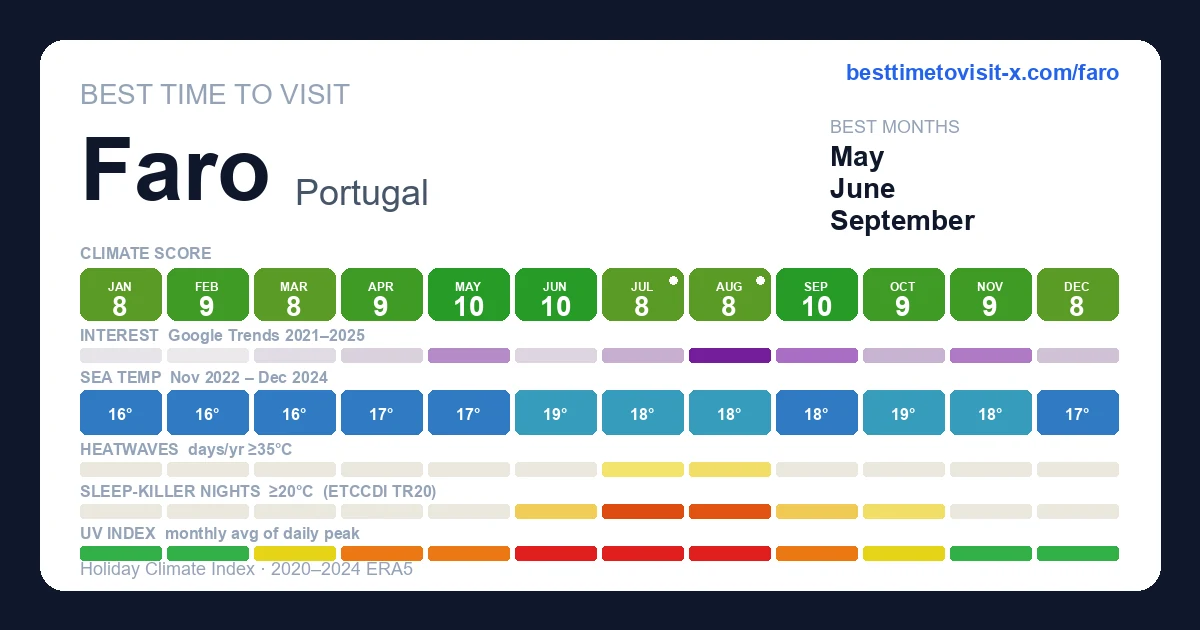
Greyed factors are scored normally — extreme heat overrides them, so a clear sky or low rain can't lift the period.
Greyed factors are scored normally — extreme heat overrides them, so a clear sky or low rain can't lift the period.
Greyed factors are scored normally — extreme heat overrides them, so a clear sky or low rain can't lift the period.
Greyed factors are scored normally — extreme heat overrides them, so a clear sky or low rain can't lift the period.
Greyed factors are scored normally — extreme heat overrides them, so a clear sky or low rain can't lift the period.
Greyed factors are scored normally — extreme heat overrides them, so a clear sky or low rain can't lift the period.
How is this scored? HCI / Steadman / CCI gate — full methodology and citations below.
Compare with another destination
Add as many as you like — stacked below the main strips above. Each row is just the recent-window score strip and (for beach destinations) sea-temperature strip.
Tours in Faro
30 top-rated tours via Viator. Booking links earn this site a commission at no cost to you. Map locations are approximate (centred on Faro).
- 1
 Sunset Tour | Ria Formosa - From Faro
 - 2
 From Faro: Benagil, Marinha Beach, 7 Hanging Valleys, Algar Seco
 - 3
 4-Hour Private Boat Tour in Ria Formosa
 - 4
 3-Hour Boat Tour in Ria Formosa on Olhão Algarve
 - 5
 Private Sightseeing Boat Tour in Ria Formosa at Olhão
 - 6
 Algarve Sunset Experience - Half Day Jeep Safari Trip
 - 7
 From Faro: Benagil Hiking Cliffs and the 4 Treasure Experience
 - 8
 Faro : Magico Tour 6h by Ria Formosa Islands Small Groups
 - 9
 Faro Airport Private Transfer to Albufeira
 - 10
 Faro Airport Private Transfer to Carvoeiro
 - 11
 Ria Formosa Natural Park Birdwatching Segway Tour from Faro
 - 12
 Welcome to Carrapateira Horse Riding Tour
 - 13
 Bordeira Beach - Horse Riding Tour at Sunset
 - 14
 Faro City Tour on Electric Tuk tuks
 - 15
 From Faro: Kayak into Benagil Cave, visit Algar Seco & Carvoeiro
 - 16
 Ria Formosa - Boat trip to the 3 Islands: Armona | Culatra Island | Lighthouse
 - 17
 4 Stops | 3 Islands & Ria Formosa Natural Park - From Faro
 - 18
 2 Stop | 2 Islands & Ria Formosa Natural Park - From Faro
 - 19
 Private Half-Day Boat Tour in Ria Formosa from Faro
 - 20
 Group Surf Lessons
 - 21
 From Faro: Benagil Cave, Marinha & Carvoeiro [Full-Day Tour]
 - 22
 Observing Dolphins in Faro
 - 23
 Small Group Dolphin and Wildlife Watching Tour in Faro
 - 24
 Boat Tour of 2 Ria Formosa Islands: Culatra and Armona
 - 25
 Ria Formosa & Ilhas: Sunset Boat Trip
 - 26
 Faro Airport Transfer Alvor Portimao Praia Rocha Ferragudo +
 - 27
 Tavira: Guided Table Olives Factory Tour & Tasting Experience
 - 28
 Dolphin Watching from Faro
 - 29
 Tour in Paradise: Ria Formosa
 - 30
 Benagil Caves, Carvoeiro and Algar Seco Private Tour From Algarve
Last refreshed 2026-08-13.
Similar climatesAlbufeira98% · Lagos97% · Cádiz96%
Other destinations with the most-alike year-round climate to Faro (apparent temperature, rain hours, sunshine — matched within the same trip-profile). The ±N chip compares each match's typical score for the current month against Faro's. Based on the 2020-2024 climatology, not this year's actual weather.
Month-by-month
| Month | Temp °C | Feels °C | Rain days | Rain h | Rain h/day | Humidity | Wind km/h | Sun h | UV | Interest | Score |
|---|---|---|---|---|---|---|---|---|---|---|---|
| Jan | 10–16 | 14 | 6 | 64 | 10.7 | 68% | 19 | 191 | 2 | Quiet | 8 |
| Feb | 11–18 | 16 | 6 | 75 | 12.5 | 66% | 21 | 194 | 3 | Quiet | 9 |
| Mar | 11–19 | 16 | 9 | 108 | 12.0 | 63% | 22 | 227 | 4 | Quiet | 8 |
| Apr | 13–21 | 19 | 8 | 95 | 11.9 | 61% | 22 | 262 | 6 | Moderate | 9 |
| May | 16–24 | 23 | 4 | 41 | 10.3 | 54% | 22 | 292 | 7 | Moderate | 10 |
| Jun | 18–26 | 25 | 4 | 38 | 9.5 | 54% | 23 | 299 | 8 | Moderate | 10 |
| Jul | 21–30 | 30 | 0 | 1 | — | 47% | 22 | 314 | 9 | Peak | 8 |
| Aug | 21–30 | 30 | 0 | 2 | — | 49% | 21 | 298 | 9 | Peak | 8 |
| Sep | 19–26 | 26 | 4 | 50 | 12.5 | 58% | 20 | 248 | 6 | Moderate | 10 |
| Oct | 17–24 | 24 | 8 | 91 | 11.4 | 63% | 20 | 220 | 4 | Quiet | 9 |
| Nov | 13–20 | 19 | 7 | 86 | 12.3 | 68% | 18 | 192 | 3 | Quiet | 9 |
| Dec | 11–17 | 16 | 7 | 86 | 12.3 | 71% | 20 | 179 | 2 | Quiet | 8 |
UV Index in Faro by Month
UV index in Faro peaks at 9 (very high) in July, dropping to 2 (low) in December. June, July, August reach very high or extreme levels — apply SPF 50+, wear a hat and protective clothing, and limit direct sun between 11:00 and 17:00.
Best months in detail
May
10/1016–24°C (feels 23°C) · 4 rain days (41h) · 292 sun hours · 54% humidity · Moderate crowd · UV 7 (high) · sunniest 1 in 10 days reach 9 (very high)
June
10/1018–26°C · 4 rain days (38h) · 299 sun hours · 54% humidity · Moderate crowd · UV 8 (very high) · sunniest 1 in 10 days reach 10 (very high)
September
10/1019–26°C · 4 rain days (50h) · 248 sun hours · 58% humidity · Moderate crowd · UV 6 (high)
Every month
Show the other 9 months in detail
January
8/1010–16°C (feels 14°C) · 6 rain days (64h) · 191 sun hours · 68% humidity · Quiet crowd · UV 2 (low)
February
9/1011–18°C (feels 16°C) · 6 rain days (75h) · 194 sun hours · 66% humidity · Quiet crowd · UV 3 (low) · sunniest 1 in 10 days reach 4 (moderate)
March
8/1011–19°C (feels 16°C) · 9 rain days (108h) · 227 sun hours · 63% humidity · Quiet crowd · UV 4 (moderate) · sunniest 1 in 10 days reach 7 (high)
April
9/1013–21°C (feels 19°C) · 8 rain days (95h) · 262 sun hours · 61% humidity · Moderate crowd · UV 6 (high) · sunniest 1 in 10 days reach 8 (very high)
July
8/1021–30°C · 0 rain days (1h) · 314 sun hours · 47% humidity · Peak crowd · UV 9 (very high)
August
8/1021–30°C · 0 rain days (2h) · 298 sun hours · 49% humidity · Peak crowd · UV 9 (very high)
October
9/1017–24°C · 8 rain days (91h) · 220 sun hours · 63% humidity · Quiet crowd · UV 4 (moderate) · sunniest 1 in 10 days reach 6 (moderate)
November
9/1013–20°C (feels 19°C) · 7 rain days (86h) · 192 sun hours · 68% humidity · Quiet crowd · UV 3 (low) · sunniest 1 in 10 days reach 3 (moderate)
December
8/1011–17°C (feels 16°C) · 7 rain days (86h) · 179 sun hours · 71% humidity · Quiet crowd · UV 2 (low)
The lagoon changes shape twice a day
Faro sits behind the Ria Formosa, a 60-kilometre lagoon of channels, salt marsh and barrier islands. The tidal range averages around two metres, and more than 5,000 hectares of sandbank and mudflat are exposed and submerged again on that cycle.
This governs how you actually see the place. The barrier islands — Deserta, Culatra, Farol, Armona — are reachable only by ferry, water taxi or charter, and the navigable channels themselves shift with the tide. Operators change route accordingly: at high water a boat may land at one end of Ilha Deserta, at low water the other. At the lowest tides sandbanks emerge that let you walk between places that are separated by open water a few hours later.
None of this appears in a monthly climate table, yet it decides what a given day in Faro contains.
Sources: Algarve Tourist — Ria Formosa boat trips and islands , Praias de Portugal — tides guide
What is the best time to visit Faro?
May, June, September and October — warm and settled without the July-August crowds, and the Ria Formosa lagoon at its best for birdlife. Winter is mild, with January lows around 11C, and very quiet, though island ferries run a reduced timetable. December is the wettest month at about 89 mm, while July is effectively rainless.
How do you get to the Ria Formosa islands?
By boat only — scheduled ferries, water taxis or charters from Faro, Olhão or Tavira. Routes and landing points shift with the tide, because much of the lagoon is shallow and parts dry out entirely at low water, so check the tide table alongside the timetable. Services thin considerably outside summer, which catches out winter visitors expecting a year-round schedule.
Is Faro worth visiting, or just the airport?
Worth visiting in its own right. The walled old town is compact and genuinely attractive, with a bone chapel at the Carmo church, and the Ria Formosa on its doorstep is unlike anything else on the Algarve coast — a protected lagoon and barrier-island system rather than a resort strip. Most package visitors drive straight past it to the western beaches.
What is the coldest month in Faro, Portugal?
January, with lows around 11C — mild by northern European standards, which is why the Algarve draws winter visitors. Daytime temperatures stay comfortable for walking and golf all winter. December is the wettest month at about 89 mm, while July is essentially rainless at around 0 mm.
Is Faro worth seeing, or is it just an airport?
Worth a stay in its own right. The walled Cidade Velha, the bone chapel at Carmo church and the working marina are genuinely worth a day, and Faro is the gateway to the Ria Formosa lagoon and its barrier islands — which most package visitors bypass entirely on their way west to the resorts.
Which is nicer, Faro or Albufeira?
Different trips. Albufeira is the resort centre — big beaches, nightlife and package hotels. Faro is a real Portuguese town with a historic quarter, university and the Ria Formosa on its doorstep, and it is far quieter. Choose Albufeira for a beach holiday, Faro for somewhere that exists outside the season.
What is the best month to visit the Algarve?
May, June, September or October. July and August bring peak Portuguese and international holiday crowds along with the highest prices, while the shoulder months keep warm, dry weather — August peaks near 27C — with far more space on the beaches and better restaurant availability.
Is there a rainy season in Faro?
Yes, though a mild one. Rain concentrates between November and February, peaking near 89 mm in December, and falls in short spells rather than for days. Summer is effectively dry — July averages about 0 mm. Even in winter, the Algarve records more sunshine hours than most of Europe.
What is Faro best known for?
Being the Algarve's gateway — its airport handles most arrivals to the region — and for the Ria Formosa, a protected lagoon of barrier islands, salt pans and channels that runs along the coast. In the town itself, the walled Cidade Velha and the Capela dos Ossos, a chapel lined with monks' bones, are the two sights.
Is Faro a walkable city?
Very. The old town, marina and main shopping streets sit within a compact area you can cross in fifteen minutes, and it is flat. That makes it an easy base compared with the hillier Algarve towns. The Ria Formosa islands are the exception — those need a boat, and services thin considerably outside summer.
What is better, Porto or Faro?
They are barely comparable. Porto is a major historic city with port lodges, architecture and the Douro valley behind it. Faro is a small, flat Algarve town whose appeal is the lagoon and its islands, plus a warm, dry climate that runs later into the year. Porto for city and culture; Faro for sun, beaches and quiet.
Frequently asked questions about visiting Faro
When is the best time to visit Faro?
May is the highest-scoring month (10/10 on the Holiday Climate Index). Typical conditions: 16–24°C (4 rainy days). The top three months by score are May, June, September.
What is the worst time to visit Faro?
March is the lowest-scoring month (8/10). Typical conditions: 11–19°C (9 rainy days).
Is Faro too hot in summer?
2 months (July, August) trip the heat deal-breaker in our scoring: apparent temperature crosses the comfort cap, so even with clear skies and low rain the score is held down. Plan around it if heat tolerance is low.
When are crowds lowest in Faro?
Search-interest seasonality (Google Trends 2021-2025) is lowest in November and peaks in July. Interest tracks both in-trip visitors and lead-time planners, so treat it as a "destination is on people's minds" signal rather than literal arrivals.
Which months in Faro have good weather but fewer tourists?
February (climate 9/10, crowd index 20) and April (climate 9/10, crowd index 44) — shoulder months with above-average climate and below-median search-interest. Often the best value-for-weather trade.
What is the UV index in Faro by month?
UV peaks at 9 (very high) in July and is lowest in December at 2 (low). Monthly peak values: Jan 2, Feb 3, Mar 4, Apr 6, May 7, Jun 8, Jul 9, Aug 9, Sep 6, Oct 4, Nov 3, Dec 2. June, July, August reach very high or extreme levels — apply SPF 50+, wear a hat and protective clothing, and limit direct sun between 11:00 and 17:00.
What is the UV index in Faro in July?
July is the peak UV month in Faro, with a daily-peak UV index of 9 (very high). At this level, sunburn can occur in under 20 minutes on unprotected fair skin. Apply SPF 50+, wear protective clothing and a hat, and avoid direct midday sun (11:00–17:00).
How high can UV get in Faro on the sunniest days?
Most days look like the monthly average, but on the sunniest ~1 in 10 days UV climbs higher than the mean suggests. June is the worst case: typical days average UV 8 (very high), but the top 10% of days reach UV 10 (very high) — and even higher. Months where the sunniest days routinely exceed the typical reading: February, March, April, May, June, October, November. Plan sun protection for the worst case, not the average.