Best time to visit New Orleans
Re-score for me — drag the dial — every chart on the page recolours live for your heat limit 27°C
Default 27 °C is the upper edge of the Holiday Climate Index "ideal comfort" band (Scott, Rutty, Amelung & Tang, 2016). Above this, most warm-tourism travellers report measurable discomfort.
Greyed factors are scored normally — extreme heat overrides them, so a clear sky or low rain can't lift the period.
Greyed factors are scored normally — extreme heat overrides them, so a clear sky or low rain can't lift the period.
Greyed factors are scored normally — extreme heat overrides them, so a clear sky or low rain can't lift the period.
Greyed factors are scored normally — extreme heat overrides them, so a clear sky or low rain can't lift the period.
Greyed factors are scored normally — extreme heat overrides them, so a clear sky or low rain can't lift the period.
Greyed factors are scored normally — extreme heat overrides them, so a clear sky or low rain can't lift the period.
Greyed factors are scored normally — extreme heat overrides them, so a clear sky or low rain can't lift the period.
Greyed factors are scored normally — extreme heat overrides them, so a clear sky or low rain can't lift the period.
Greyed factors are scored normally — extreme heat overrides them, so a clear sky or low rain can't lift the period.
Greyed factors are scored normally — extreme heat overrides them, so a clear sky or low rain can't lift the period.
Greyed factors are scored normally — extreme heat overrides them, so a clear sky or low rain can't lift the period.
Greyed factors are scored normally — extreme heat overrides them, so a clear sky or low rain can't lift the period.
Greyed factors are scored normally — extreme heat overrides them, so a clear sky or low rain can't lift the period.
Greyed factors are scored normally — extreme heat overrides them, so a clear sky or low rain can't lift the period.
Greyed factors are scored normally — extreme heat overrides them, so a clear sky or low rain can't lift the period.
Greyed factors are scored normally — extreme heat overrides them, so a clear sky or low rain can't lift the period.
Greyed factors are scored normally — extreme heat overrides them, so a clear sky or low rain can't lift the period.
Greyed factors are scored normally — extreme heat overrides them, so a clear sky or low rain can't lift the period.
Greyed factors are scored normally — extreme heat overrides them, so a clear sky or low rain can't lift the period.
Greyed factors are scored normally — extreme heat overrides them, so a clear sky or low rain can't lift the period.
Greyed factors are scored normally — extreme heat overrides them, so a clear sky or low rain can't lift the period.
Greyed factors are scored normally — extreme heat overrides them, so a clear sky or low rain can't lift the period.
Greyed factors are scored normally — extreme heat overrides them, so a clear sky or low rain can't lift the period.
Greyed factors are scored normally — extreme heat overrides them, so a clear sky or low rain can't lift the period.
Greyed factors are scored normally — extreme heat overrides them, so a clear sky or low rain can't lift the period.
Greyed factors are scored normally — extreme heat overrides them, so a clear sky or low rain can't lift the period.
Greyed factors are scored normally — extreme heat overrides them, so a clear sky or low rain can't lift the period.
Greyed factors are scored normally — extreme heat overrides them, so a clear sky or low rain can't lift the period.
Greyed factors are scored normally — extreme heat overrides them, so a clear sky or low rain can't lift the period.
Greyed factors are scored normally — extreme heat overrides them, so a clear sky or low rain can't lift the period.
Greyed factors are scored normally — extreme heat overrides them, so a clear sky or low rain can't lift the period.
Greyed factors are scored normally — extreme heat overrides them, so a clear sky or low rain can't lift the period.
Greyed factors are scored normally — extreme heat overrides them, so a clear sky or low rain can't lift the period.
Greyed factors are scored normally — extreme heat overrides them, so a clear sky or low rain can't lift the period.
Greyed factors are scored normally — extreme heat overrides them, so a clear sky or low rain can't lift the period.
Greyed factors are scored normally — extreme heat overrides them, so a clear sky or low rain can't lift the period.
How is this scored? HCI / Steadman / CCI gate — full methodology and citations below.
Compare with another destination
Add as many as you like — stacked below the main strips above. Each row is just the recent-window score strip and (for beach destinations) sea-temperature strip.
Tours in New Orleans
30 top-rated tours via Viator. Booking links earn this site a commission at no cost to you.
- 1
 The Bad Broads Tour of New Orleans - Rebels, Scandals & Secrets
 - 2
 New Orleans Garden District Food and History Tour
 - 3
 New Orleans Small-Group Garden District Walking Tour
 - 4
 French Quarter Historical Sights and Stories Walking Tour
 - 5
 Paddlewheeler Creole Queen Historic Mississippi River Cruise
 - 6
 New Orleans Steamboat Natchez Jazz Cruise
 - 7
 Paddlewheeler Creole Queen Jazz Dinner Cruise in New Orleans
 - 8
 Witches Coven Walking Tour in New Orleans
 - 9
 Court of Two Sisters Live Jazz Brunch Buffet with Mimosa
 - 10
 Private Transfer to/from Louis Armstrong Intl Airport and NOLA
 - 11
 The National WWII Museum Campus Pass plus 4-D Film
 - 12
 New Orleans Cemetery and Paranormal Investigation Bus Tour
 - 13
 New Orleans Swamp and Bayou Boat Tour with Transportation
 - 14
 New Orleans Zipline Swamp Tour
 - 15
 Large Airboat Swamp Tour with Transportation from New Orleans
 - 16
 New Orleans Hands-On Cooking Class with Meal
 - 17
 New Orleans Adults-Only True Crime and Ghost Walking Tour
 - 18
 New Orleans Self-Transport Swamp and Bayou Boat Tour
 - 19
 Ghost Hunt Inside Haunted Locations with New Orleans Paranormal
 - 20
 New Orleans Swamp Tour Boat Adventure
 - 21
 New Orleans Food Walking Tour of the French Quarter with Small-Group Option
 - 22
 Small-Group Airboat Swamp Tour with Downtown New Orleans Pickup
 - 23
 New Orleans Food and History Walking Tour
 - 24
 New Orleans Demonstration Cooking Class with Meal
 - 25
 The National WWII Museum Admission Ticket New Orleans
 - 26
 New Orleans Cocktail and Food History Tour
 - 27
 French Quarter Food Tour: 5 Classic Bites and NOLA Stories
 - 28
 French Quarter Walking Food Tour: Famous Flavors of New Orleans
 - 29
 New Orleans Cemetery Walking Tour
 - 30
 Private Transfer in a Luxury Vehicle to and or from MSY Airport
Last refreshed 2026-08-13.
Similar climatesSavannah91% · Atlanta88% · Hsinchu88%
Other destinations with the most-alike year-round climate to New Orleans (apparent temperature, rain hours, sunshine — matched within the same trip-profile). The ±N chip compares each match's typical score for the current month against New Orleans's. Based on the 2020-2024 climatology, not this year's actual weather.
Month-by-month
| Month | Temp °C | Feels °C | Rain days | Rain h | Rain h/day | Humidity | Wind km/h | Sun h | UV | Interest | Score |
|---|---|---|---|---|---|---|---|---|---|---|---|
| Jan | 9–17 | 15 | 13 | 116 | 8.9 | 70% | 23 | 174 | 3 | Moderate | 7 |
| Feb | 11–19 | 17 | 11 | 116 | 10.5 | 70% | 24 | 167 | 5 | Moderate | 7 |
| Mar | 15–23 | 22 | 13 | 139 | 10.7 | 65% | 23 | 216 | 6 | Quiet | 8 |
| Apr | 17–25 | 24 | 12 | 121 | 10.1 | 60% | 23 | 222 | 7 | Quiet | 8 |
| May | 21–29 | 30 | 15 | 146 | 9.7 | 62% | 20 | 256 | 8 | Quiet | 5 |
| Jun | 24–31 | 35 | 18 | 190 | 10.6 | 67% | 19 | 255 | 9 | Quiet | 2 |
| Jul | 25–31 | 36 | 24 | 242 | 10.1 | 74% | 15 | 238 | 9 | Quiet | 1 |
| Aug | 26–32 | 36 | 17 | 187 | 11.0 | 67% | 17 | 237 | 9 | Moderate | 2 |
| Sep | 24–29 | 32 | 16 | 179 | 11.2 | 68% | 18 | 221 | 7 | Quiet | 4 |
| Oct | 19–26 | 27 | 7 | 82 | 11.7 | 62% | 19 | 229 | 6 | Quiet | 9 |
| Nov | 15–21 | 21 | 10 | 105 | 10.5 | 68% | 20 | 180 | 4 | Quiet | 8 |
| Dec | 12–18 | 17 | 9 | 88 | 9.8 | 72% | 20 | 183 | 3 | Peak | 8 |
UV Index in New Orleans by Month
UV index in New Orleans peaks at 9 (very high) in June, dropping to 3 (low) in December. June, July, August reach very high or extreme levels — apply SPF 50+, wear a hat and protective clothing, and limit direct sun between 11:00 and 17:00.
Best months in detail
October
9/1019–26°C · 7 rain days (82h) · 229 sun hours · 62% humidity · Quiet crowd · UV 6 (high)
April
8/1017–25°C · 12 rain days (121h) · 222 sun hours · 60% humidity · Quiet crowd · UV 7 (high) · sunniest 1 in 10 days reach 9 (very high)
November
8/1015–21°C · 10 rain days (105h) · 180 sun hours · 68% humidity · Quiet crowd · UV 4 (moderate)
Every month
Show the other 9 months in detail
January
7/109–17°C (feels 15°C) · 13 rain days (116h) · 174 sun hours · 70% humidity · Moderate crowd · UV 3 (moderate)
February
7/1011–19°C (feels 17°C) · 11 rain days (116h) · 167 sun hours · 70% humidity · Moderate crowd · UV 5 (moderate) · sunniest 1 in 10 days reach 7 (high)
March
8/1015–23°C · 13 rain days (139h) · 216 sun hours · 65% humidity · Quiet crowd · UV 6 (high) · sunniest 1 in 10 days reach 8 (very high)
May
5/1021–29°C (feels 30°C) · 15 rain days (146h) · 256 sun hours · 62% humidity · Quiet crowd · UV 8 (high) · sunniest 1 in 10 days reach 10 (very high)
June
2/1024–31°C (feels 35°C) · 18 rain days (190h) · 255 sun hours · 67% humidity · Quiet crowd · UV 9 (very high) · sunniest 1 in 10 days reach 10 (very high)
July
1/1025–31°C (feels 36°C) · 24 rain days (242h) · 238 sun hours · 74% humidity · Quiet crowd · UV 9 (very high) · sunniest 1 in 10 days reach 10 (very high)
August
2/1026–32°C (feels 36°C) · 17 rain days (187h) · 237 sun hours · 67% humidity · Moderate crowd · UV 9 (very high) · sunniest 1 in 10 days reach 10 (very high)
September
4/1024–29°C (feels 32°C) · 16 rain days (179h) · 221 sun hours · 68% humidity · Quiet crowd · UV 7 (high) · sunniest 1 in 10 days reach 9 (very high)
December
8/1012–18°C (feels 17°C) · 9 rain days (88h) · 183 sun hours · 72% humidity · Peak crowd · UV 3 (low) · sunniest 1 in 10 days reach 4 (moderate)
Comparisons people search for
Pairs validated by Google Autocomplete demand — only pairs people actually compare.
The cheap months are cheap for a reason
New Orleans has one of the sharpest price-to-comfort inversions of any American city. From June through September, highs sit in the 90s Fahrenheit with humidity that can push the heat index past 110. The Atlantic hurricane season officially runs 1 June to 30 November, and its peak for the Louisiana coast falls in August and September.
Those are, unsurprisingly, the emptiest and cheapest months. Hotels, restaurants and tours are all available, and the city is far less crowded than during Mardi Gras or Jazz Fest. The trade is real heat and genuine, if usually manageable, storm risk.
Mardi Gras itself moves — it is tied to Easter, so it can fall anywhere from early February to early March. A date that is quiet one year can be the busiest week of the next.
Sources: NewOrleans.com — hurricane season and preparedness , Lonely Planet — when to visit New Orleans
What is the cheapest month to go to New Orleans?
June through August. Demand collapses because of the heat and humidity — July highs near 31C with heavy humidity — so rates fall sharply. The city is fully open and much less crowded, and the museums and restaurants are all running. You are trading comfort and some hurricane risk for the saving, since the season peaks August to October.
Is hurricane season a real risk for visitors?
The season runs June to November with the Louisiana peak in August and September. Direct hits in any given week are unlikely, but disruption is possible — travel insurance covering named storms and a flexible itinerary are sensible for a late-summer trip.
What is the rainiest month in New Orleans?
August, at around 157 mm, with November driest at about 84 mm. Summer rain arrives as intense, short afternoon thunderstorms that clear quickly rather than as all-day cloud. The season also overlaps the Atlantic hurricane period, which runs from June to November.
When is the worst time to visit New Orleans?
July and August — highs near 31C with heavy humidity make walking the Quarter draining, and it is peak hurricane season. It is also the cheapest time, so the trade-off is real if budget dominates. Most visitors do far better in spring or late autumn.
What is the best month to visit New Orleans?
February through May, and October to early December. Spring brings comfortable temperatures and the major festival calendar including Mardi Gras and Jazz Fest, though prices rise accordingly. Late autumn is quieter and cheaper with similarly pleasant weather.
How many days do you need in New Orleans?
Three. One for the French Quarter and the riverfront, one for the Garden District, streetcars and a cemetery tour, and one for music, food and either a swamp tour or the WWII museum, which is among the best in the country and takes most of a day on its own.
Is hurricane season a real concern for visitors?
Worth planning around rather than fearing. The season runs June to November, peaking August to October, and direct hits on any given week are unlikely — but travel insurance and flexible bookings are sensible in that window. The city monitors and communicates threats well in advance.
What should I not miss in New Orleans?
The French Quarter early in the morning before the crowds, a streetcar down St Charles through the Garden District, live music on Frenchmen Street rather than Bourbon Street, and the National WWII Museum, which is among the best in the country and takes most of a day. Eat beignets at Café du Monde at an odd hour to skip the queue.
Is it better to stay in the French Quarter or elsewhere?
The French Quarter puts you in the middle of everything and is walkable, but the blocks near Bourbon Street are loud until dawn — pick a quieter street lower down. The Garden District and Marigny are calmer, cheaper and a short streetcar ride away, and Marigny is closer to the Frenchmen Street music scene.
What is New Orleans famous for?
Mardi Gras, jazz — it is where the form emerged — and Creole and Cajun food. Architecturally it is known for the French Quarter's ironwork balconies and the above-ground cemeteries, built that way because of the high water table. The city's cultural mix is Caribbean and French as much as American, which is why it feels distinct.
Frequently asked questions about visiting New Orleans
When is the best time to visit New Orleans?
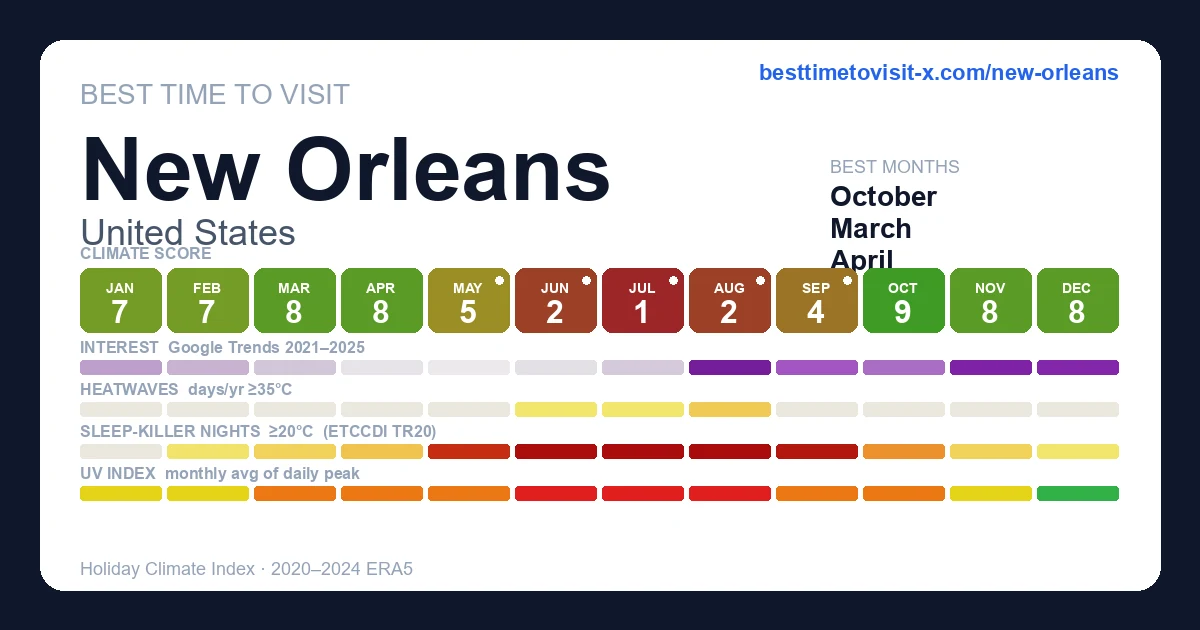
October is the highest-scoring month (9/10 on the Holiday Climate Index). Typical conditions: 19–26°C (7 rainy days). The top three months by score are October, April, November.
What is the worst time to visit New Orleans?
July is the lowest-scoring month (1/10, capped by extreme heat). Typical conditions: 25–31°C (24 rainy days).
Is New Orleans too hot in summer?
5 months (May, June, July, August, September) trip the heat deal-breaker in our scoring: apparent temperature crosses the comfort cap, so even with clear skies and low rain the score is held down. Plan around it if heat tolerance is low.
When are crowds lowest in New Orleans?
Search-interest seasonality (Google Trends 2021-2025) is lowest in June and peaks in December. Interest tracks both in-trip visitors and lead-time planners, so treat it as a "destination is on people's minds" signal rather than literal arrivals.
Which months in New Orleans have good weather but fewer tourists?
October (climate 9/10, crowd index 38) and March (climate 8/10, crowd index 37) — shoulder months with above-average climate and below-median search-interest. Often the best value-for-weather trade.
What is the UV index in New Orleans by month?
UV peaks at 9 (very high) in June and is lowest in December at 3 (low). Monthly peak values: Jan 3, Feb 5, Mar 6, Apr 7, May 8, Jun 9, Jul 9, Aug 9, Sep 7, Oct 6, Nov 4, Dec 3. June, July, August reach very high or extreme levels — apply SPF 50+, wear a hat and protective clothing, and limit direct sun between 11:00 and 17:00.
What is the UV index in New Orleans in June?
June is the peak UV month in New Orleans, with a daily-peak UV index of 9 (very high). At this level, sunburn can occur in under 20 minutes on unprotected fair skin. Apply SPF 50+, wear protective clothing and a hat, and avoid direct midday sun (11:00–17:00).
How high can UV get in New Orleans on the sunniest days?
Most days look like the monthly average, but on the sunniest ~1 in 10 days UV climbs higher than the mean suggests. June is the worst case: typical days average UV 9 (very high), but the top 10% of days reach UV 10 (very high) — and even higher. Months where the sunniest days routinely exceed the typical reading: February, March, April, May, June, July, August, September, December. Plan sun protection for the worst case, not the average.
Is air quality in New Orleans bad for travelers?
PM2.5 (fine-particle pollution) exceeds the WHO sensitive-group guideline (15 µg/m³) in 4 months: May, June, July, August. The worst month is July with a typical-day mean of 16 µg/m³ (unhealthy for sensitive); on the worst 10% of days PM2.5 reaches 24 µg/m³ (unhealthy for sensitive) and higher. People with asthma, heart conditions, or sensitive children may want to avoid these months or limit outdoor activity. Source: CAMS via Open-Meteo.