Best time to visit La Gomera
Re-score for me — drag the dial — every chart recolours live for your heat & sea limits 27°C · sea 29°C
Default 27 °C is the upper edge of the Holiday Climate Index "ideal comfort" band (Scott, Rutty, Amelung & Tang, 2016). Above this, most warm-tourism travellers report measurable discomfort.
Default 29 °C is the Beach Climate Index "bathtub" line (Morgan et al.) — where the sea stops being refreshing and starts feeling like a warm bath.
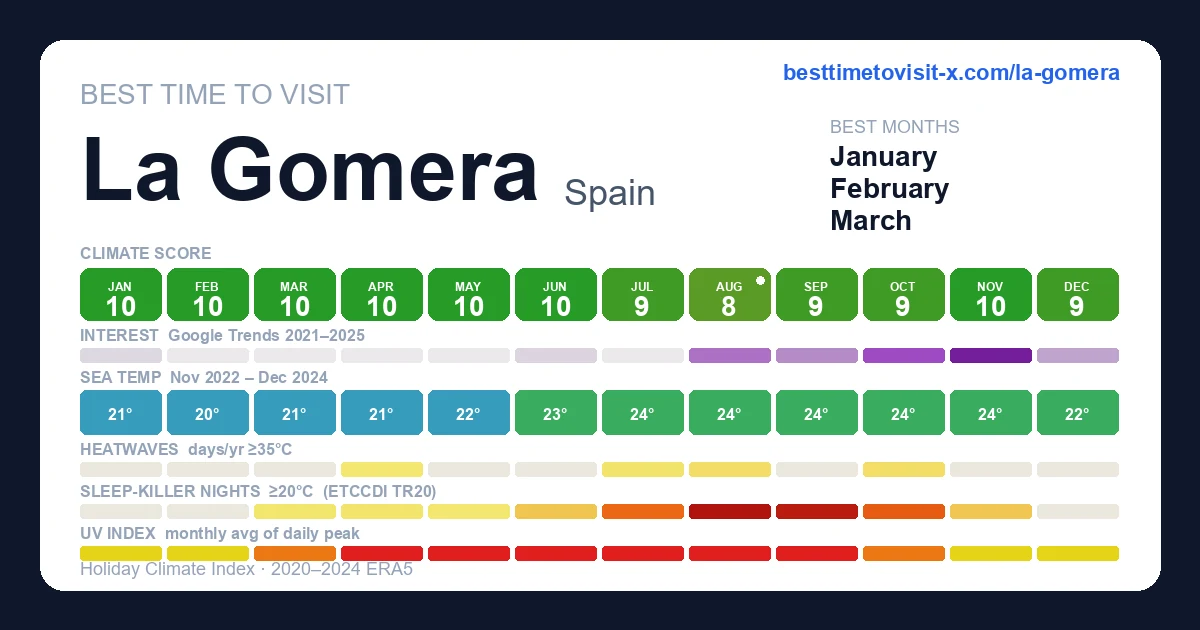
Greyed factors are scored normally — extreme heat overrides them, so a clear sky or low rain can't lift the period.
Greyed factors are scored normally — extreme heat overrides them, so a clear sky or low rain can't lift the period.
Greyed factors are scored normally — extreme heat overrides them, so a clear sky or low rain can't lift the period.
Greyed factors are scored normally — extreme heat overrides them, so a clear sky or low rain can't lift the period.
Greyed factors are scored normally — extreme heat overrides them, so a clear sky or low rain can't lift the period.
Greyed factors are scored normally — extreme heat overrides them, so a clear sky or low rain can't lift the period.
How is this scored? HCI / Steadman / CCI gate — full methodology and citations below.
Compare with another destination
Add as many as you like — stacked below the main strips above. Each row is just the recent-window score strip and (for beach destinations) sea-temperature strip.
Tours in La Gomera
8 top-rated tours via Viator. Booking links earn this site a commission at no cost to you.
- 1
 Hiking in the Garajonay
 - 2
 Small Group Boat Whale and Dolphin Watching Tour
 - 3
 Full Day Guided Tour to La Gomera from Tenerife
 - 4
 Inflatable boat without a license
 - 5
 Visit the Ethnographic Park of La Gomera
 - 6
 Private excursion to Masca Garachico and Icod the best of Tenerife
 - 7
 Tenerife Wild Natural Cliffs and Pools
 - 8
 Tenerife UNESCO Worlds Tour of Teide La Laguna
Last refreshed 2026-08-13.
Similar climatesArrecife92% · Santa Barbara90% · Larnaca89%
Other destinations with the most-alike year-round climate to La Gomera (apparent temperature, rain hours, sunshine — matched within the same trip-profile). The ±N chip compares each match's typical score for the current month against La Gomera's. Based on the 2020-2024 climatology, not this year's actual weather.
Month-by-month
| Month | Temp °C | Feels °C | Rain days | Rain h | Rain h/day | Humidity | Wind km/h | Sun h | UV | Interest | Score |
|---|---|---|---|---|---|---|---|---|---|---|---|
| Jan | 15–22 | 21 | 3 | 51 | 17.0 | 59% | 16 | 227 | 4 | Peak | 10 |
| Feb | 16–23 | 22 | 3 | 45 | 15.0 | 56% | 18 | 228 | 6 | Busy | 10 |
| Mar | 16–23 | 22 | 4 | 58 | 14.5 | 57% | 20 | 263 | 7 | Moderate | 10 |
| Apr | 17–24 | 24 | 4 | 43 | 10.8 | 55% | 17 | 271 | 9 | Quiet | 10 |
| May | 18–25 | 24 | 2 | 28 | 14.0 | 56% | 20 | 299 | 10 | Quiet | 10 |
| Jun | 19–26 | 26 | 2 | 34 | 17.0 | 58% | 19 | 296 | 11 | Quiet | 10 |
| Jul | 20–28 | 28 | 0 | 5 | — | 58% | 25 | 298 | 10 | Moderate | 9 |
| Aug | 21–29 | 30 | 1 | 10 | 10.0 | 57% | 24 | 279 | 10 | Peak | 8 |
| Sep | 21–28 | 29 | 3 | 36 | 12.0 | 60% | 17 | 255 | 9 | Peak | 9 |
| Oct | 21–28 | 29 | 2 | 29 | 14.5 | 56% | 16 | 248 | 7 | Peak | 9 |
| Nov | 19–26 | 26 | 4 | 46 | 11.5 | 56% | 15 | 213 | 5 | Peak | 10 |
| Dec | 17–23 | 23 | 5 | 71 | 14.2 | 62% | 15 | 224 | 4 | Busy | 9 |
UV Index in La Gomera by Month
UV index in La Gomera peaks at 11 (very high) in June, dropping to 4 (moderate) in December. April, May, June, July, August, September reach very high or extreme levels — apply SPF 50+, wear a hat and protective clothing, and limit direct sun between 11:00 and 17:00.
Best months in detail
February
10/1016–23°C (feels 22°C) · 3 rain days (45h) · 228 sun hours · 56% humidity · Busy crowd · UV 6 (moderate) · sunniest 1 in 10 days reach 7 (high)
April
10/1017–24°C · 4 rain days (43h) · 271 sun hours · 55% humidity · Quiet crowd · UV 9 (very high)
May
10/1018–25°C · 2 rain days (28h) · 299 sun hours · 56% humidity · Quiet crowd · UV 10 (very high)
Every month
Show the other 9 months in detail
January
10/1015–22°C · 3 rain days (51h) · 227 sun hours · 59% humidity · Peak crowd · UV 4 (moderate)
March
10/1016–23°C (feels 22°C) · 4 rain days (58h) · 263 sun hours · 57% humidity · Moderate crowd · UV 7 (high) · sunniest 1 in 10 days reach 9 (very high)
June
10/1019–26°C · 2 rain days (34h) · 296 sun hours · 58% humidity · Quiet crowd · UV 11 (very high) · sunniest 1 in 10 days reach 11 (extreme)
July
9/1020–28°C · 0 rain days (5h) · 298 sun hours · 58% humidity · Moderate crowd · UV 10 (very high) · sunniest 1 in 10 days reach 11 (extreme)
August
8/1021–29°C · 1 rain days (10h) · 279 sun hours · 57% humidity · Peak crowd · UV 10 (very high)
September
9/1021–28°C (feels 29°C) · 3 rain days (36h) · 255 sun hours · 60% humidity · Peak crowd · UV 9 (very high)
October
9/1021–28°C (feels 29°C) · 2 rain days (29h) · 248 sun hours · 56% humidity · Peak crowd · UV 7 (high)
November
10/1019–26°C · 4 rain days (46h) · 213 sun hours · 56% humidity · Peak crowd · UV 5 (moderate)
December
9/1017–23°C · 5 rain days (71h) · 224 sun hours · 62% humidity · Busy crowd · UV 4 (moderate)
A cloud forest kept alive by wind, not rain
Garajonay, on La Gomera's high central plateau, holds the most extensive surviving laurisilva — a subtropical laurel forest of a type that covered much of the Mediterranean basin some 15 to 20 million years ago. It is a UNESCO World Heritage site and the reason many people come to the island.
What keeps it alive is not rainfall in the ordinary sense. The northeasterly trade winds push a persistent bank of cloud against the high ground — the mar de nubes, sea of clouds — and the forest harvests moisture directly from the fog as it condenses on leaves and moss. This horizontal precipitation sustains the ecosystem year-round even when measured rainfall is modest.
For a visitor, that means the summit is often inside the cloud that feeds it. Up at around 1,400 metres, visibility can drop to twenty metres among moss-hung trees, while the coast below sits in full sun.
Sources: Britannica — Garajonay National Park , UNESCO via Google Arts & Culture — Garajonay
What is the best time to visit La Gomera?
Spring and autumn. The island is mild all year — August peaks near 27C and January lows sit around 17C — but April-May and September-October give the best combination of comfortable walking temperatures and clearer summit days. Winter is greenest and very good value; summer is busiest with Spanish and German visitors, and haziest.
Is Garajonay always foggy?
Often, and by design — the laurel forest survives on moisture harvested directly from trade-wind cloud, so the mist is the ecosystem rather than bad luck. Mornings tend to be clearer than afternoons. The coast can sit in full sun while the summit is inside cloud, so check from below before driving up, and carry a layer for the temperature drop.
How many days do you need on La Gomera?
Three to four. One for Garajonay and the laurel forest, one for Valle Gran Rey and the west coast, one for the northern villages around Agulo and Hermigua. The roads are slow, steep and heavily switchbacked, so distances take far longer than the map suggests — an hour to cover 30 km is normal here. Add a day if you plan serious walking.
How warm is La Gomera in January?
Mild — lows average around 17C, which is why the Canaries draw European winter visitors. Rain is minimal even in the wettest month, December, at about 33 mm. The catch is altitude: Garajonay's laurel forest sits high and is markedly cooler and damper than the coast on the same day.
What is the best time of year to visit La Gomera?
Almost any month works — this is one of the most seasonally stable destinations on the site, with August near 27C and January lows around 17C. Spring is best for hiking, with clear air and wildflowers. Summer is busiest with Spanish and German visitors; winter is warm, quiet and excellent value.
Is La Gomera expensive?
Less than Tenerife or Gran Canaria. It has little mass-market resort development, so accommodation is mostly small hotels and rural houses at moderate prices. The ferry from Tenerife adds cost to reach it, but food and lodging on the island are generally cheaper than the larger Canaries.
What is the prettiest village on La Gomera?
Agulo, on the north coast, is widely considered the loveliest — a cluster of old houses on a terrace above the sea with Tenerife's volcano across the water. Hermigua's terraced valley and Valle Gran Rey's palm-filled gorge are the other two most visitors single out.
Is it worth going to La Gomera?
If you want hiking and quiet, yes — it is the walkers' Canary Island, with Garajonay's UNESCO-listed laurel forest and deep ravines running to the sea. If you want big resorts, nightlife or long sandy beaches, choose a larger island. La Gomera rewards visitors who intend to walk.
What is La Gomera known for?
Garajonay National Park, a UNESCO-listed laurel forest that survives from a subtropical woodland type largely lost elsewhere, and for Silbo Gomero — a whistled language, itself UNESCO-recognised, developed to carry across the island's deep ravines. It is also the island Columbus sailed from in 1492.
How long is the ferry from Tenerife to La Gomera?
Roughly 50 minutes on the fast ferry from Los Cristianos to San Sebastián de La Gomera, with several sailings a day. It is the standard way in — the island's small airport has very limited service. Crossings can be rough in winter swell, and the timetable thins outside the summer months.
Which is the prettiest Canary Island?
That depends on what you want, and beauty rankings are personal. La Gomera and La Palma are the two most often named by walkers, for laurel forest and deep ravines. Tenerife has the highest peak and the widest range of landscapes; Lanzarote is volcanic and stark. La Gomera's distinction is quiet — it has almost no resort development.
Frequently asked questions about visiting La Gomera
When is the best time to visit La Gomera?
February is the highest-scoring month (10/10 on the Holiday Climate Index). Typical conditions: 16–23°C (3 rainy days). The top three months by score are February, April, May.
What is the worst time to visit La Gomera?
August is the lowest-scoring month (8/10, capped by extreme heat). Typical conditions: 21–29°C (1 rainy day).
Is La Gomera too hot in summer?
1 month (August) trip the heat deal-breaker in our scoring: apparent temperature crosses the comfort cap, so even with clear skies and low rain the score is held down. Plan around it if heat tolerance is low.
When are crowds lowest in La Gomera?
Search-interest seasonality (Google Trends 2021-2025) is lowest in June and peaks in November. Interest tracks both in-trip visitors and lead-time planners, so treat it as a "destination is on people's minds" signal rather than literal arrivals.
Which months in La Gomera have good weather but fewer tourists?
April (climate 10/10, crowd index 24) and May (climate 10/10, crowd index 20) — shoulder months with above-average climate and below-median search-interest. Often the best value-for-weather trade.
What is the UV index in La Gomera by month?
UV peaks at 11 (very high) in June and is lowest in December at 4 (moderate). Monthly peak values: Jan 4, Feb 6, Mar 7, Apr 9, May 10, Jun 11, Jul 10, Aug 10, Sep 9, Oct 7, Nov 5, Dec 4. April, May, June, July, August, September reach very high or extreme levels — apply SPF 50+, wear a hat and protective clothing, and limit direct sun between 11:00 and 17:00.
What is the UV index in La Gomera in June?
June is the peak UV month in La Gomera, with a daily-peak UV index of 11 (very high). At this level, sunburn can occur in under 20 minutes on unprotected fair skin. Apply SPF 50+, wear protective clothing and a hat, and avoid direct midday sun (11:00–17:00).
How high can UV get in La Gomera on the sunniest days?
Most days look like the monthly average, but on the sunniest ~1 in 10 days UV climbs higher than the mean suggests. July is the worst case: typical days average UV 10 (very high), but the top 10% of days reach UV 11 (extreme) — and even higher. Months where the sunniest days routinely exceed the typical reading: February, March, June, July. Plan sun protection for the worst case, not the average.
Is air quality in La Gomera bad for travelers?
PM2.5 (fine-particle pollution) exceeds the WHO sensitive-group guideline (15 µg/m³) in 5 months: January, February, April, August, December. The worst month is February with a typical-day mean of 13 µg/m³ (moderate); on the worst 10% of days PM2.5 reaches 33 µg/m³ (unhealthy) and higher. People with asthma, heart conditions, or sensitive children may want to avoid these months or limit outdoor activity. Source: CAMS via Open-Meteo.