Best time to visit Everglades
Re-score for me — drag the dial — every chart on the page recolours live for your heat limit 27°C
Default 27 °C is the upper edge of the Holiday Climate Index "ideal comfort" band (Scott, Rutty, Amelung & Tang, 2016). Above this, most warm-tourism travellers report measurable discomfort.
Greyed factors are scored normally — extreme heat overrides them, so a clear sky or low rain can't lift the period.
Greyed factors are scored normally — extreme heat overrides them, so a clear sky or low rain can't lift the period.
Greyed factors are scored normally — extreme heat overrides them, so a clear sky or low rain can't lift the period.
Greyed factors are scored normally — extreme heat overrides them, so a clear sky or low rain can't lift the period.
Greyed factors are scored normally — extreme heat overrides them, so a clear sky or low rain can't lift the period.
Greyed factors are scored normally — extreme heat overrides them, so a clear sky or low rain can't lift the period.
Greyed factors are scored normally — extreme heat overrides them, so a clear sky or low rain can't lift the period.
Greyed factors are scored normally — extreme heat overrides them, so a clear sky or low rain can't lift the period.
Greyed factors are scored normally — extreme heat overrides them, so a clear sky or low rain can't lift the period.
Greyed factors are scored normally — extreme heat overrides them, so a clear sky or low rain can't lift the period.
Greyed factors are scored normally — extreme heat overrides them, so a clear sky or low rain can't lift the period.
Greyed factors are scored normally — extreme heat overrides them, so a clear sky or low rain can't lift the period.
Greyed factors are scored normally — extreme heat overrides them, so a clear sky or low rain can't lift the period.
Greyed factors are scored normally — extreme heat overrides them, so a clear sky or low rain can't lift the period.
Greyed factors are scored normally — extreme heat overrides them, so a clear sky or low rain can't lift the period.
Greyed factors are scored normally — extreme heat overrides them, so a clear sky or low rain can't lift the period.
Greyed factors are scored normally — extreme heat overrides them, so a clear sky or low rain can't lift the period.
Greyed factors are scored normally — extreme heat overrides them, so a clear sky or low rain can't lift the period.
Greyed factors are scored normally — extreme heat overrides them, so a clear sky or low rain can't lift the period.
Greyed factors are scored normally — extreme heat overrides them, so a clear sky or low rain can't lift the period.
Greyed factors are scored normally — extreme heat overrides them, so a clear sky or low rain can't lift the period.
Greyed factors are scored normally — extreme heat overrides them, so a clear sky or low rain can't lift the period.
Greyed factors are scored normally — extreme heat overrides them, so a clear sky or low rain can't lift the period.
Greyed factors are scored normally — extreme heat overrides them, so a clear sky or low rain can't lift the period.
Greyed factors are scored normally — extreme heat overrides them, so a clear sky or low rain can't lift the period.
Greyed factors are scored normally — extreme heat overrides them, so a clear sky or low rain can't lift the period.
Greyed factors are scored normally — extreme heat overrides them, so a clear sky or low rain can't lift the period.
Greyed factors are scored normally — extreme heat overrides them, so a clear sky or low rain can't lift the period.
Greyed factors are scored normally — extreme heat overrides them, so a clear sky or low rain can't lift the period.
Greyed factors are scored normally — extreme heat overrides them, so a clear sky or low rain can't lift the period.
Greyed factors are scored normally — extreme heat overrides them, so a clear sky or low rain can't lift the period.
Greyed factors are scored normally — extreme heat overrides them, so a clear sky or low rain can't lift the period.
Greyed factors are scored normally — extreme heat overrides them, so a clear sky or low rain can't lift the period.
Greyed factors are scored normally — extreme heat overrides them, so a clear sky or low rain can't lift the period.
Greyed factors are scored normally — extreme heat overrides them, so a clear sky or low rain can't lift the period.
Greyed factors are scored normally — extreme heat overrides them, so a clear sky or low rain can't lift the period.
Greyed factors are scored normally — extreme heat overrides them, so a clear sky or low rain can't lift the period.
Greyed factors are scored normally — extreme heat overrides them, so a clear sky or low rain can't lift the period.
Greyed factors are scored normally — extreme heat overrides them, so a clear sky or low rain can't lift the period.
Greyed factors are scored normally — extreme heat overrides them, so a clear sky or low rain can't lift the period.
Greyed factors are scored normally — extreme heat overrides them, so a clear sky or low rain can't lift the period.
Greyed factors are scored normally — extreme heat overrides them, so a clear sky or low rain can't lift the period.
Greyed factors are scored normally — extreme heat overrides them, so a clear sky or low rain can't lift the period.
Greyed factors are scored normally — extreme heat overrides them, so a clear sky or low rain can't lift the period.
Greyed factors are scored normally — extreme heat overrides them, so a clear sky or low rain can't lift the period.
Greyed factors are scored normally — extreme heat overrides them, so a clear sky or low rain can't lift the period.
Greyed factors are scored normally — extreme heat overrides them, so a clear sky or low rain can't lift the period.
Greyed factors are scored normally — extreme heat overrides them, so a clear sky or low rain can't lift the period.
Greyed factors are scored normally — extreme heat overrides them, so a clear sky or low rain can't lift the period.
Greyed factors are scored normally — extreme heat overrides them, so a clear sky or low rain can't lift the period.
Greyed factors are scored normally — extreme heat overrides them, so a clear sky or low rain can't lift the period.
Greyed factors are scored normally — extreme heat overrides them, so a clear sky or low rain can't lift the period.
Greyed factors are scored normally — extreme heat overrides them, so a clear sky or low rain can't lift the period.
Greyed factors are scored normally — extreme heat overrides them, so a clear sky or low rain can't lift the period.
Greyed factors are scored normally — extreme heat overrides them, so a clear sky or low rain can't lift the period.
How is this scored? HCI / Steadman / CCI gate — full methodology and citations below.
Compare with another destination
Add as many as you like — stacked below the main strips above. Each row is just the recent-window score strip and (for beach destinations) sea-temperature strip.
Tours in Everglades
9 top-rated tours via Viator. Booking links earn this site a commission at no cost to you. Map locations are approximate (centred on Everglades).
- 1
 Small Group Boat, Kayak and Walking Guided Eco Tour Everglades
 - 2
 Small-Group Everglades Boating Kayaking and Walking Eco Tour
 - 3
 Two-Hour Everglades Dolphin, Manatee and Birding Boat Tour
 - 4
 Everglades Birding, Dolphin and Wildlife Boat Tour (2 hours)
 - 5
 Flamingo Everglades Boat Tours
 - 6
 Everglades Small Group Guided Boating & Walking Tour Expedition
 - 7
 Everglades Small Group Guided Boating and Walking Expedition
 - 8
 Everglades National Park: 3 Hikes + 90 minute Boat Tour + Lunch
 - 9
 Private Everglades Inshore Fishing Charter in Chokoloskee
Last refreshed 2026-08-13.
Similar climatesOrlando91% · Chichén Itzá87% · Kaohsiung86%
Other destinations with the most-alike year-round climate to Everglades (apparent temperature, rain hours, sunshine — matched within the same trip-profile). The ±N chip compares each match's typical score for the current month against Everglades's. Based on the 2020-2024 climatology, not this year's actual weather.
Month-by-month
| Month | Temp °C | Feels °C | Rain days | Rain h | Rain h/day | Humidity | Wind km/h | Sun h | UV | Interest | Score |
|---|---|---|---|---|---|---|---|---|---|---|---|
| Jan | 16–25 | 26 | 7 | 71 | 10.1 | 60% | 20 | 219 | 5 | Busy | 9 |
| Feb | 17–27 | 27 | 8 | 88 | 11.0 | 59% | 20 | 214 | 7 | Peak | 9 |
| Mar | 19–29 | 29 | 7 | 74 | 10.6 | 52% | 21 | 247 | 8 | Peak | 8 |
| Apr | 20–30 | 31 | 13 | 124 | 9.5 | 52% | 21 | 264 | 9 | Busy | 6 |
| May | 22–32 | 34 | 15 | 149 | 9.9 | 54% | 19 | 279 | 10 | Quiet | 3 |
| Jun | 23–31 | 35 | 25 | 241 | 9.6 | 69% | 16 | 235 | 9 | Quiet | 1 |
| Jul | 24–32 | 37 | 23 | 204 | 8.9 | 66% | 15 | 261 | 9 | Quiet | 1 |
| Aug | 25–32 | 37 | 25 | 230 | 9.2 | 65% | 17 | 253 | 9 | Moderate | 1 |
| Sep | 24–31 | 36 | 24 | 237 | 9.9 | 70% | 15 | 217 | 8 | Quiet | 1 |
| Oct | 22–30 | 33 | 16 | 195 | 12.2 | 67% | 18 | 222 | 7 | Quiet | 3 |
| Nov | 20–28 | 30 | 10 | 124 | 12.4 | 65% | 20 | 204 | 5 | Moderate | 7 |
| Dec | 17–26 | 26 | 8 | 93 | 11.6 | 63% | 18 | 204 | 4 | Busy | 9 |
UV Index in Everglades by Month
UV index in Everglades peaks at 10 (very high) in May, dropping to 4 (moderate) in December. March, April, May, June, July, August, September reach very high or extreme levels — apply SPF 50+, wear a hat and protective clothing, and limit direct sun between 11:00 and 17:00.
Best months in detail
January
9/1016–25°C · 7 rain days (71h) · 219 sun hours · 60% humidity · Busy crowd · UV 5 (moderate)
February
9/1017–27°C · 8 rain days (88h) · 214 sun hours · 59% humidity · Peak crowd · UV 7 (high) · sunniest 1 in 10 days reach 8 (very high)
December
9/1017–26°C · 8 rain days (93h) · 204 sun hours · 63% humidity · Busy crowd · UV 4 (moderate)
Every month
Show the other 9 months in detail
March
8/1019–29°C · 7 rain days (74h) · 247 sun hours · 52% humidity · Peak crowd · UV 8 (very high)
April
6/1020–30°C · 13 rain days (124h) · 264 sun hours · 52% humidity · Busy crowd · UV 9 (very high)
May
3/1022–32°C (feels 34°C) · 15 rain days (149h) · 279 sun hours · 54% humidity · Quiet crowd · UV 10 (very high)
June
1/1023–31°C (feels 35°C) · 25 rain days (241h) · 235 sun hours · 69% humidity · Quiet crowd · UV 9 (very high) · sunniest 1 in 10 days reach 11 (very high)
July
1/1024–32°C (feels 37°C) · 23 rain days (204h) · 261 sun hours · 66% humidity · Quiet crowd · UV 9 (very high)
August
1/1025–32°C (feels 37°C) · 25 rain days (230h) · 253 sun hours · 65% humidity · Moderate crowd · UV 9 (very high) · sunniest 1 in 10 days reach 11 (very high)
September
1/1024–31°C (feels 36°C) · 24 rain days (237h) · 217 sun hours · 70% humidity · Quiet crowd · UV 8 (very high) · sunniest 1 in 10 days reach 10 (very high)
October
3/1022–30°C (feels 33°C) · 16 rain days (195h) · 222 sun hours · 67% humidity · Quiet crowd · UV 7 (high) · sunniest 1 in 10 days reach 9 (very high)
November
7/1020–28°C (feels 30°C) · 10 rain days (124h) · 204 sun hours · 65% humidity · Moderate crowd · UV 5 (moderate) · sunniest 1 in 10 days reach 7 (high)
The wildlife you came for is a function of the water table
Most destinations trade heat against crowds. The Everglades trades on something else: water level. The park runs on two seasons — a dry season from November through April, and a wet season occupying the rest of the year.
In the dry months the surface water retreats, and wildlife concentrates around the remaining sloughs and ponds. The National Park Service describes the dry season as the most popular time to visit precisely because of the lower temperatures, the lessening of mosquitoes and the abundance of wildlife. In the wet season the water spreads out across the marl prairie, and so do the animals — the same alligators and wading birds are present, just dispersed across a far larger area and much harder to see.
The climate figures will tell you the summer is hot and wet. They will not tell you the birds have scattered.
Sources: NPS — The dry season, Everglades National Park , NPS — The wet season, Everglades National Park
What is the best month to visit the Everglades National Park?
January through March. This is the heart of the dry season — mild temperatures, the fewest mosquitoes of the year, and wildlife concentrated around receding water, which makes it dramatically easier to see. December and April are nearly as good and slightly quieter.
How many days do you need to see the Everglades?
Two days. The park has three separate entrances that do not connect inside it: Homestead in the south, Shark Valley on the Tamiami Trail, and Gulf Coast at Everglades City. One day covers the Homestead road to Flamingo with its boardwalks; a second lets you add Shark Valley's tram loop or a boat trip.
Which part of the Everglades is best to visit?
For a first visit, the Homestead entrance — the Anhinga Trail there offers the most reliable close alligator and wading-bird viewing in the park, especially in the dry season. Shark Valley suits cyclists and its observation tower; Gulf Coast is the base for the Ten Thousand Islands by boat.
What are the top things to do at Everglades National Park?
Walk the Anhinga and Gumbo Limbo trails near Royal Palm, cycle or take the tram round the Shark Valley loop to the observation tower, take a boat trip through the Ten Thousand Islands from Gulf Coast, paddle a section of the mangroves, and stay out for the night sky — the park is far from city light.
What is the best time of year to visit the Everglades?
December through April, the dry season. Water levels drop, wildlife concentrates around the remaining ponds and sloughs where you can actually see it, mosquitoes ease and temperatures are mild — January averages around 16C at night. This is also when the ranger programmes and boat operations run at full schedule.
How bad are mosquitoes in the Everglades?
In the wet season, severe enough to end a walk. June averages about 205 mm of rain and the mosquitoes that follow are the single most common reason visitors cut a summer trip short. The National Park Service still recommends repellent, head nets or bug jackets even in the dry season, when numbers drop sharply but do not vanish.
What is the best time of day to go to the Everglades?
Early morning. Wildlife is most active around dawn, temperatures are lowest and the light is best for photography along the boardwalks. Dusk is the second choice for activity but the worst for insects — mosquitoes and biting flies peak at dawn and dusk, so morning gives the better balance.
What are the worst weather months in Florida?
June through November is the Atlantic hurricane season, overlapping the Everglades wet season of May to October. June is the wettest month here at around 205 mm. Beyond storms, this period brings heat near 31C, high humidity and the year's worst mosquitoes — the combination is why the dry season is so strongly preferred.
How many days are needed for the Everglades?
Two days. The park has three entrances that do not connect inside it: Homestead in the south, Shark Valley on the Tamiami Trail and Gulf Coast at Everglades City. One day covers the Homestead road to Flamingo with the Anhinga Trail; a second adds Shark Valley's tram loop or a boat trip into the Ten Thousand Islands.
Is a trip to the Everglades worth it?
Yes, if you time it. This is the largest subtropical wilderness in the United States and the only place where alligators and crocodiles coexist. But the experience swings enormously with season: in the November-to-April dry season wildlife packs around shrinking waterholes, while in the summer wet season it disperses across flooded ground and the mosquitoes are severe.
What is the main attraction of Everglades National Park?
The wildlife, and specifically how visible it becomes in the dry season — alligators, herons, egrets, roseate spoonbills and anhingas concentrated where the water still is. The landscape itself is subtle rather than dramatic: a shallow, slow-moving river of grass rather than scenery, which is why visitors expecting mountains or forest are sometimes surprised.
Frequently asked questions about visiting Everglades
When is the best time to visit Everglades?
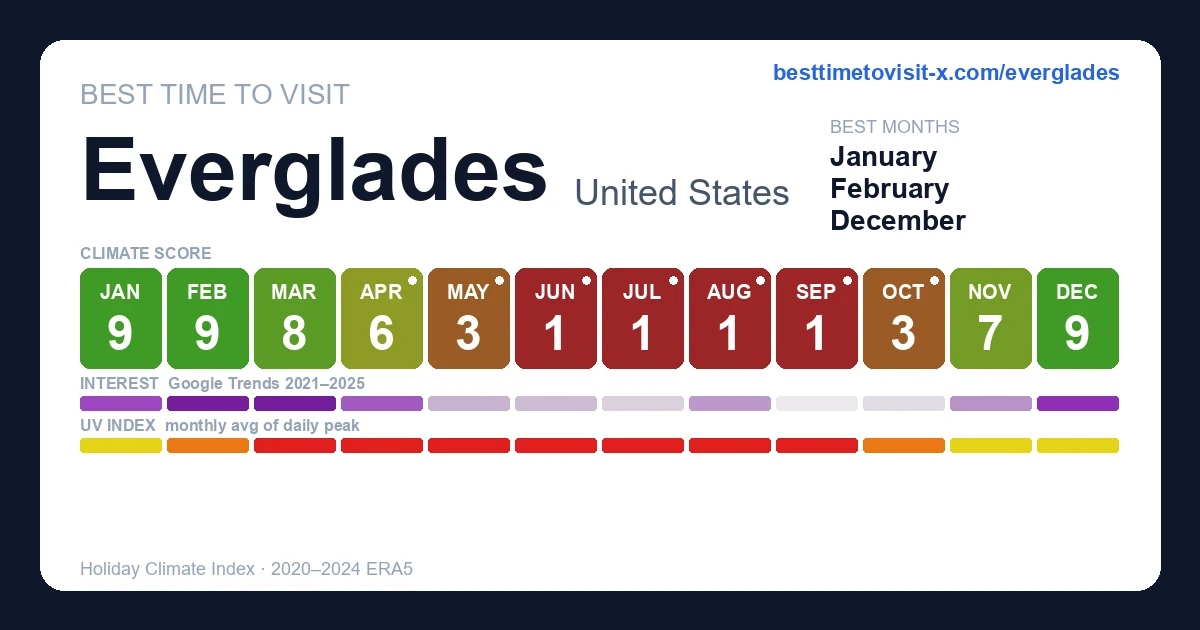
January is the highest-scoring month (9/10 on the Holiday Climate Index). Typical conditions: 16–25°C (7 rainy days). The top three months by score are January, February, December.
What is the worst time to visit Everglades?
September is the lowest-scoring month (1/10, capped by extreme heat). Typical conditions: 24–31°C (24 rainy days).
Is Everglades too hot in summer?
7 months (April, May, June, July, August, September, October) trip the heat deal-breaker in our scoring: apparent temperature crosses the comfort cap, so even with clear skies and low rain the score is held down. Plan around it if heat tolerance is low.
When are crowds lowest in Everglades?
Search-interest seasonality (Google Trends 2021-2025) is lowest in September and peaks in March. Interest tracks both in-trip visitors and lead-time planners, so treat it as a "destination is on people's minds" signal rather than literal arrivals.
Which months in Everglades have good weather but fewer tourists?
November (climate 7/10, crowd index 42) — shoulder months with above-average climate and below-median search-interest. Often the best value-for-weather trade.
What is the UV index in Everglades by month?
UV peaks at 10 (very high) in May and is lowest in December at 4 (moderate). Monthly peak values: Jan 5, Feb 7, Mar 8, Apr 9, May 10, Jun 9, Jul 9, Aug 9, Sep 8, Oct 7, Nov 5, Dec 4. March, April, May, June, July, August, September reach very high or extreme levels — apply SPF 50+, wear a hat and protective clothing, and limit direct sun between 11:00 and 17:00.
What is the UV index in Everglades in May?
May is the peak UV month in Everglades, with a daily-peak UV index of 10 (very high). At this level, sunburn can occur in under 20 minutes on unprotected fair skin. Apply SPF 50+, wear protective clothing and a hat, and avoid direct midday sun (11:00–17:00).
How high can UV get in Everglades on the sunniest days?
Most days look like the monthly average, but on the sunniest ~1 in 10 days UV climbs higher than the mean suggests. June is the worst case: typical days average UV 9 (very high), but the top 10% of days reach UV 11 (very high) — and even higher. Months where the sunniest days routinely exceed the typical reading: February, June, August, September, October, November. Plan sun protection for the worst case, not the average.
Is air quality in Everglades bad for travelers?
PM2.5 (fine-particle pollution) exceeds the WHO sensitive-group guideline (15 µg/m³) in 1 month: July. The worst month is July with a typical-day mean of 11 µg/m³ (moderate); on the worst 10% of days PM2.5 reaches 18 µg/m³ (unhealthy for sensitive) and higher. People with asthma, heart conditions, or sensitive children may want to avoid these months or limit outdoor activity. Source: CAMS via Open-Meteo.